
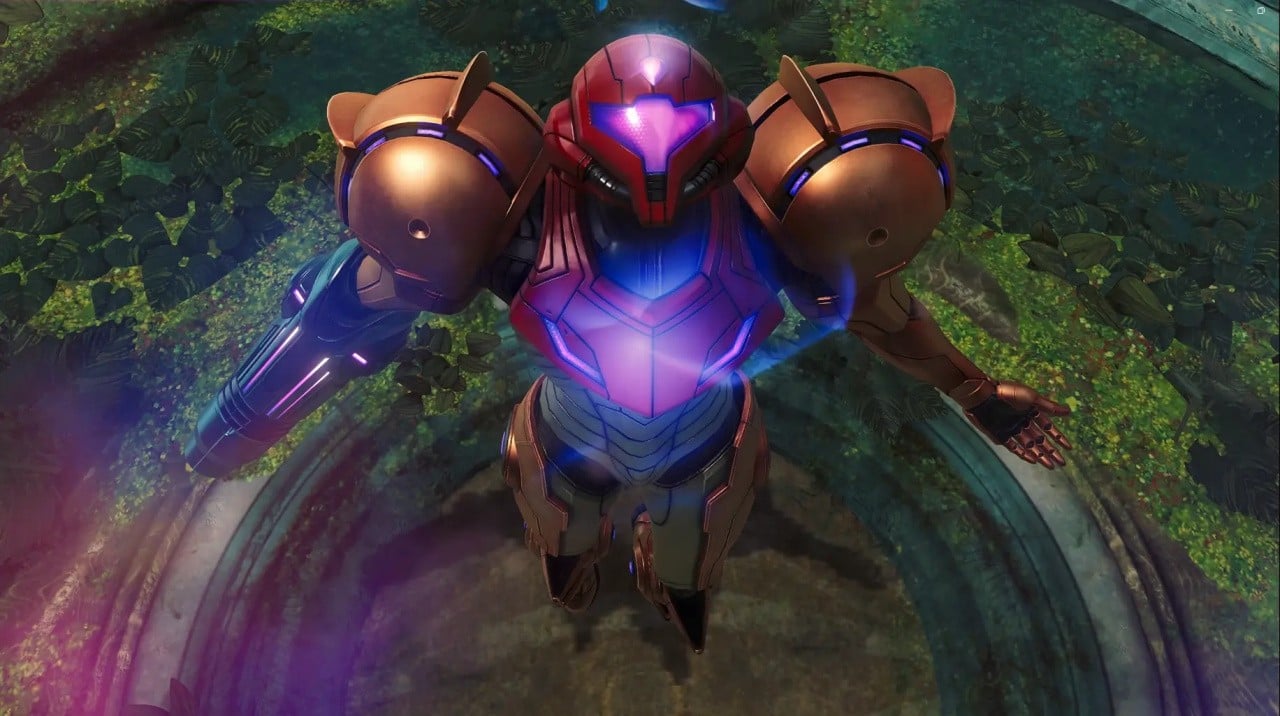
As the story goes, when the developers at Retro Studios were planning Metroid Prime 3: Corruption, the original idea was to have Samus Aran actually collect bounties on space pirates. When that idea was pitched to Nintendo execs, they were left horrified, and understandably so. Because despite Samus being described as a bounty hunter since the first Metroid, owing perhaps to something being lost in translation, the original developers conceived of her as a bounty hunter more along the lines of Indiana Jones than Boba Fett.
That internal perception is relevant to Metroid Prime 4: Beyond. This is a game that bears the marks of Retro wanting to evolve Metroid as a series, but the studio can’t quite conceive of what that evolution should be except by putting the property in context of other popular series.
After a dimensional rift is opened during a planetary skirmish with highly forgettable series villain Sylux, Samus and a small group of Federation Force soldiers find themselves stranded on the derelict planet of Viewros. It’s fascinating just how aggressively female this planet is from an audiovisual standpoint, and it’s by far the most captivating element of the game. That’s evident right away in the abundant yonic architecture and symbology. The score is haunting and ethereal, but also very much female voice-forward. Even the story of Viewros, unlocked through Samus’s scan visor, tells a tale of a female-leaning androgyne society suddenly ruined when a planetary disease mutates its population into brutal, non-verbal apes.
The the planet’s deepest secrets are locked to the humans and enemies but are given freely to our six-foot-three heroine just from her presence adds a unique layer of subtext to the whole game. Of course, a Nintendo-published game would never get that deep in the psychosexual alien weeds to explore that further. But the undercurrent is there, and it’s so much more intriguing than everything else that passes for “new” in Metroid Prime 4.
This is a Metroid game infected with elements from modern open-world titles, and every single one is a poor fit. This isn’t the first time fully voiced military NPCs have been injected into this series, and one can only hope that it will be the last. At best, you get Armstrong, the single female NPC in the game, who has an adorkable crush on Samus. At worst, you get Mackenzie, a tech-wizard who comes across like a ChatGPT composite of every nerd character from a Joss Whedon project. Even if the writing were top-tier, which it isn’t, these characters would absolutely leak the atmosphere and mood out of this game like air from a balloon.
The desert overworld is highly reminiscent of the open worlds in Breath of the Wild and Tears of the Kingdom, and while the game’s take on Sheikah Shrines has its interesting moments, and the single boss you eventually face out on the sand is a blast, those don’t justify how pointlessly desolate the vast majority of the space is, and certainly not the fact that the endgame is gated until you’ve farmed enough resources from the sands. Not only is this open world pointless, but it’s a near-total waste of the game’s best new element: a badass Tron-esque motorcycle.
This game was reviewed with a code provided by Golin.
Since 2001, we've brought you uncompromising, candid takes on the world of film, music, television, video games, theater, and more. Independently owned and operated publications like Slant have been hit hard in recent years, but we’re committed to keeping our content free and accessible—meaning no paywalls or fees.
If you like what we do, please consider subscribing to our Patreon or making a donation.

…is that it? The article ends at “motorcycle”?
I feel like I just read half a review. (And too bad, I was enjoying it :/ )