“Call me Isabelle,” the title character of Jamie Wax’s Call Me Izzy instructs the audience when she first meets us, while sneaking into the bathroom late at night to write her story on a roll of toilet paper with an eyebrow pencil. It’s a reference to Moby Dick’s famous first line (“Call me Ishmael”), she clarifies, admitting, “That’s not terribly original.”
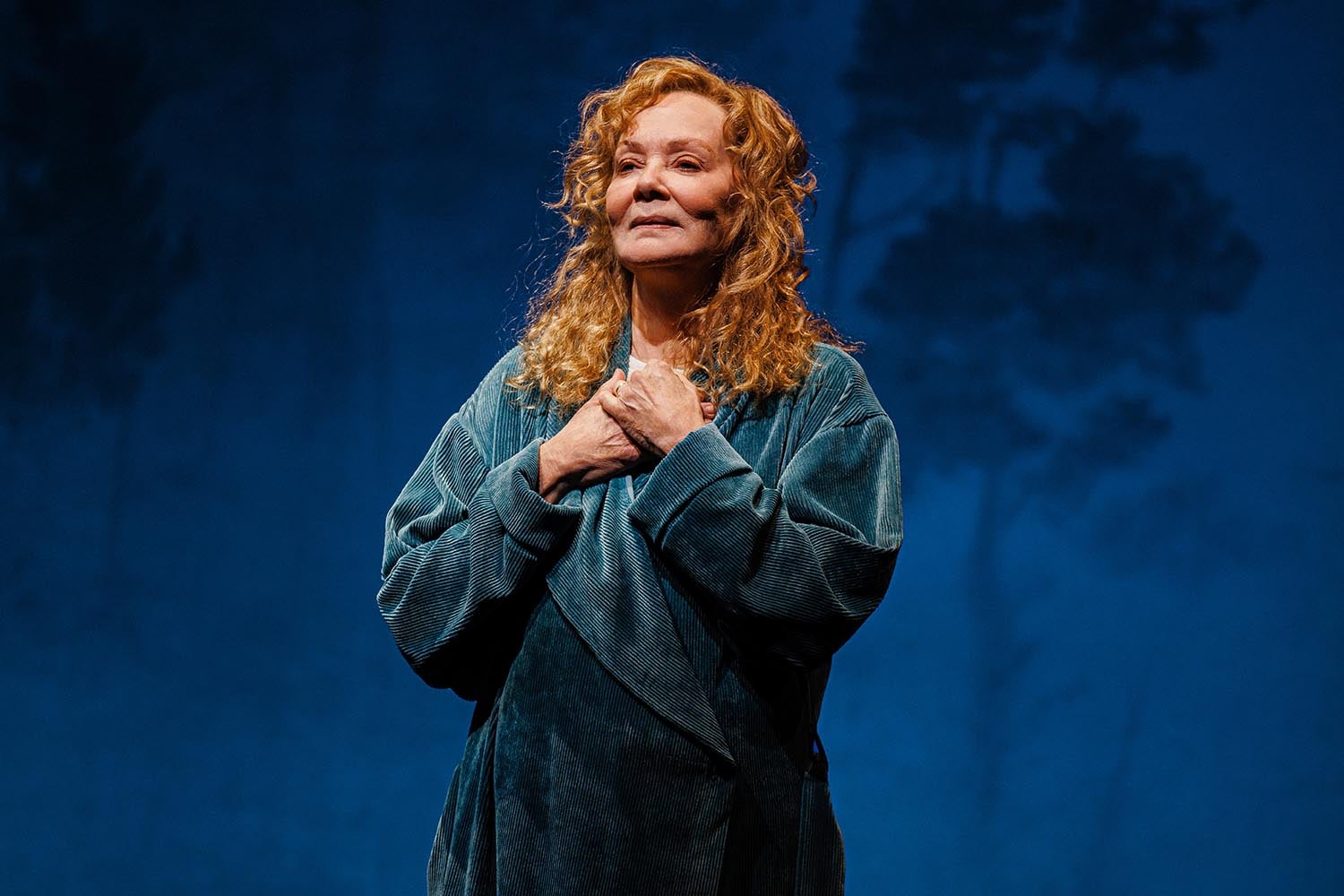
Well, no, and neither is this solo play, despite a terrifically tender performance from Jean Smart in a heel-turn from Deborah Vance, the caustic egoist she plays on HBO’s Hacks. Isabelle has no ego at all, her shoulders in a perpetual hunch and her small, self-effacing smiles barely visible. Her Louisiana twang often drifts into breathiness, as if she’d rather not be heard, but a stray sardonic thought can bring out a harsher, harder sound in her voice.
And Isabelle very much has been hardened. She’s spent her whole life in rural Mansfield, married at 17 to a man who once made her laugh but now, decades later, regularly beats her and abhors her passion for writing poetry. Exactly how many decades later is rendered unclear by the casting; though Smart is 73, Isabelle hides her writing in a Tampax box.
The present-tense narration hops back and forth in time as Isabelle charts the overlapping arcs of both her catastrophic marriage and her clandestine writing career, making what should be a straightforward story unnecessarily confusing to track. And perhaps the challenge of making Isabelle a persuasively extraordinary poet would have been better achieved if we could imagine her verses for ourselves. (“The old men long, in a daze/For the old days long ago/When the days were not so long/And long dazes were not so” begins one such unconvincing example.)
Wax’s depiction of rural poverty can also seem voyeuristic. When a wealthy New York couple sponsoring a poetry competition pays a patronizing visit to the trailer park, it seems like maybe that’s what the play has also been doing, despite its sympathetic treatment of Isabelle herself.
But it’s been 25 years since Smart’s last Broadway appearance, a revival of The Man Who Came to Dinner for which she received a Tony nomination, and Call Me Izzy works, at least, as a reminder of how, well, smart she is as a stage performer. She’s especially magnetic in the rare moments when she can openly express a modicum of raunchy joy, as in one brief interlude when Isabelle takes an unexpected sexual detour from her melancholic routine. Rugged as the script may be, Smart massages the character’s bumpy edges into a recognizable whole human being, one who’s lit up by an inner literary passion that she’s never been bold enough to celebrate.
As diligently as Smart animates Wax’s writing, though, Sarna Lapine’s directorial interventions undermine the actress in what should be the play’s most harrowing moments. A low ominous drone melodramatically underscores the scenes of domestic violence. And in depicting the climactic night when Isabelle’s husband threatens to kill her, Lapine opts for a strobe-lit thunderstorm. Surrounded by bolts of lightning, Smart isn’t given the chance to generate Isabelle’s terror herself or even to suggest the quotidian reality of abuse that hides in plain sight, unadorned by special effects. On stage, Smart is special effect enough. Perhaps in somewhat less than 25 years, she can be paired with a play that gets out of her way.
Call Me Izzy is now running at Studio 54.
Since 2001, we've brought you uncompromising, candid takes on the world of film, music, television, video games, theater, and more. Independently owned and operated publications like Slant have been hit hard in recent years, but we’re committed to keeping our content free and accessible—meaning no paywalls or fees.
If you like what we do, please consider subscribing to our Patreon or making a donation.