An adaptation of Amélie Nothomb’s autobiographical novella The Character of Rain, Maïlys Vallade and Liane-Cho Han’s Little Amélie or the Character of Rain amusingly implies in its opening moments that Francophones are prone to existentialist ways of thinking. Depicting the birth of Amélie (Loïse Charpentier), the child of a Belgian couple (Marc Arnaud and Laetitia Coryn) living in Japan, the first scene is accompanied by narration from the girl looking back at her delivery. Exposed to the sudden light and sound of the world outside the womb, Amélie begins contemplating the mysteries of life and even questions if she might be a god incarnated into what she later terms the “prison” of a body.
The mundane and transcendent dance hand in hand as Little Amélie or the Character of Rain follows Amélie through her first few years navigating the familiar terrain of childhood, while occasionally grappling with the discombobulation brought on by learning how social cues differ across cultures. The film is keyed to the essence of its protagonist, always breathlessly rushing ahead and inquisitive about everything, be it the behavior of her older siblings or the culture and history of Japan that she slowly gleans from her nanny, Nishio (Victoria Grosbois).
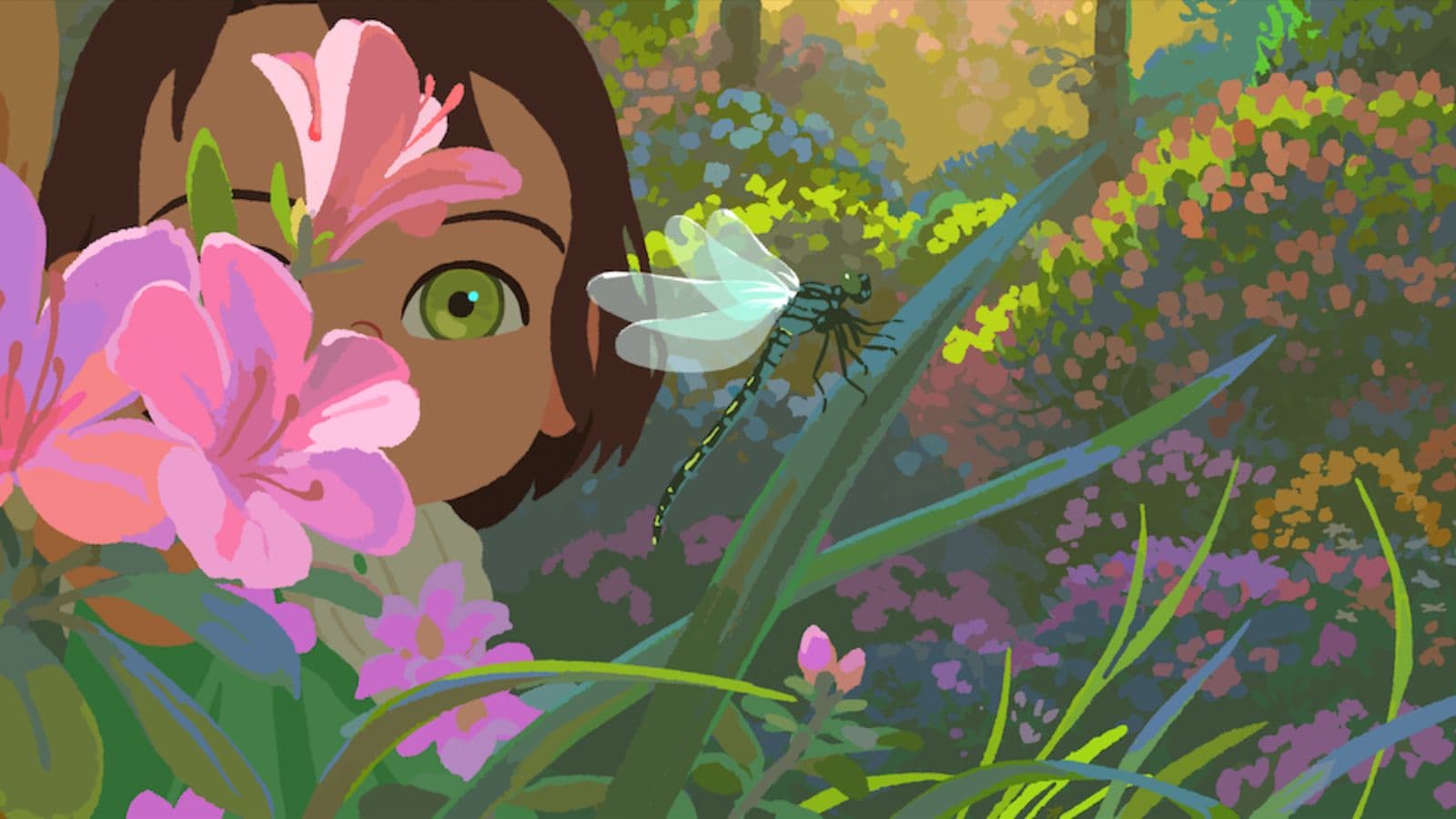
To visualize the culture clash that Amélie experiences, the filmmakers adopt a style pitched somewhere between anime and watercolor. Characters have the expressive eyes and broad physical reactions common to the former, but colors often bleed over the linework of characters and backgrounds, smudging their definitions. This ingeniously conveys Amélie’s still-forming sense of perspective, seeing the world as objects not yet firmly fixed in her mind beyond the simplest concepts, and as such subject to fluidity. Nishio in particular becomes both a sororal and maternal figure to the girl, offering just as much care as Amélie’s actual mother while also talking to her more like a peer than an adult or other symbol of authority. Every time Amélie and Nishio embrace, the animation makes it seem as if they’re about to meld into one another.
Little Amélie or the Character of Rain changes up its breezy account of a toddler’s growth with the occasional moment of slowed-down rumination when the girl asks a question beyond her years and an adult respects her enough to give her a considered answer. This happens most often when the subject of World War II arises; set in the late-’60s, the film takes place soon enough after the war where even a young woman like Nishio can have memories of surviving it.
When Amélie asks her nanny to talk about her experiences as part of a larger attempt to understand the notion of depth, Nishio gathers herself to find a way to confront her trauma for the first time, and to articulate it in a way a child can grasp. Where the film depicts Amélie’s flights of imagination in floridly detailed fashion, Nishio’s memories are visualized obliquely. As the woman recalls the Allied fire-bombings while washing rice, the sloshing water in the bowl curls upward into the shape of flames before quickly returning to its natural state, reflecting how Nishio seeks to suppress these memories. But as guarded as she may be when it comes to talking about the war, Nishio is still more forthright about the subject than some other Japanese characters who stew in silent anger toward the West for the losses they suffered.
In such moments, Little Amélie or the Character of Rain hints at complexities that its toddler protagonist isn’t yet ready to handle. The girl’s early reveries about godhood stem from a traditional Japanese belief that we’re all born as deities and slowly become mortal as our cognition develops over one’s first few years of life. The wistful, elegiac quality of that belief—that knowledge ultimately overrides an inborn sensual oneness with the universe—infuses what is otherwise a light, charming coming-of-age story. “When you’re three you see everything and understand nothing,” Amélie remarks near the film’s end, and the more that the girl comes to understand, the more finite and concrete the boundaries of her world become.
Since 2001, we've brought you uncompromising, candid takes on the world of film, music, television, video games, theater, and more. Independently owned and operated publications like Slant have been hit hard in recent years, but we’re committed to keeping our content free and accessible—meaning no paywalls or fees.
If you like what we do, please consider subscribing to our Patreon or making a donation.