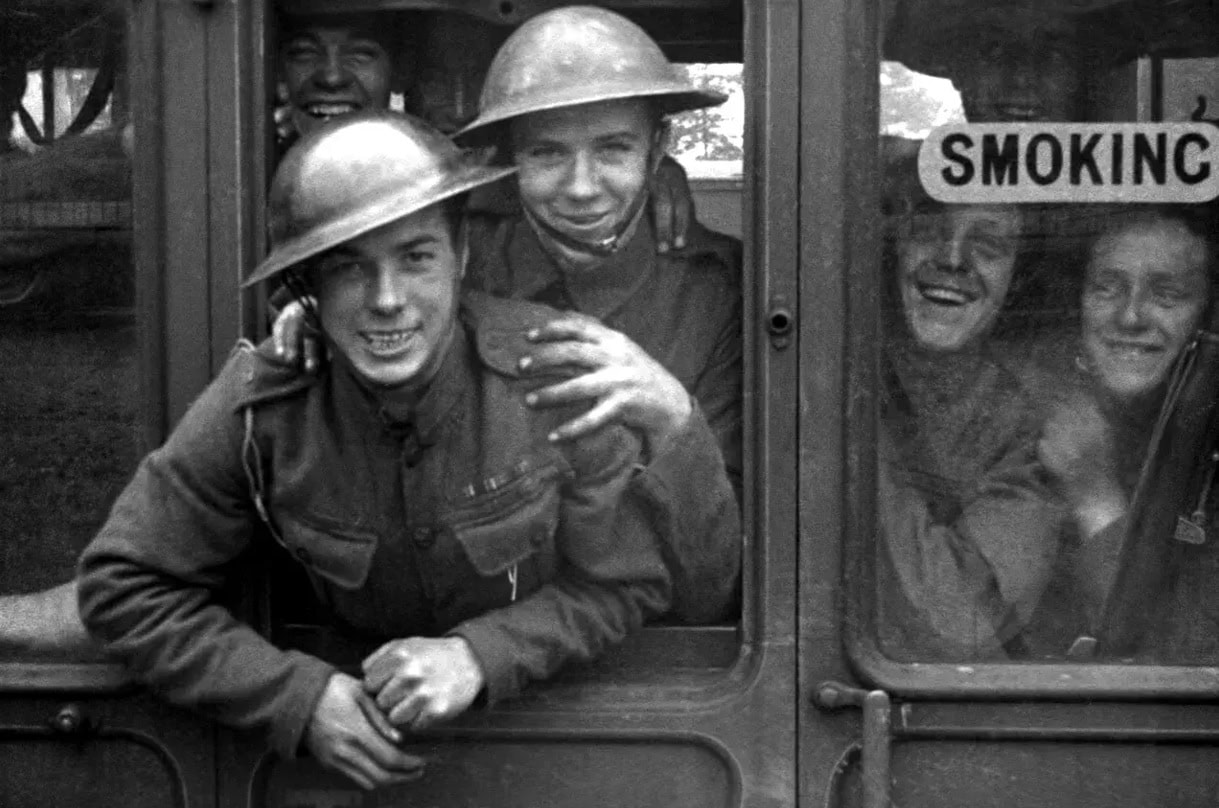
Composed entirely of archival footage, Maciej Drygas’s latest documentary tells the story of the early 20th century through images of trains. With a syncopated, muscular style of montage that evokes such city symphony films as Dziga Vertov’s Man with a Movie Camera, Trains might be called a railway symphony. That said, Drygas’s attitude to his subject is far from starry-eyed. As it turns out, the 20th century looks downright ghastly refracted through a locomotive prism, even more so in light of the only words to appear in the film—an epigraph from Kafka: “There is plenty of hope, an infinite amount of hope…but not for us.”
Drygas’s chronological rigor imparts an “on-rails” historical linearity, a sensation of inexorable progress and doom. There’s a push and pull between those times of war when trains are used to convey weapons and cannon fodder, and those of peace when they offer a certain luxury and freedom of travel. By and large, though, Trains despairs over technological determinism, drawing a through line between the mass production of locomotives themselves to that of artillery shells, gas masks, amputees, shell-shock, prosthetic limbs, and ideologies.
With the benefit of hindsight, we know what horrors the 20th century has in store for these passengers reading their newspapers or watching the world slip by through their windows. But there’s a pathos, an uncanniness, in the fact that the camera operators who captured this footage couldn’t have known that a filmmaker would repurpose it, or where all these trains were ultimately headed. Footage of Nazi officers lounging in their compartments, smiling and goofing off for the benefit of the camera, is particularly chilling.
Further undertones may be gleaned from Saulus Urbanavičius’s impeccable sound design. The chugging of pistons, the screeching of steel on steel, and the howling of steam whistles play an immersive role throughout the film. At the same time, they serve a more abstract, atmospheric function than the archival images, as, for example, when we see a railcar-mounted World War I artillery barrage set to a whistling that, while it does “represent” the sound of shells falling, sounds too haunting to be strictly realistic. And where there’s music, it comes from Paweł Szymański’s ominous composition “Compartment 2, Car 7.” As such, the soundtrack interprets just as much as it illustrates, standing in for voiceover commentary.
The film’s final shot may offer a particle, at least, of hope. Taken from a camera mounted on the front of a train emerging from a station, this footage keys us to the perspective of a conductor switching from one track to another, almost meandering, suggesting that we can still choose between alternate trajectories. It’s something to keep in mind at a time when technologies of another, algorithmically powered sort dominate our lives, threatening to drag us down the rails in the direction from which we came, toward a history we’d do better not to repeat.
Since 2001, we've brought you uncompromising, candid takes on the world of film, music, television, video games, theater, and more. Independently owned and operated publications like Slant have been hit hard in recent years, but we’re committed to keeping our content free and accessible—meaning no paywalls or fees.
If you like what we do, please consider subscribing to our Patreon or making a donation.