Mercedes Bryce Morgan’s Bone Lake begins with a naked couple running through a forest, hunted by an unknown person wielding a crossbow. They’re ultimately taken down in gruesome fashion—the scene’s money shot, such as it is, sees the man taking an arrow to the testicles—before being arranged rather artfully on a chaise lounge.
As it turns out, this little prologue is one of our protagonists, Diego (Marco Pigossi), reading his partner, Sage (Maddie Hasson), an early draft of the novel he’s been writing as they ride to a vacation retreat. Sage isn’t impressed, calling the whole thing “gratuitous,” before eventually arriving at an Airbnb mansion and having some pretty lackluster sex, what with Sage faking an orgasm, because apparently talking to Diego about how to get you off would be gratuitous.
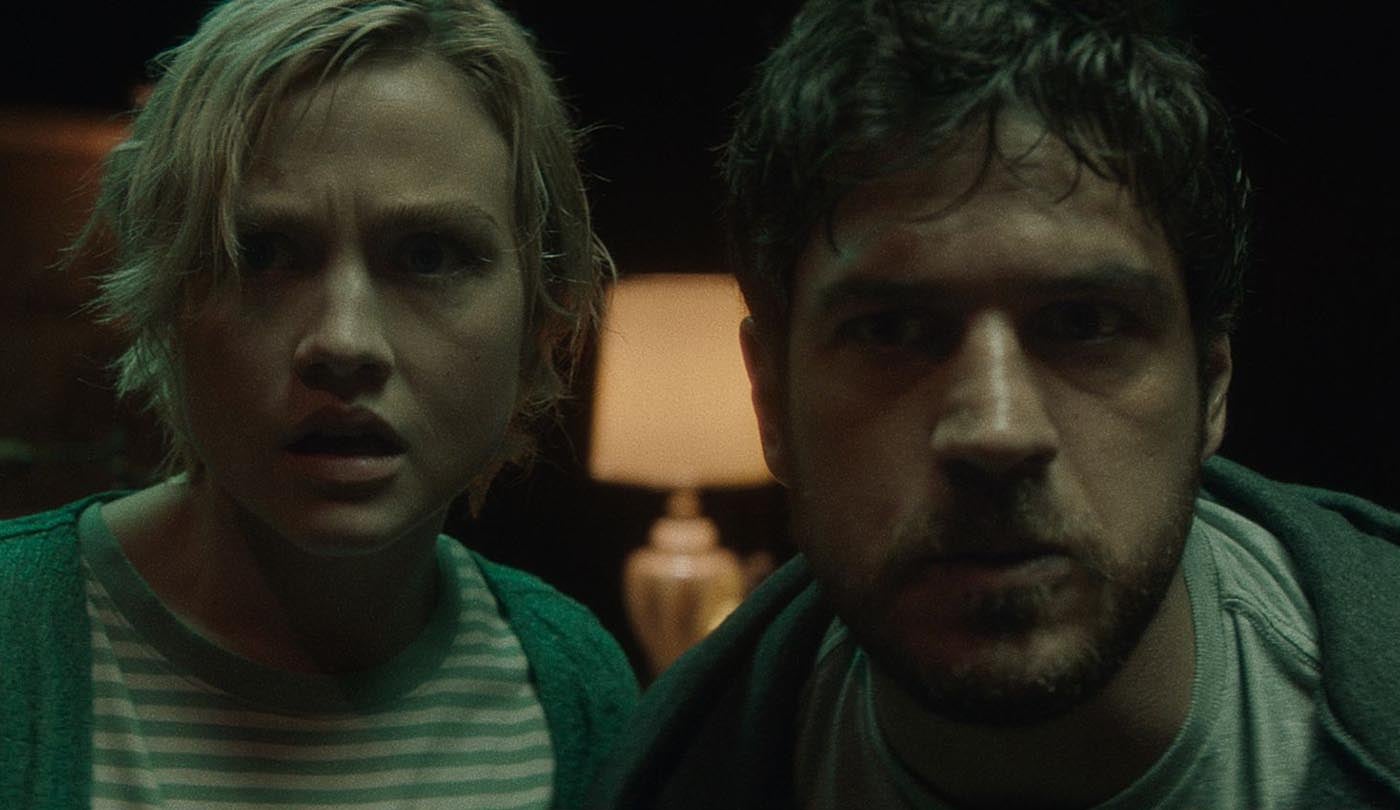
Sage is, I guess, consistent, which isn’t something that can be said for Bone Lake. Right as Diego and Sage are settling in, Will (Alex Roe) and Cin (Andra Nechita) show up at the manse, having somehow booked the same place for the same weekend. Naturally, the addition of a couple of fun, flirty, and horny L.A. 10s to the mix to bounce off of two extremely vanilla Ohio 6s sparks a relationship crisis, which gradually turns the film from a cliché sex comedy into a cliché thriller.
But the crisis is less about two walking American Apparel ads traipsing around half-naked for the vast majority of the film than some extremely basic he-said-she-said games. Every attempt by Bone Lake, as written by Joshua Friedlander, to ramp up the sex factor—a secret kink room here, some masturbation in the bathtub there—is by design, a means of propelling Diego and Sage toward some sort of new dynamic in their relationship, but none of it is deep.
There’s at least some level of self-awareness to the film’s soapy provocations being enough to shatter Diego and Sage’s world, namely with a line in the climax that their relationship was never stable if Will and Cin’s actions were enough to threaten it. Still, that awareness doesn’t extend to the emotionally and physically neglected Sage realizing what flavor of loser she’s attached to, or the film’s violent conclusion, which is more willing to take a wrecking ball to the uncomfortable silences that seem to define Sage’s relationship with Diego.
Unfortunately, the onus is entirely on Will and Cin’s big secrets to carry the trashy weight of Morgan’s film, and their particular kinks being as Funny Games-coded as they are doesn’t grant us much more impetus to want Diego and Sage to make it past the weekend—alive or as a couple. At least the violence winds up delivering by the end, but aside from one particularly gnarly moment involving a chainsaw, our lack of investment in Diego and Sage’s relationship means that much of that violence comes off as, well, gratuitous.
Since 2001, we've brought you uncompromising, candid takes on the world of film, music, television, video games, theater, and more. Independently owned and operated publications like Slant have been hit hard in recent years, but we’re committed to keeping our content free and accessible—meaning no paywalls or fees.
If you like what we do, please consider subscribing to our Patreon or making a donation.