Victor Kossakovsky’s Architecton may forever change the way you look at rocks. Aside from a sequence featuring Italian architect and designer Michele de Lucci building a stone circle in his garden with the help of some stonemasons, very few human beings appear across the documentary. Throughout, the Gunda director allows the variegated textures of rock, stone, masonry, and ruins, to express personalities of their own.
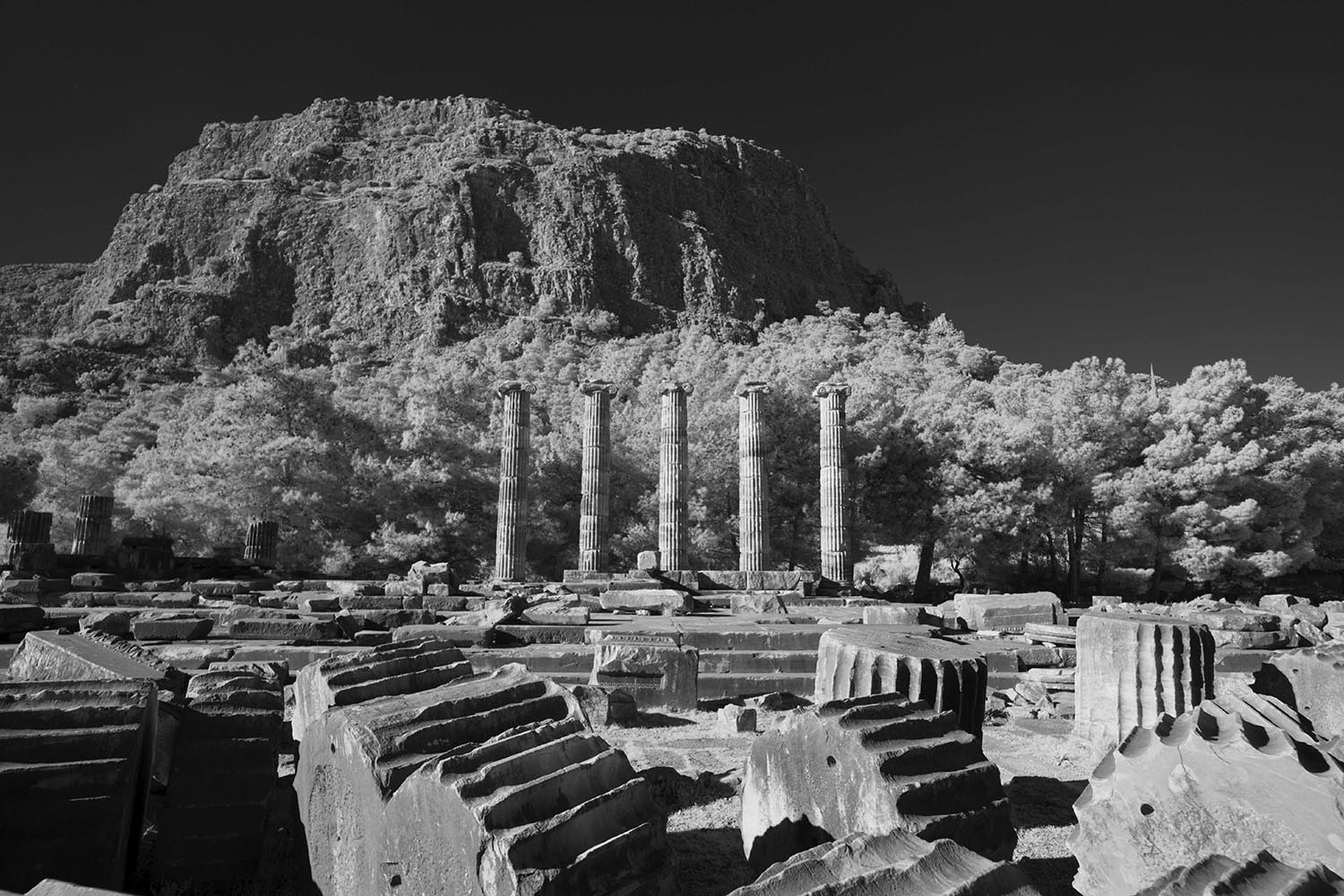
With the progress of de Lucci’s “magic circle” as a through line, Kossakovsky finds a continuum between architecture and its materials. Exquisite slow-motion photography documents the mineral extraction process at a quarry. Black-and-white sequences explore the Greek and Roman ruins in Baalbek, Lebanon. We also see the cleanup in the aftermath of the 2023 earthquake in southeastern Turkey, as bulldozers pile up untold tons of wreckage.
Architecton’s non-narrative, composite structure cements together these fragments so that they play off each other thematically. This emphasis on editing and cinematography perhaps inevitably recalls the opening geological sequence of Godfrey Reggio’s Koyaanisqatsi, but Kossavosky finds novel ways to create a sensation of deep time.
Evgueni Galperine’s original score beautifully underlines the film’s textural preoccupations. If it evokes the minimalist stylings of Philip Glass at times, it’s much more granular, even abrasive at others, with staccato bursts of trumpet and synthesizer, or samples of panicked breathing. Parts of it, at least, seem to have been composed with direct reference to the images. In one memorable shot set to a crunchy electronic beat, lumps of ore, jounced and jumbled as part of some opaque industrial process, suggest dancers at rave.
In Architecton’s prologue, as automated lawnmowers bounce off de Lucci’s magic circle, Kossakovsky asks the architect and designer, “Why do we build ugly, boring buildings, if we know how to build beautiful ones?” But Architecton isn’t merely a polemic against concrete, which, as an intertitle claims, is the most widely used substance on the planet after water.
The shots of blasting at a quarry cannot help but evoke the finale of Michelangelo Antonioni’s Zabriskie Point, in which various commodities explode in slow motion to Pink Floyd’s “Careful with that Ax, Eugene.” But the mood is less revolutionary and more despairing, with the tumbling, spinning shards of rock suggesting the fragmentation and collapse of global society.
There’s a radical materialism at the foundation of Architecton, reinforcing the notion that objects, in the properties that derive from their structure, exert a subtle yet powerful agency. When we design something, de Lucci says, we design not only products, buildings, or spaces, but our own behavior. The unspoken obverse to this architectural shibboleth, though, is that the materials we use have a way of designing us back, in dialectical fashion. The sad truth is, we rarely build anything, anymore, that will look beautiful even as a ruin, and the cheaper, the uglier, the less sustainable we make our buildings, the more dispensable our buildings make us.
Since 2001, we've brought you uncompromising, candid takes on the world of film, music, television, video games, theater, and more. Independently owned and operated publications like Slant have been hit hard in recent years, but we’re committed to keeping our content free and accessible—meaning no paywalls or fees.
If you like what we do, please consider subscribing to our Patreon or making a donation.