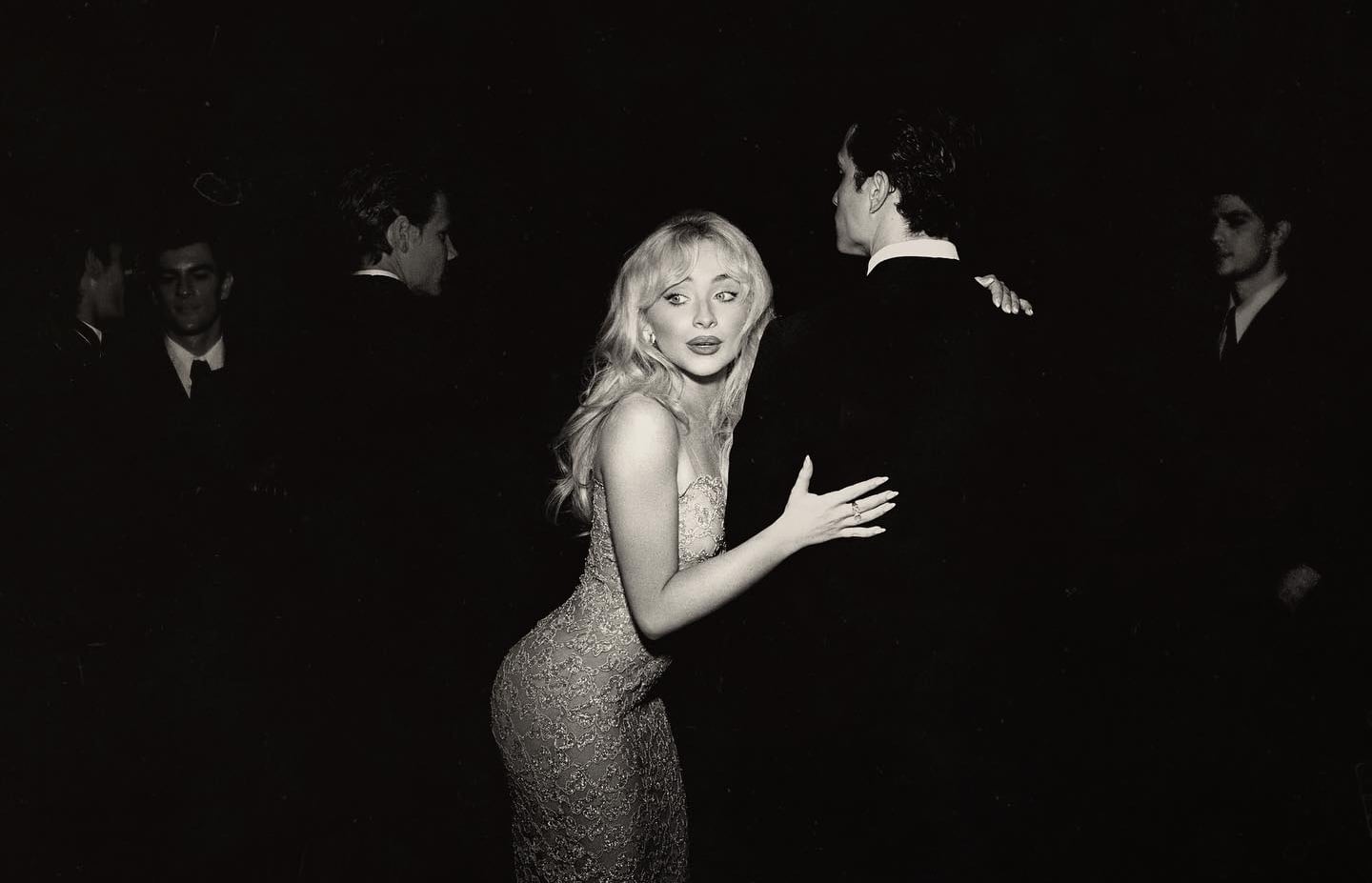
In a recent episode of the Are You a Charlotte? podcast, famed Sex and the City columnist Candace Bushnell claimed that Gen Z isn’t having as much sex as previous generations. She and countless others have lamented that today’s youth have developed views about sex that are, if not puritanical, alarmingly regressive. To wit: When pop singer Sabrina Carpenter revealed the title and cover art for her seventh studio album, Man’s Best Friend, TikTok and the app formerly known as Twitter lit up with outrage over the image of the 26-year-old on her bare knees at the foot of a man gripping a fistful of her blond hair.
It’s an intentionally provocative photo, and the myriad think pieces that popped up overnight at least attempted to grapple with the wearyingly perennial question about whether images of women like these are self-possessed satire or inherently pandering to the male gaze. It’s a distinction that has eluded the grasp of many of Carpenter’s youngest detractors, who seem to be immune to irony.
Carpenter is a throwback to female stars of a certain vintage: more Dolly Parton or Madonna—women who understood and were unafraid to harness their sexual agency—than, say, Taylor Swift or Gracie Abrams. Decades after Madonna and Bushnell helped normalize in the American mind the concept of women speaking frankly about sex, specifically the sex they wanted to have or were actively having, a lyric like “I’m so horny” from Carpenter’s 2024 album Short n’ Sweet is apparently still shocking to some.
If possible, Man’s Best Friend is even hornier. “I get wet at the thought of you…Tears run down my thighs,” Carpenter quips on “Tears,” a Donna Summer-inspired disco-pop gem. The lyrics might sound gauche if Carpenter weren’t also, at least in part, taking the piss. The bar for boys is so terminally low—another running theme in the singer’s recent output—that simply finding one capable of assembling an IKEA chair could send her into fits of ecstasy.

On the withering “When Did You Get Hot?,” Carpenter teases, “Big riff coming, I need a minute…Okay, here it comes,” before letting out an orgasmic vocal run worthy of Ariana Grande. Carpenter’s voice is folksy, coquettish, and conversational throughout the album, and she delivers her bon mots with seemingly minimal effort. Which makes her overreliance on expletives, puns, and cheeky one-liners all the more glaring.
Carpenter is pop’s proudest potty mouth. There are no subverted rhymes here. She goes for it. But the sheer volume of her libidinous linguistics can be dulling. She caps off the lovely “We Almost Broke Up Again Last Night,” an otherwise insightful sendup of the kind of perpetually on-again-off-again couple we all know, with a gratuitous “Gave me his whole heart and I gave him head.” And “House Tour” is dotted with puerile metaphors for various forms of intercourse despite her thoroughly unconvincing insistence that “I promise none of this is a metaphor.”
Sonically, Man’s Best Friend sees Carpenter and main collaborators Jack Antonoff and John Ryan continuing in a similar vein as Short n’ Sweet, paying homage to the past with the multi-culti, pan-genre pastiche of lead single “Manchild” bumping up against the Paula Abdul-era dance-pop of “House Tour” and the yacht-rock-meets-R&B standout “Never Getting Laid,” which is filled with smooth electric piano and some very ’70s-coded mono synth lines.
Missing, though, is the rollicking pop-rock edge of the Short n’ Sweet hit “Taste” and, aside from the banjo-driven “Don’t Worry I’ll Make You Worry,” the stripped-down acoustic folk (and heart) of the Jewel-esque “Dumb & Poetic” and the swooning “Couldn’t Make It Any Harder.” Even Man’s Best Friend’s closing track, “Goodbye,” is a scathing, albeit jovial, kiss-off rather than a heartfelt au revoir, replete with a Latin-infused climax of strings, sax, trumpet, and—because it wouldn’t be a Sabrina Carpenter song without it—innuendo that will send her detractors reaching for their proverbial pearls.
Since 2001, we've brought you uncompromising, candid takes on the world of film, music, television, video games, theater, and more. Independently owned and operated publications like Slant have been hit hard in recent years, but we’re committed to keeping our content free and accessible—meaning no paywalls or fees.
If you like what we do, please consider subscribing to our Patreon or making a donation.