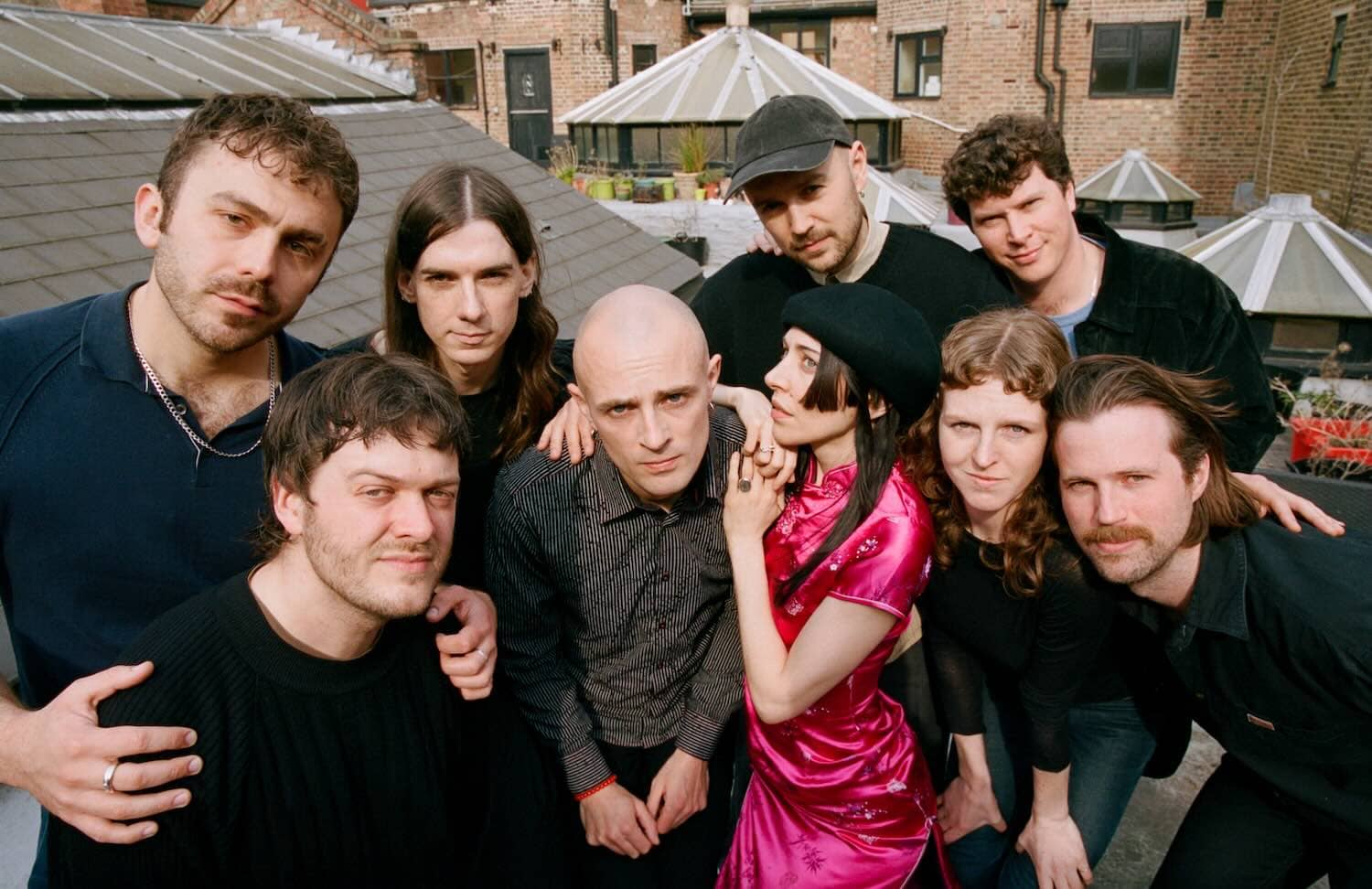
There’s a jarring, mind-bending moment halfway through Caroline’s second studio album where the boundaries of what a song is and what it’s supposed to do start to dissolve. The misleadingly titled “Coldplay Cover” begins with half of the London eight piece playing in a living room and then, midway through, the engineer picks up the mic and walks into the kitchen, where the other half begins to play. Footsteps creak, distant voices blur, and what began as one song fractures into two happening at once, bleeding into one another.
Caroline 2 is an album of collisions: between time and space, past and present, precision and spontaneity. The songs never settle, seemingly discovering themselves in real time. The album resists clean structures and resolutions, creating a space where songs feel less like finished products and more like living systems—always in motion and always on the verge of change.
“U R UR ONLY ACHING” begins as an acoustic vocal duet and slowly crescendos into a dissonant clash of strings. Then, without warning, it cuts to a section recorded in London’s Nunhead Cemetery; you can hear the breeze blowing as band members Jasper Llewellyn and Magdalena McLean’s vocals lock together to scratch a melodic itch that somehow rises from the fray. Constantly shifting between takes, spaces, moods, and textures, the track toys with the listener, yet it never loses shape, building toward an improbably affecting emotional arc.
That same sense of fluidity can be found in the album’s lyrics, which often take a mantra-like quality—repeated, reshaped, and recontextualized until their meaning begins to shift. On “Tell Me I Never Knew That,” featuring Caroline Polachek, the chant “It always has been, it always will be” subtly mutates into “It always happens,” then “This always happens,” and finally back to “It always will be.” By then, it doesn’t mean what it did before. The words have turned bitter—or maybe they’re actually hopeful? The track’s use of Auto-Tune only heightens the disorientation, warping voices until their intent becomes a moving target.

A similar effect plays out on “Total euphoria,” which revolves around the looping question “Did we ever talk about how you left them?” It’s a line that feels cryptic at first but deepens with repetition. The effect is both spiritual and slippery, inviting interpretation but resisting clarity.
This use of repetition gives Caroline 2 a fragmentary internal mythology. The phrase “Now I know your mind” shows up in three different songs—each time landing a little differently, like a thought the album can’t quite let go of. The words “Lightning on sky” first appear in “Song Two” as a cryptic half-remembered quote, then return in “Two Riders Down,” now rooted more firmly in memory and grief. These opaque phrases start to hint at something larger.
Part of what makes Caroline 2 so compelling is how closely its mysteries mirror its methodology. The lore behind the album’s writing and recording—the traveling mic, the cemetery sessions, the collaged demos—feels like an extension of the music itself. The songs build a world you can almost see but never fully grasp. That distance is part of Caroline 2’s pull. The band understands that not knowing can be its own kind of truth.
No track on the album captures this better than the collage-like “When I Get Home”: A pulsing club beat plays in the distance, like it’s bleeding in from a dance floor in some adjacent room, while bits of studio recordings, old demos, and group sessions are arranged together on top. You can hear the openness, the indecision, the ghost of what the song might have been. But instead of “finishing” it in the traditional sense, the band leaves its potential intact—to, in a way, preserve it. By embracing its own flawed history, the song rejects its destiny and finds itself the process. The space around the idea completes it.
Caroline 2 is both fixed and fluid—a complete package that feels like it’s evolving. Like Brian Wilson’s Smile or Kanye West’s The Life of Pablo, it holds onto the feeling of incompleteness, if purposefully so. The result is an album that feels impossibly alive in its contradictions, its friction, and its refusal to resolve. Every listen carries the possibility that it’ll sound completely different. That restless tension is what gives Caroline 2 a strange and sublime power.
Since 2001, we've brought you uncompromising, candid takes on the world of film, music, television, video games, theater, and more. Independently owned and operated publications like Slant have been hit hard in recent years, but we’re committed to keeping our content free and accessible—meaning no paywalls or fees.
If you like what we do, please consider subscribing to our Patreon or making a donation.