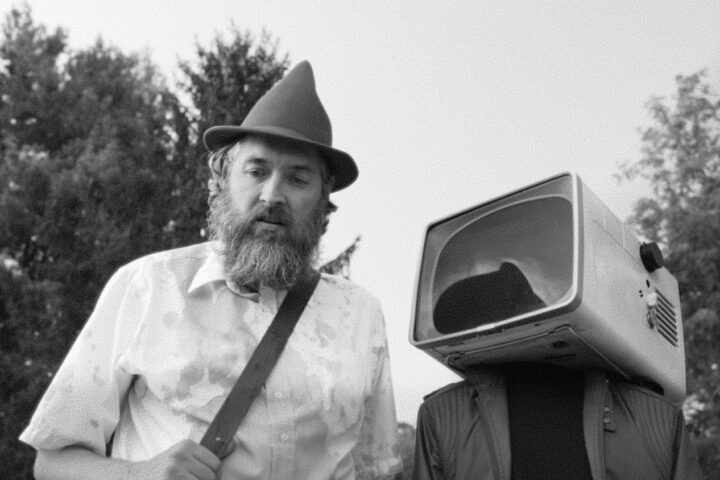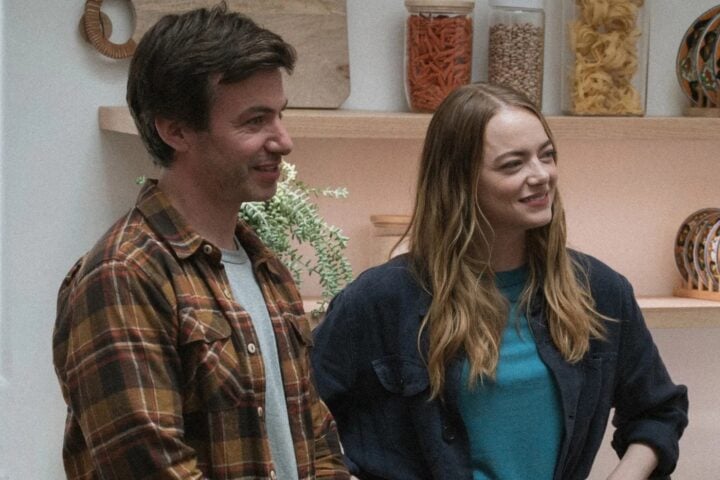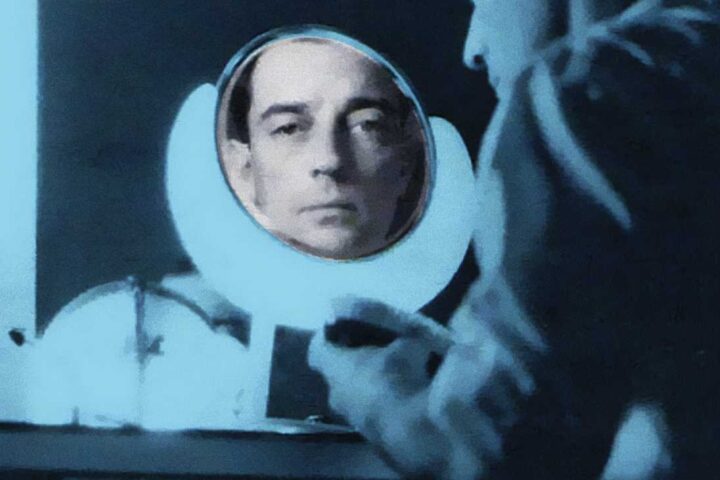
No matter how deep their journey into the irrational world of the unconscious, surrealism’s typically male protagonists, from Magritte’s “Son of Man” to Twin Peaks’s Dale Cooper, often seem to be dressed for another day at the office. This discordant signaling of everyday order amid nonsensical dreamscapes constitutes the thematic kernel of Kentucker Audley and Albert Birney’s charming pop-surrealist Strawberry Mansion, which centers a quirky sci-fi romantic epic around a hipster rendition of this figure.
James Preble (Audley) is a “dream tax” auditor in a near-future in which citizens’ dreams have been monetized. Is there a hot air balloon in your dreams? Well, the value of that image is somehow $5,000, so you owe a couple bucks to the tax man. Dreaming of a spider infestation? Conveniently, the anonymous party dude in the Hawaiian shirt who keeps popping up in your dreams has a spider spray to recommend to you. Just such a mysterious and garrulous good-time bro (Linas Phillips) shows up in one of Preble’s own dreams, remedying our hero’s failure to prepare himself a meal by offering up a bucket of “Cap’n Kelly’s Chicken.”
Somehow, though Preble’s job consists of levying taxes on monetizable dream-images, the man doesn’t clock that companies are also paying for advertising space in the dreams of the populace. (This despite his otherwise rather inexplicable decision to order a “chicken gravy shake” at Cap’n Kelly’s the day after his dream.) The revelation that corporations have been implanting thoughts in people’s heads for years is left to Bella (Penny Fuller), an elderly widow whose decades of recorded but hitherto untaxed dreams Preble is sent to audit.
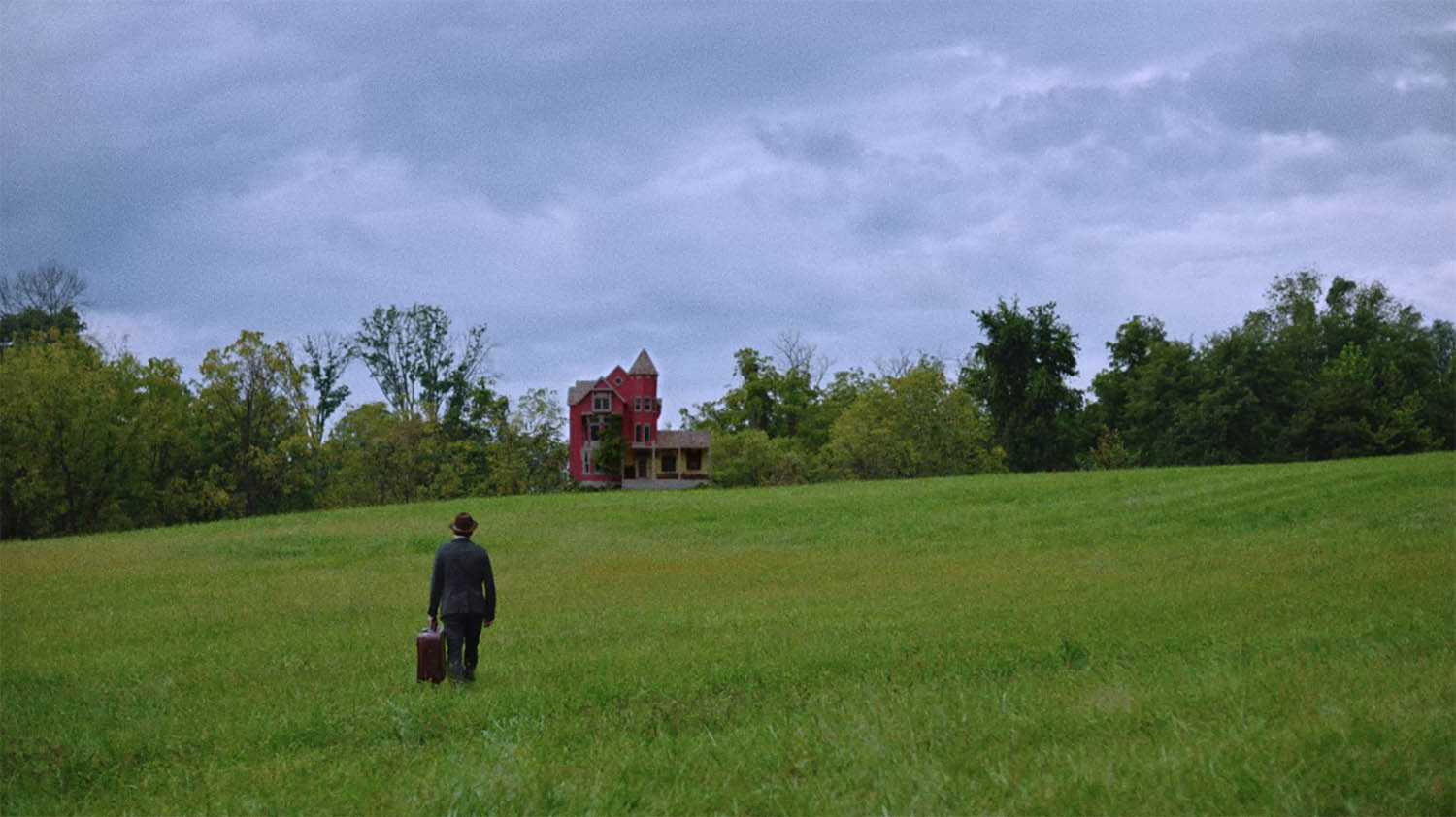
After rolling up to Bella’s rural Victorian mansion in a teal-colored boat of a midcentury sedan that itself looks like something out of a hazy dream, Preble is denied entry until he licks the half-melted strawberry ice cream cone that she presents to him. This ritual of entry, along with numerous other bewildering events, not only points to the porosity of the line between dreams and reality at Bella’s, but also kicks into motion a series of payoffs late in Strawberry Mansion that are as neat as they are utterly nonsensical. Call it Chekov’s ice cream cone. Or don’t, because nothing as predictable as somebody being shot with it ever happens here.
Offered a room in Bella’s cluttered home, Preble begins the process of going through her 2,001 VHS tapes of dreams dating back to the 1980s. To project a kind of digital-astral version of himself into them, he pops the tapes into a player and dons a steampunky helmet that looks like something that Michel Gondry hand-crafted for Be Kind Rewind. The filmmakers’ charming use of paper-maché props, consumer-grade digital compositing, and especially stop-motion animation—along with the creamy saturated colors of Tyler Davis’s cinematography—lends Strawberry Mansion a bewitching daydream quality. It also draws an implicit parallel between the creative agency of dreams and the waking creativity of filmmaking, as they both assemble strange and fascinating worlds out of, as Freud called it, “the day’s residue.”
Preble finds himself enamored of the younger “ego ideal” form that Bella takes in her dreams (played by Grace Glowicki), but, of course, complications arise when you fall in love with someone in another person’s dreams, particularly when dystopian corporations are involved. The stage, then, is set for an Orpheus-like quest for Bella through the depths of Preble’s unconscious after the real-life, aged Bella shuffles off her mortal coil, and her conniving son, Peter (Reed Birney), appears on the scene. He’s doubled by a blue demon (Albert Birney, Reed’s nephew) in the dream realm, who, with his barely articulable, plastic golden beak and wild mane of stringy hair, looks like a refugee from a Power Rangers episode.
Strawberry Mansion, with its shadowy corporations, VHS tapes, demons, and impossible recursive connections between present and past, weirdly covers ground similar to that of the recent Netflix horror series Archive 81. The two share a fantasy of being able to enliven archaic media formats—the wish that the discarded tapes that lie forgotten in dank basements might offer real interchange with the histories, fantasies, and people they archive. Except that Strawberry Mansion doesn’t view the repressed material of the mind (or of the video tape) with trepidation, but rather with a sense of open, playful delight. Here, even the demon who’s kidnapped the object of your VHS-mediated affection will at least offer to make you breakfast.
Since 2001, we've brought you uncompromising, candid takes on the world of film, music, television, video games, theater, and more. Independently owned and operated publications like Slant have been hit hard in recent years, but we’re committed to keeping our content free and accessible—meaning no paywalls or fees.
If you like what we do, please consider subscribing to our Patreon or making a donation.