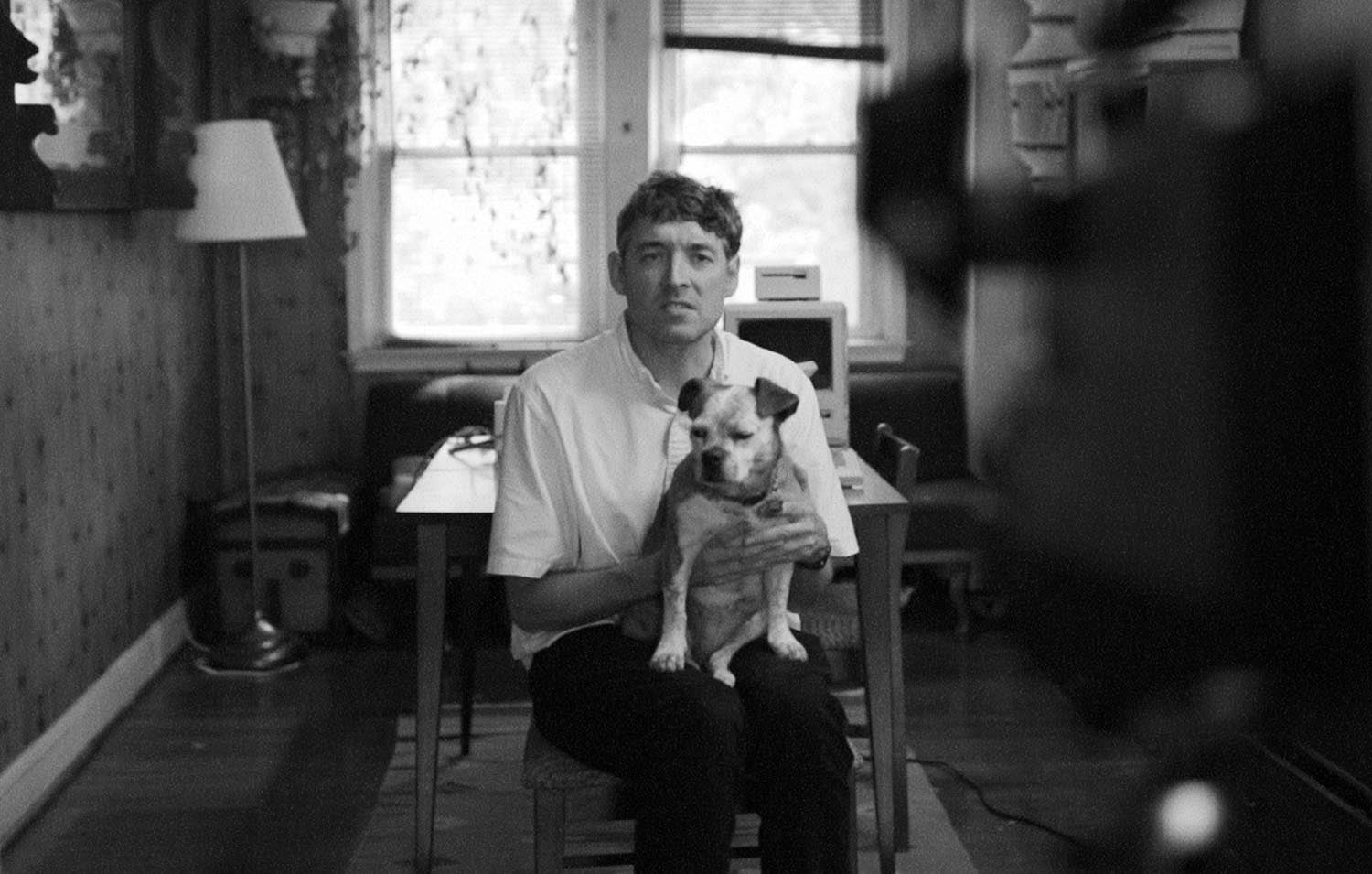
A coffee mug glimpsed early in Albert Birney’s sophomore feature, OBEX, bears the phrase “Have you hugged your computer today?” For 21st-century audiences trying to escape the vise grip of omnipresent digital technology, that sentiment might seem naively sanguine about the relationship between humans and their devices. But Conor, the film’s tech-savvy protagonist (played by Birney), sees a bright future ahead in 1987 for using these tools to connect with a world from which he’s otherwise disengaged. And, as if he needed any other excuse to stay inside his home in Baltimore, the city is in the middle of the once-every-17-year cycle of a cicada brood emerging to shed their skins.
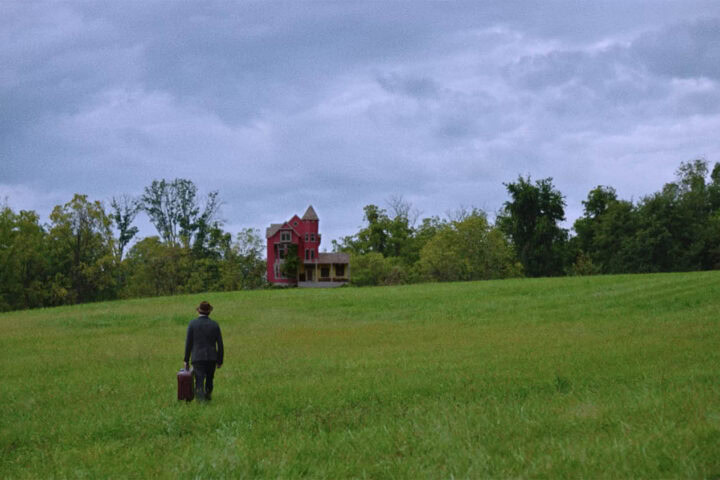
The title of Birney’s film refers to a computer game that allows players to place themselves directly in the action. Once a monster emerges from the static of Conor’s TV to kidnap his beloved dog, Sandy, the agoraphobic Conor must venture outside his home for a rescue mission. This journey into the terrain of OBEX, rendered before Conor as a tangible reality rather than just another 8-bit game, pushes him outside his comfort zone and closer to what really matters.
As Conor’s adventure progresses, Birney offers a thrilling immersion into this lo-fi fantasy realm. While OBEX might take place in the past, its promise of technology as a portal for better human connection serves up plenty of food for thought for present-day audiences recalibrating their relationship to the digital world. Conor’s techno-optimism may be a relic of the early computer age, but the ever-imaginative Birney provides a potent reminder that gaming can serve as a tool for self-actualization when approached with sincerity and humanity.
I spoke with Birney ahead of OBEX’s theatrical release. Our conversation covered what attracts him to specific technological tools, why he finds value in adding friction to the creative process, and where he sees connective tissue between cinema and video games.
I was in Baltimore in the brood summer of 2004. How did that summer come to cross-pollinate with the ideas about technology that you explore in OBEX?
I was here in the summer of 2004 as well. I had just graduated from college and was back at home. It was wild to have those cicadas flying about! When I first moved to Baltimore, it was 17 years before that, another cicada summer. In 2021, when this idea of OBEX first started to take shape, it was another one of the cicada brood summers. It made me think a lot about time and how 17 years were ticking off just like that. The very first footage I filmed for this movie was the cicadas in the trash can. That actually just happened: They were in the backyard, and I had this footage up close of these cicadas on their backs at the bottom of this trash can.
And the connection with technology, something about the hiss of the cicadas in the trees began to remind me of the white noise of static from a TV when you go on the wrong channel, and you just get that beautiful wash of sound. I started to think about it like a world of these static creatures trying to break in, like the way that TVs and screens feel like portals. When you put on a movie, you’re transported to another place. When you put in a computer game, it takes you to another land. They all just started to match up against each other, and [I had] the idea that maybe the cicadas are connected to this insect demon god who can travel through the static and TVs and come through the computer games, enter our world, kidnap [Sandy] and we have to go into that world to follow them. Somehow, it all just became one idea. Whether or not it’s successful, to me, it felt an exciting mash-up to put all together.
Did making a movie set in 1987 feel like a true period piece, or did it feel similar in the way that people related to technology, just with less sophisticated gadgets?
It’s funny, we filmed in my house. To make it [look like] 1987, I didn’t have to do too much. The main thing was taking all of the books off the bookshelf and put in VHS tapes, and then getting rid of the modern flat screen TV and putting the old TVs up here. But the house is pretty much locked in to another era; we haven’t made many changes to it. Filming it, Pete [Ohs, the co-writer] and I entered into our own rhythm where you’re a little bit removed from the modern world. We’re not on our cellphones doomscrolling all day when we’re filming, or we’re not locked into the latest news cycles. Maybe you entered a little bit into that old 1987 rhythm just because of how we’re going about our days. But it felt very natural to sink into that and have a character who’s just in their own world with their dog and no outside influence.
There’s such a frictionless nature to computer-generated art now, especially with the advent of generative A.I. Did that play into the process-oriented way you show Conor creating his digital drawings, down to each keystroke?
I don’t know if I’d call myself a Luddite, but I think there’s something to be gained from taking your time with certain things, [like] making a cup of coffee by hand in a French press the slow way, versus a Keurig, where you just pop a pod in and don’t think about it. I’m a fan of using my hands and some more analog techniques. Just because things can be faster and more efficient isn’t always beneficial to the human being who’s doing it. With this A.I. thing, is there going to be a generation of kids raised on this who aren’t able to think for themselves because everything is just a quick click away? I don’t want to be the “in my day, we used to do it this way” guy, but I think there is a certain thing that’s lost when you are just trying to go faster.
You were creating art on Vine back in the day, which isn’t something a Luddite does. When you see a new technology entering the world, what is it that makes you say it’s worth engaging with the syntax of those new tools?
With Vine, this six-second video app, you had to do it all in-app in those early days. It was like a step backwards. It very much reminded me of when I was making movies with my friends and family in middle and high school, and we’d have to do the editing in-camera before there was computer editing. It was very playful and fun. Making those Vines was very tactile, and it got me back to a sense of play. I think with any new technology, [I like] if I can feel the human element of it or bring myself into it and still feel like I’m not getting lost.
I’ve had friends tell me I should use After Effects, which is a program where you can do all these special effects. And I’ve used it from time to time, and I’ve taken some classes to learn it. But I lose a little bit too much of the human element of it, so I always just go back to Photoshop. That’s another program made by the same people, Adobe, but there’s something a little bit more clunky about it. I’m just doing it frame by frame, and it reminds me of how people might have been animating 80 years ago with cell animation. Personally, what I’m looking for is something where I can feel the artist’s hand coming through. I’m not opposed to new programs or things, but which ones are tools that I can channel my own ideas and visions through?
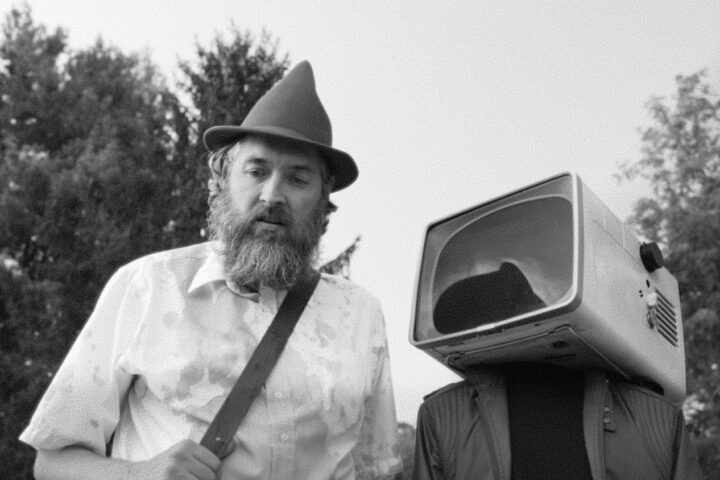
I was struck by the TV monitor giving the monologue about watching Conor and his family watch him. How did this personification of technology enter the film?
First, I just love fun characters. If there’s a character in the movie who’s just a normal person, I’m like, “Well, let’s do something here.” I still have some of the TVs I grew up watching because they feel like old friends or something. I watched the Academy Awards with my grandmother when I was 12 on [one] TV, and I watched a Super Bowl when I was 13 on [another] TV, and I first saw The Wizard of Oz on this [other] TV. What if the TV was also alive and having these same memories and experiences, and could be like, “I remember when you and your grandmother watched me that night, and you both cheered when Good Will Hunting won”…wouldn’t that be nice to have these objects come alive and have feelings like we all do?
I was just home for the holidays, and I had to clean out the DVD drawer. It was harder for me to get rid of them, even ones that I have no intention of watching again. Do you feel a different engagement with that virtual world of 1987 since that connection in an analog world was so tethered to the devices themselves?
Oh, definitely. I still have a couple VHS tapes that I had as a kid. I don’t know if I’d ever watch them again, but it’s impossible to throw them out. There’s just something about the clunkiness of these old machines that’s very endearing. I’m on a modern computer, and I have a modern phone and devices throughout the house. Maybe in 20 or 30 years, I’ll be making movies with those devices. I’ll be like, “I miss the time before we all put the little chip in our brain.”
Maybe every time is like this, but especially with how fast A.I. is moving in video generation, it just feels like it’s going to be a wild five or 10 years. I don’t think we can conceive of where things are going to go, and you hope they go in a place that’s good or healthy and beneficial to us. But the way things have been going, I’m not exactly hopeful all the time. Sometimes I think we’re past where, if this were a Black Mirror episode, we might say, “Oh, it’s too on the nose.”
Heavy users of technology in the early adopter stage of computers, such as Conor, used to be the most sanguine about what it could do for the world. Now, they tend to be among the biggest naysayers. I don’t think OBEX is necessarily a nostalgic work, but was there any desire to try and reclaim that mantle of techno-optimism?
Yeah, I think [the film is partly saying], “Look how simple and hopeful it all was.” There was no World Wide Web really happening at that moment. I’ve started to hear whispers of the younger generation returning to CDs and wanting to not be on their phones or computers. Maybe, with all the new technology, there’s this response where people will want to have real experiences with real people in real places, and meet up in the park or go on a walk through the forest. All these things give me some hope. The hope is no longer connected to the technology; the hope is connected to the people being opposed to the technology.
I thought about OBEX in relation to I Saw the TV Glow before even realizing you were in Jane Schoenbrun’s film. Do you feel a trend is building around millennial filmmakers engaging with the culture and technology of the early digital age?
Jane and I are similar ages and grew up watching the same TV shows and movies, and responding to video games. It just makes sense that now, as we’re making films, we’re looking back and thinking about all of these formative parts of our lives, wanting to investigate them and figure out what’s at the heart of it. We tell stories that are very rooted in traditional storytelling techniques, but looking at them through this lens of growing up in the ’80s and ’90s, all having watched A Nightmare on Elm Street or seen The X-Files, and putting our own spin on it.
You drew inspiration from video games as well as cinema in the genesis of OBEX. Those two forms of media are often foiled against each other, but do you see them as having more connective tissue than people realize?
Oh, definitely. Making my first video game in 2021 really opened my eyes to that. It’s a lot of the same stuff I’ve learned from making movies—just applying character and story to this different model. But they’re not that different at the end of the day, and the seed of OBEX was wanting to connect them even more. I had this early dream of doing something that had never been done: a movie that’s a video game, and a video game that’s a movie. Maybe that’s been done. A lot of modern video games have these amazing cutscenes that are very cinematic in their presentation, but I wanted to try to bridge that gap even more. I realized I had no idea what that even looks like, so I just made a movie about a game. That was how it morphed.
But I think they’re definitely connected. I know they’re connected in my own life and inspirations. When I was watching A Nightmare on Elm Street, I was also playing The Legend of Zelda, so they were forming and shaping me at the same time. I still love video games. I don’t play newer ones as much, but I watch people play them and am in awe of what they’re doing now with the hyper-realistic graphics and open worlds. I will always return to the era of games that I grew up with, and I love game makers who are making retro-type games or games that are modern but still have that old type of feeling to them. I think video games are a great art form.
Are there any parallels between OBEX and the exploration of dream logic in your last feature, Strawberry Mansion?
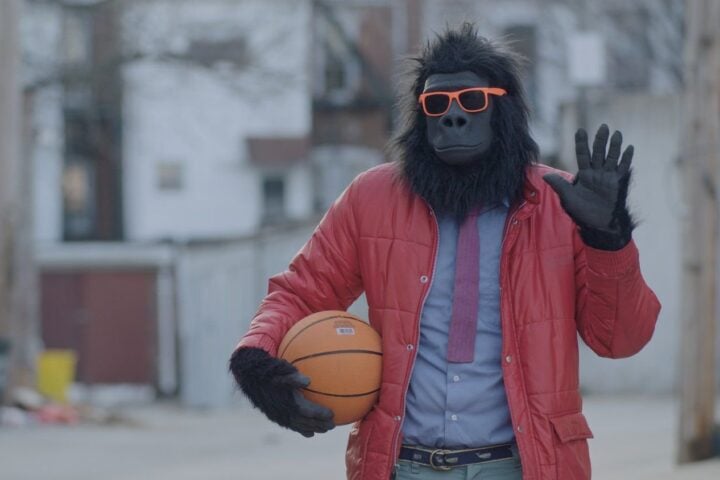
You can’t escape yourself and your obsessions. I’ll always be drawn to dreams and the liminal space between waking and sleeping. That’s what movies have always felt like to me—these dreams that you can get lost in. You can explore other people’s dreams in role-playing games. On a practical level, some props and costumes appear just for the simple fact that I still have them in storage in my basement, and it feels good every couple of years to dust them off and put them in front of the camera again. But within a body of work, they’re all connected. Whatever project you’re working on, there’s overlap and connective tissue that I think is very deliberate.
In Conor’s letter to the OBEX creators, he speculates that one day we’ll all be living in computers. Based on the way his reality blurs by the end of the film, do you think his prophecy has come true?
I think that’s one way to read into it. There are different interpretations. I think Conor is a little prophetic with that line. And writing that line in 2023, when we were coming out of the pandemic and had all grown very accustomed to Zoom and being able to talk to anybody at any time, I think certainly we are past there. Which is maybe why the younger kids are trying to come out of the computer. But for the OBEX story, I’m keeping it a little bit vague or open to interpretation where Conor ends up. But hopefully, wherever he ends up, he’s happy.
Since 2001, we've brought you uncompromising, candid takes on the world of film, music, television, video games, theater, and more. Independently owned and operated publications like Slant have been hit hard in recent years, but we’re committed to keeping our content free and accessible—meaning no paywalls or fees.
If you like what we do, please consider subscribing to our Patreon or making a donation.