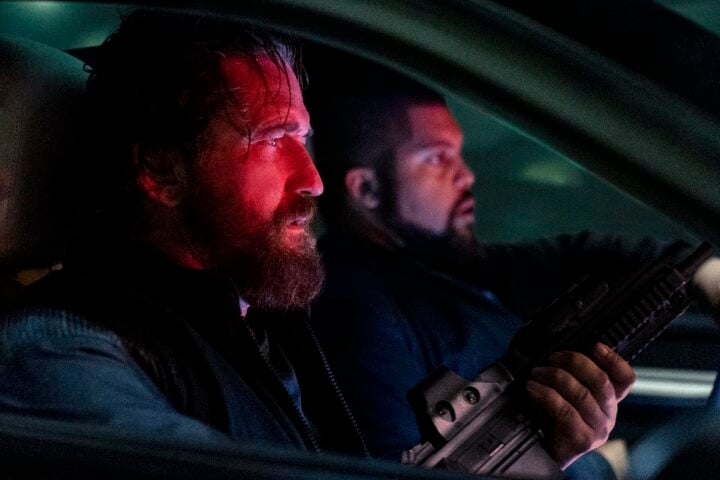
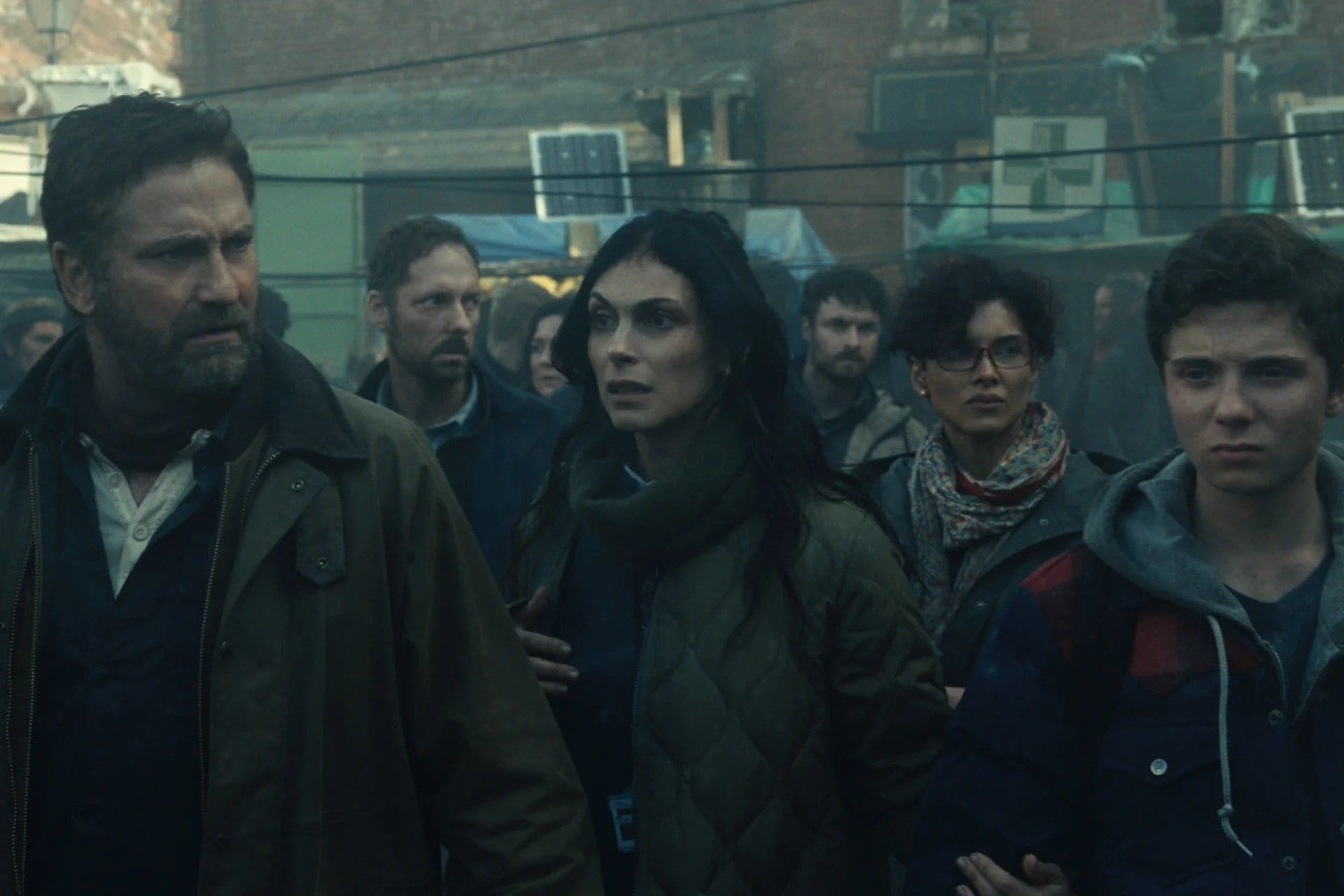
Surprisingly tender for a disaster flick, 2020’s Greenland grounded itself in the humanity of its central family unit. As Ric Roman Waugh’s film ended with John Garrity (Gerard Butler) having escorted his family to the safety of a complex of underground bunkers in the eponymous Danish territory, it seemed as if their story had reached its natural resolution. But after Greenland become a sleeper success, a sequel became inevitable, and Greenland 2: Migration follows the Garrity clan, five years after the Clarke comet hit the Earth, as their bunker’s collapse forces them back outside again to face the exceedingly harsh natural elements.
The first film’s tension was shrewdly intensified by both John and Allison’s (Morena Baccarin) recent marital strife and their son’s diabetes, which Greenland 2 will have you believe are now non-issues for the Garritys. While it’s easy to imagine that John and Allison have figured out a way to successfully keep their marriage alive in the five years since the events of the first film, one has to wonder how their son’s chronic condition has been managed during that time.
Which is to say that Greenland 2, as written by Chris Sparling and Mitchell La Fortune, doesn’t similarly dot its narrative with memorable moments of interpersonal friction. Nathan, now a teenager played by Roman Griffin Davis, is interested in girls, but even an exchange of flirtatious glances with a fellow student (Megan Jacobs Shrivastava) goes nowhere once Nathan and his parents are forced to migrate to somewhere, anywhere, that serves as a hospitable respite from the constant wave of radioactive thunderstorms now occurring worldwide.
So the Garritys fight to cross the English Channel and make their way down to the south of France, where the biggest crater left by one of Clarke’s fragments is believed to provide a safe zone from radiation. This gives John a noble goal and the film its stakes, but the post-apocalyptic road movie that follows mines the familiar beats of similar films (including Children of Men, which Waugh has stated as an influence) and TV shows (like The Walking Dead).
As its suspense arises almost solely through external forces, such as armed militias and thieves, Greenland 2 plays out as a much more generic thriller than its predecessor. The film also has the aggravating tendency of dispatching characters almost immediately after they’ve been introduced, rendering their sometimes tragic ends devoid of their intended emotional impact.
At one point, a desperate father, Denis (William Abadie), offers the Garritys hope, both in giving them an updated map that shows the least dangerous route to the crater and in his desire to make a life for his daughter, Camille (Nelia Valery de Costa). But the pell-mell momentum of this segment is such that you never buy just how willing Denis is to thrust Camille into another family’s lives because of where they’re heading. We may know that the Garritys are good people, but Greenland 2 doesn’t carve out enough space to make the man’s trust in them feel credible.
You could say that the film, which has a frustrating patchwork quality, might have benefited from being longer, but one also doesn’t imagine that whatever was left on the cutting-room floor would have allowed the glimpses of the interpersonal forces at the end of the world to take on a deeper dimension. The film’s attempts to convey a sense of positivity and solidarity in times of struggle is admirable, but its hollow characterizations, mostly uninspired action, and trite, mundane plotting all serve to make this a sequel that’s less inspirational than ineffectual.
Since 2001, we've brought you uncompromising, candid takes on the world of film, music, television, video games, theater, and more. Independently owned and operated publications like Slant have been hit hard in recent years, but we’re committed to keeping our content free and accessible—meaning no paywalls or fees.
If you like what we do, please consider subscribing to our Patreon or making a donation.