
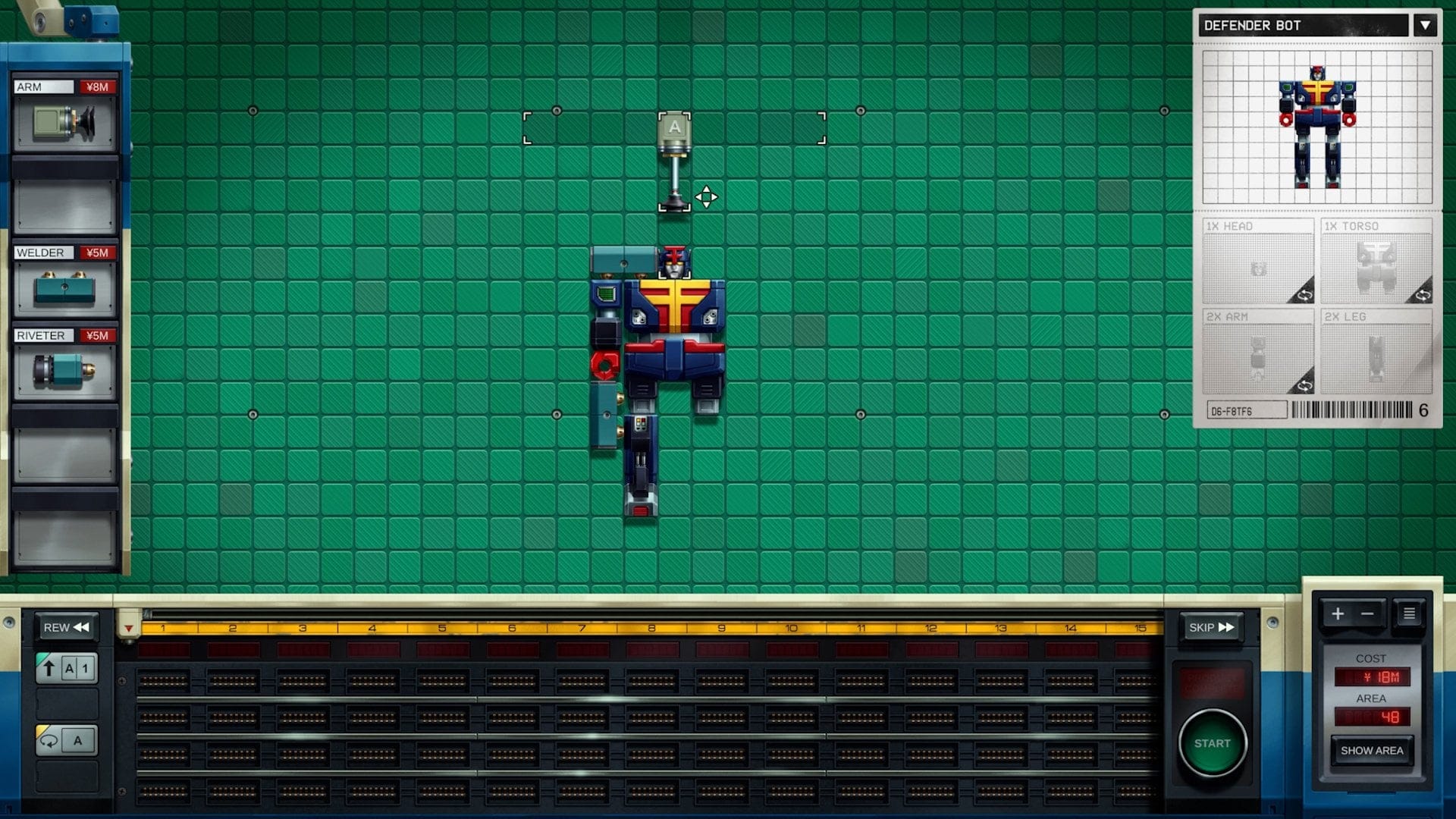
Set against the backdrop of the bubble-and-burst Japanese economy of the late ’80s and early ’90s, Coincidence’s Kaizen: A Factory Story has you designing assembly lines to cut, weld, and rivet together everything from plastic food to arcade cabinets. If you know about the puzzle and programming-centric output of shuttered developer Zachtronics (alumni of which form Coincidence), then you know the score: Not only are you arranging the factory layouts, but you’re crafting step-by-step lists of commands for the mechanical arms to automate.
A single puzzle can be long, given the trial-and-error factors that will often see you scrapping everything and starting anew. The filled progress bars and glowing treasure chests of other games have nothing on the satisfaction of a plan that comes together here, with machinery humming and hissing as it lugs components down tracks, drills holes in them, and flips them over for ease of assembly. Kaizen has you create beauty from abstract tools of industry, with groups of puzzles arranged around distinct themes and in a variety of shapes and colors.
None of the commands and tools are complex on their own. A mechanical arm can only extend or retract so far, and there are no curves in the tracks. Welding and riveting happen automatically and as soon as product components are in range. But between the versatility of all the commands working together and the diversity of the puzzles, Kaizen has you constantly reevaluating your strategies, especially since the tools all take up space on the planning grid.
Each puzzle, then, is twofold: how to assemble the final product, and how to do so efficiently. And efficiency is where things get really complex, because the end-of-puzzle progress reports score you based on how many steps the assembly process takes, how much space your final design takes up, and how much all the required machinery costs. An efficient design has to weigh different compromises: For one, it may be more expensive to set up two mechanical arms, but it may also save valuable time compared to maneuvering a single arm along a track.
The real masterstroke of Kaizen is how seamlessly it eases you into its complexities without becoming punishing or overwhelming. The pursuit of efficiency is entirely up to you; the game only determines whether you’ve assembled a complete product, casting no judgment on what your solution looks like. There’s a joy to cutting costs and minimizing surface area that the scoreboards encourage, but there’s also joy in creating a hopelessly convoluted Rube Goldbergian workflow because the basic assembly process is so satisfying on its own.
Even the wraparound story slyly keeps your options open. As an American who came overseas to work in marketing, yet found himself planning assembly lines, you’re specifically written as an unfamiliar outsider who’s coming up with unorthodox solutions. Much like all the products you assemble, the disparate components of Kaizen all come together into one elegant whole.
Since 2001, we've brought you uncompromising, candid takes on the world of film, music, television, video games, theater, and more. Independently owned and operated publications like Slant have been hit hard in recent years, but we’re committed to keeping our content free and accessible—meaning no paywalls or fees.
If you like what we do, please consider subscribing to our Patreon or making a donation.