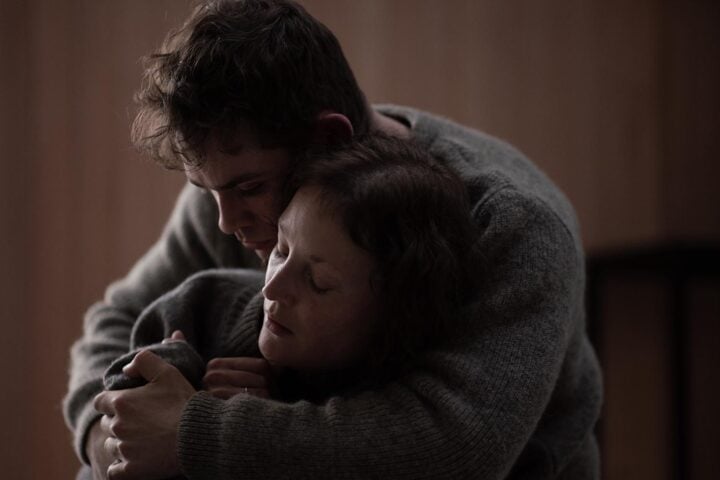
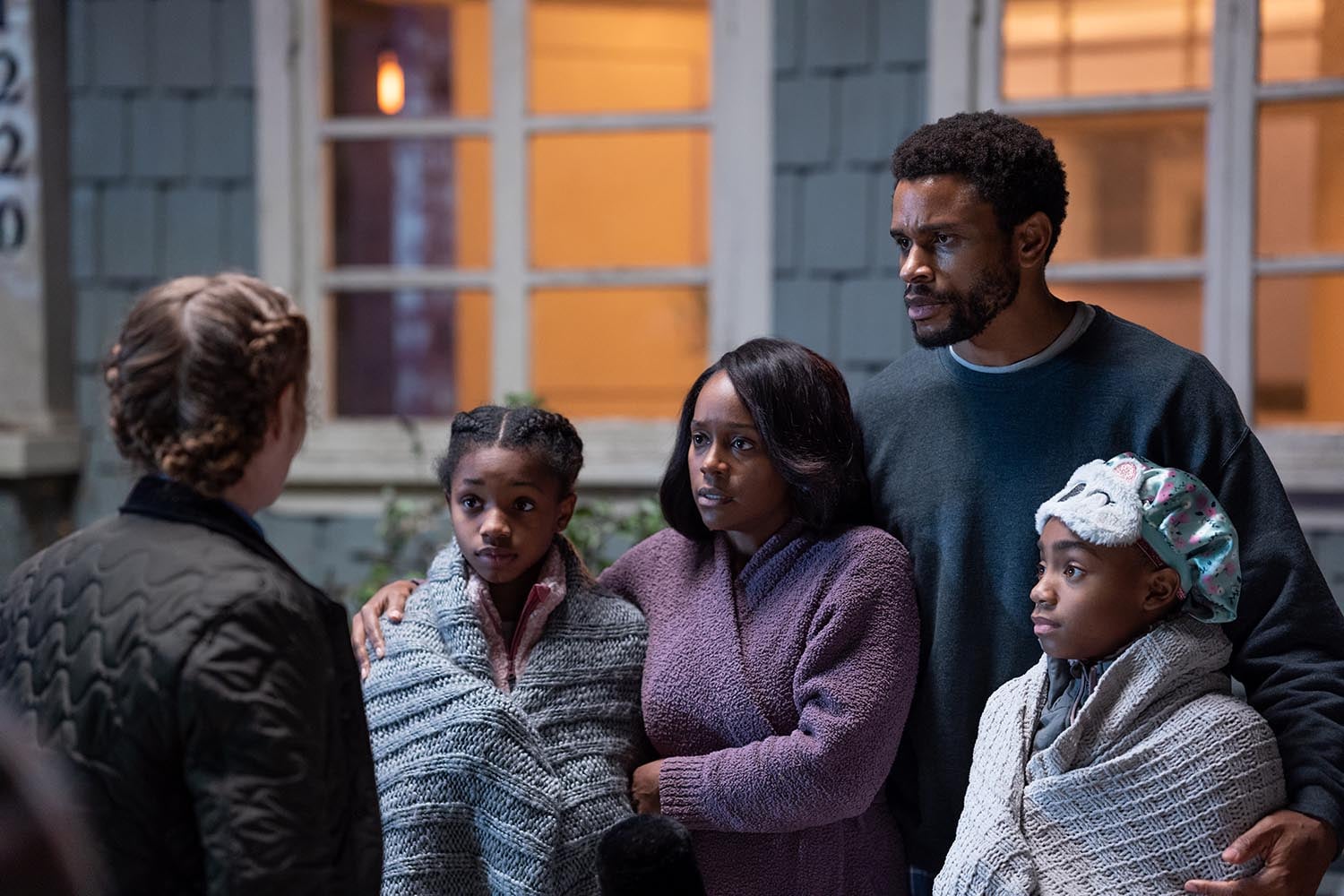
With The Knife, Nnamdi Asomugha turns a night of domestic crisis into a taut moral thriller about the slipperiness of truth. The film unfolds in near-real time, tracing how a Black family must cope with the fallout of their choices after a woman is discovered in their kitchen and ends up bloodied on the floor with a knife in her hands.
Written by Asomugha and Mark Duplass, The Knife begins in tranquil domesticity as Chris (Asomugha) recalls in voiceover his grandmother’s warning that “our choices determine our future.” As he says good night to his daughters Ryley (Aiden Price) and Kendra (Amari Price), he deflects the sting of them agreeing that he smells like beer, then slips into bed with his wife, Alex (Aja Naomi King), as their newborn child sleeps in a crib next to them.
Hours later, Chris wakes to a sound, and after heading downstairs with a pocket knife, he finds an older woman (Lucinda Jenney) standing inside the kitchen. Chris tells her that she’s in the wrong house, and after she eventually turns, the film cuts to Alex, who, upon entering the kitchen, discovers Chris hovering over the woman. Then, once Ryley and Kendra enter, we see that the woman has been stabbed. Soon, the baby’s cries from the bedroom are punctuating Chris and Alex’s whispered strategizing over what to tell the cops. Chris can’t remember exactly what happened, and in a snap decision, Alex puts the pocket knife in the woman’s hand.
From here, The Knife operates as a chamber piece that stews in suspicion. An Asian-American officer (Manny Padilla) arrives on the scene, then a white detective, Carlsen (Melissa Leo), whose words are ominously cloaked in neutrality. “There are no wrong answers here, as long as it’s the truth,” she claims. The pointed nature of the scenario is unmistakable: a Black family under scrutiny, and law enforcement riven along internal lines of race, gender, and power.
The fraught nature of the interrogation, as the members of the family try and sometimes fail to protect one another, is the film’s centerpiece. As she’s interviewed, Ryley mentions the beer on her father’s breath and that he “panicked” upon seeing the woman. The word hits Carlsen, who suspects that Chris may have stabbed the woman with his own knife, like a wrecking ball. Then, her questioning of Kendra prompts flashes of the truth in the girl’s mind, but Kendra denies her mother’s manipulation of the crime scene despite Carlsen’s suggestion of Alex’s tampering.
Watching The Knife, it’s sometimes hard to shake that its preoccupations feel like manipulations—that the characters’ actions are the handiwork of puppeteers behind the camera. The police swing between the menacing and the compassionate, the threat of violence always thick in the air. At one point, as Chris rushes into the living room from the front lawn and the police draw their weapons on him, it can feel as if we’re at the mercy of filmmakers who are aware of the charged nature of the material and are teasing us with the possibility of where things can go.
But at least the script generally avoids blunt sermonizing on race and class, focusing instead on how fear breeds invention—how a rash act of self-preservation ripples outward and causes lasting harm. The Knife also captures how interrogation pressure corrodes memory, offering an implicit critique of eyewitness testimony as reliable evidence in police investigations.
The overriding suspense here is largely created by watching truth become negotiable, and through the small, plausible distortions of the truth that people come up with when survival instincts kick in. That the film can build sustained tension, make each of its characters’ actions feel consequential, and finish before some thrillers hit their midpoint is a modest triumph.
Since 2001, we've brought you uncompromising, candid takes on the world of film, music, television, video games, theater, and more. Independently owned and operated publications like Slant have been hit hard in recent years, but we’re committed to keeping our content free and accessible—meaning no paywalls or fees.
If you like what we do, please consider subscribing to our Patreon or making a donation.