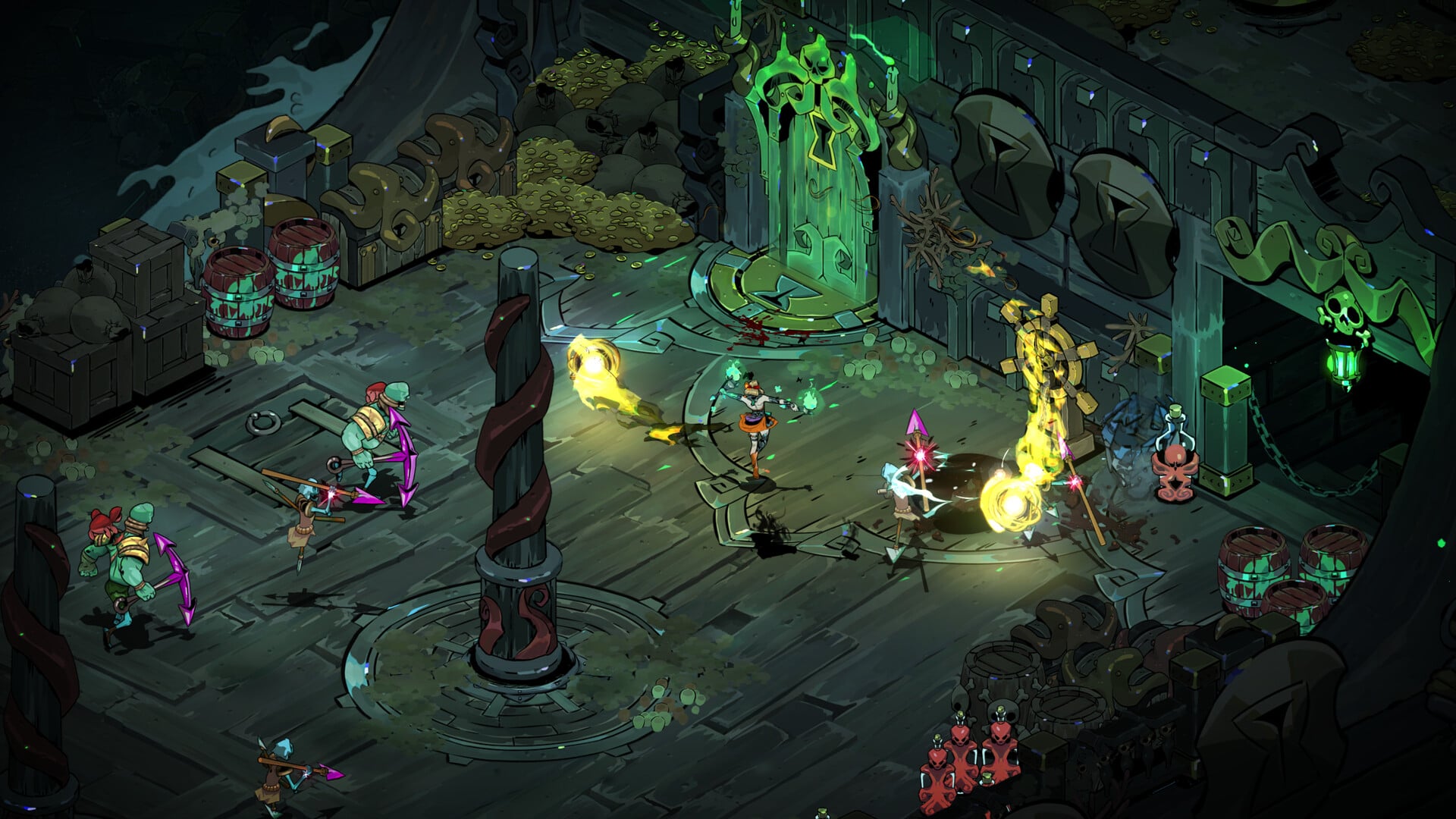
Odysseus, so goes the tale, was shipwrecked while sailing home from the war in Troy and held captive by the nymph Calypso. For seven years he wept on her impossibly beautiful island. Imagine the surprise of the goddess when Hermes, delivering the decree of Zeus, bid her release the master tactician. “I cared for him and loved him,” Calypso says, in Emily Wilson’s translation of The Odyssey. “I vowed to set him free from time and death forever.”
Time and death, death and time—Supergiant Games would have us shatter those shackles. In Hades, Zagreus, prince of the underworld, rebelled against his father, the lord of the dead. Now, in Hades II, another heir to hell’s throne sets her sights further up the family tree. The sequel sees the witch Melinoë, Zagreus’s deft and self-possessed sister, strive to kill their grandfather: Chronos, the titan of time, who’s conquered Hades and turned his forces on Olympus.
Where roguelite design often feels tacked onto games, suggesting depth without doing much digging, Hades II’s use of the form compellingly evokes the oral tradition of Greek mythology. Each run—replete with delightfully varied boons from the gods, lyrical narration by Homer himself (voiced by the always transportive Logan Cunningham), and confrontations of both dramatic and mechanical intensity—becomes a fresh retelling of the legend of Melinoë.
Some say she slew Chronos with an axe so immense she had to drag it, sparking, along the ground; others insist she did the deed with dagger and sickle in hand, the blades booming with explosions like kindling in Hephaestus’s forge. (May we all enjoy the dizzying highs of the upgrade combo that leaves a fiery trail in Melinoë’s wake and hurtles a swirling orb of water forward when she hits the brakes. What a lovely mess.)
Overly familiar runs are rare—a credit not just to the range of abilities on offer, many of which reconfigure Melinoë’s combat style in refreshing bursts, but to the myriad spontaneous moments that grant the world a remarkable sense of lived-in texture. If you ask the enchantress Circe to enlarge Melinoë, augmenting her strength, an upcoming boss may comment on her beefier build. If, when lucky enough to be visited by Athena, you loot the room before addressing her, she might ask, “Can this not wait?” And don’t you dare hit pause while brawling with Chronos, lest he chide you, with the menu still up, for presuming to control time.
Melinoë’s descent into Tartarus would have been a blessing on its own, but Hades II also features a second route, which sends our hero to the surface. There awaits the miracle of even more entrancing music by Darren Korb, the score a raging squall that grows increasingly discordant as you scale Olympus’s peaks. (Your faceoff with a famed cyclops features a ripping saxophone solo performed by Sam Gendel.) A new cohort of eccentric figures roams the alternate path, with a ferocious and depressed Heracles proving a standout, a champion surrendered to doing his divine kin’s dirty work.
The depiction of that most formidable son of Zeus embodies the tonal shift of Hades II, which dials down its predecessor’s soapy charm—what with the whole pantheon on the same page this time around—and leans into tragedy. Heracles has ceased hoping for an invitation to his father’s halls. He’s insufficiently pure, not perfectly destructive enough, to walk among the gods. The warrior’s plight, like the game’s historical contours, is given shape diegetically: When he intervenes in Melinoë’s battles, he fights beside her, but when Athena lends her aid, there’s no more fighting left to do. Her power instantly rends hordes asunder.
Melinoë, however, can make it to the top of Olympus. But when she does, unease gnaws at her triumph. The gods commend her bravery and skill. They deny having ever doubted her. Then, with their young relative’s purpose fulfilled, if only temporarily, they nudge her back to her home between planes, where she diligently returns to her labors. Would that Melinoë, at some point in her long quest to fell Chronos, stopped to wonder: What comes after time and death?
This game was reviewed with a code provided by Supergiant Games.
Since 2001, we've brought you uncompromising, candid takes on the world of film, music, television, video games, theater, and more. Independently owned and operated publications like Slant have been hit hard in recent years, but we’re committed to keeping our content free and accessible—meaning no paywalls or fees.
If you like what we do, please consider subscribing to our Patreon or making a donation.