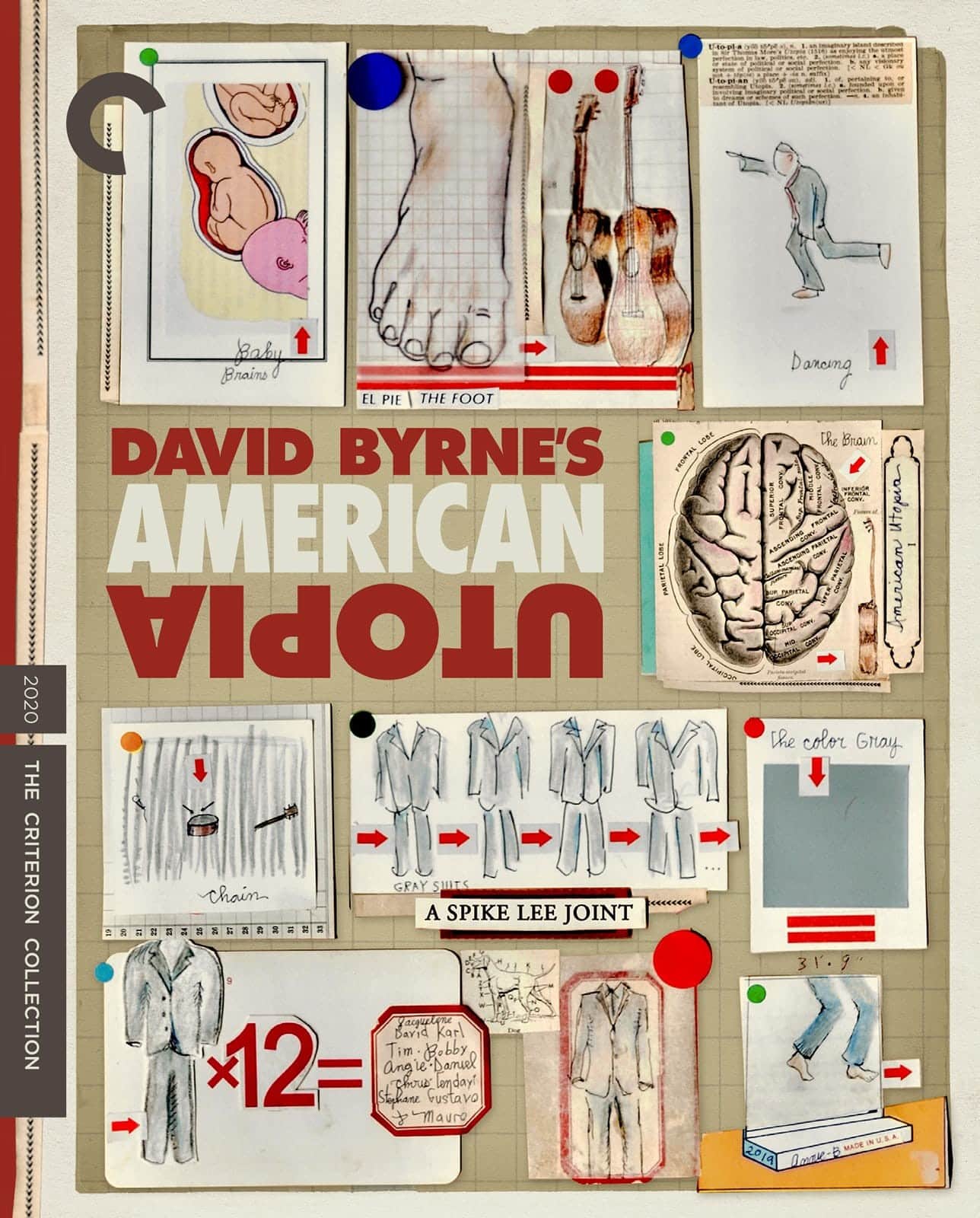
 “Thank you for coming. Thank you for leaving your homes,” David Byrne says when first addressing the audience in Spike Lee’s filmed version of the musician’s world tour turned Broadway show American Utopia. An ironic statement in 2019 was inadvertently cast in a radically different, altogether more earnest light a year later. Byrne, of course, is the central figure in one of the greatest concert films of all time, Stop Making Sense, and one wonders if Lee felt any trepidation at the prospect of working in the long shadow of Jonathan Demme. If he did, though, there’s no sign of it here, as the filmmaker has crafted a concert movie nearly the equal of the elephant in the room, one whose joyous celebration of its singular subject is among the year’s most invigorating works.
Lee’s dynamic visual sense initially takes a back seat to merely capturing the theatricality inherent to Byrne’s production. American Utopia opens with a bird’s-eye view of Byrne, a prop brain before him on a table. The camera then cuts to an eye-level view of the singer, and as he walks around the stage, scrutinizing the brain in his hands as he sings “Here,” curtains of reflective beads rise from the floor, enclosing Byrne and his dancers on three sides. Not unlike Demme, Lee tends to avoid audience shots in favor of isolating the paradoxically intricate minimalism of Byrne’s mildly surreal stage design and choreography.
At times, though, Lee flexes his visual rhetoric to highlight the intricacy of the show’s choreography, his camera suggesting a moving fourth wall. “Everybody’s Coming to My House” arrives at a momentary pause during which the troupe of dancers collapse into a mass of bodies, at which point the camera rapidly pushes forward into Byrne’s face (shades of John Wayne’s introduction in John Ford’s classic western Stagecoach). The harsh, electronic stomp of “I Dance Like This” inspires Lee to mimic old industrial music videos by employing black and white, strobe effects, and rapid-fire cutting. Most endearingly, “Burning Down the House” appears to bring out the fan in the director, as some shots are taken from the theater balcony, framed from the perspective of a giddy audience member capturing the performance on their phone and unconcerned with getting the framing just right.
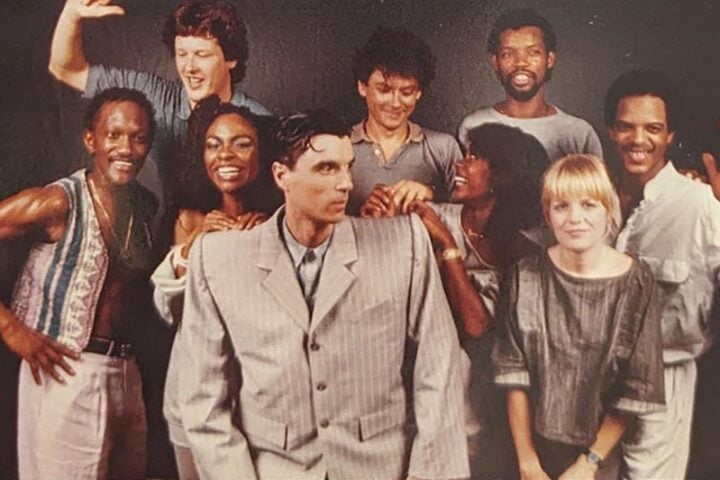
Stop Making Sense famously narrativized the Talking Heads story by starting with Byrne humbly taking the stage alone and gradually being joined by more and more of his bandmates. This stage show plays on that idea by having the backup dancers and musicians constantly appear and disappear around Byrne, circling him in ways that, in classic Byrne fashion, make American Utopia as much a one-man show as a vast ensemble piece. There’s a certain irony to Byrne belatedly learning to be a more generous collaborator as a solo artist than he ever was as an equal in an ostensibly collaborative band. It’s apt, then, that Lee sees the show’s performers less as a backdrop for a marquee star and more as a collective. The subject of his camera’s focus tends to change in relay fashion, moving with one player until getting sidetracked to follow someone else as they dance past. Shots tend to begin or end with Byrne as the dominant person in the frame, but Lee plays up the dancers’ choreography in between.
Both Byrne’s choreography and Lee’s focus as a director not only reckon with the legacy of Stop Making Sense, they find ways to update its rich undercurrents of social commentary. Byrne’s dance moves in Demme’s concert film subtly incorporated parodies of ’80s excess, from exercise-video-craze dances to the use of a too-big suit as a metaphor for the hollow promise of Reaganomics. Here, the robotic movements of Byrne and his performers, in their matching gray suits, become a kind of interpretive dance about gentrification, homogenizing an international, diverse roster of performers for a show performed on Broadway.
Despite this satirical undercurrent, American Utopia doesn’t wallow in cynicism, and the closing stretch breaks through the show’s many layers of postmodern impunity for a stirring plea for a better world. Byrne covers Janelle Monáe’s “Hell You Talmbout,” an enraged lament for Black people slain by cops and white supremacists that’s given added emotional impact by cutaways to blown-up photographs of the young men and women named in the song.
And in a testament to this seemingly perpetual cycle of violence, and editor Adam Gough fills the space after the song ends with photographs of others killed since this performance was filmed, including Ahmaud Arbery, George Floyd, and Breonna Taylor, alongside a wall of text printing a full screen of names that point to an urgent message at the bottom of the frame that screams “AND TOO MANY MORE.” The a cappella “One Fine Day” doubles down on the feeling of Byrne fading into his sizable cast, surrendering his ego to collaborators that he takes time to name and credit for pulling off the show’s unorthodox staging.
Byrne’s openness climaxes in the encore, the Talking Heads song “Road to Nowhere,” during which he and the band leave the stage and wade throughout the audience. As they march through the aisles, the camera switches from professional hi-def to consumer-grade, suggesting a fan of the show now marching with the band, leading to a curtain drop in which both the musicians and audience are left on the other side of the fabric, the lines between performer and audience dissolved in a moment of bliss. In a year in which the coronavirus pandemic has devastated both the theatrical and live-music industries, American Utopia feels as much like a balm as it is a surprisingly direct call to political action and social betterment.
Image/Sound
Criterion’s transfer, from a new 4K digital master supervised by director of photography Ellen Kuras, features a sharp image that really highlights every exuberant movement and facial expression in the film. This isn’t exactly a colorful film, but the skin tones are naturalistic and there’s more than enough variety in the color shades to accentuate the subtlety in the lighting throughout. It’s the 5.1 surround audio, though, that’s the real selling point, capturing the power and energy of all the live instruments with impressive depth and resonance.
Extras
A new 55-minute documentary featuring Spike Lee, David Byrne, and numerous collaborators delves into the various artistic choices that helped bring American Utopia to life on the stage and on film. Byrne elaborates on his process and what he hoped to convey through this performance, and from the words of his collaborators, it’s clear that they shared his vision. We also get a 2020 conversation between Byrne and Lee where they talk about how they met and their ideas about how to make the stage show cinematic, as well as share some amusing behind-the-scenes stories. Lastly, there’s a foldout booklet with an appreciation by critic Jia Tolentino and an essay by critic K. Austin Collins, who discusses Byrne and Lee’s experience in live performances and what made their pairing on this project so perfect.
Overall
If there’s a path toward an American utopia, it feels as much like a climb today as it did back in 2020, but Criterion’s 4K release of this ebullient and optimistic concert film serves as a potent reminder that whatever the outcome, we all play a part in making it happen.
Since 2001, we've brought you uncompromising, candid takes on the world of film, music, television, video games, theater, and more. Independently owned and operated publications like Slant have been hit hard in recent years, but we’re committed to keeping our content free and accessible—meaning no paywalls or fees.
If you like what we do, please consider subscribing to our Patreon or making a donation.