When I revisited The Phantom of the Opera, the longest running show in Broadway history, in its final months at the Majestic Theatre in early 2023, I was surprised how musty the production had become. Twenty years after I’d last seen it, the staging seemed stilted, the acting felt like something out of an early 20th-century operetta, and even the special effects had been dwarfed by decades of technical advancement elsewhere.
But the score, at its passionate and melodramatic heights, is Andrew Lloyd Webber’s best, and only two years later, that music has a new ingenious and most alive production, the immersive Masquerade, filling out all the floors, from rooftop to basement lair, of a creepy building just west of Carnegie Hall. Walking a tightrope between dramatic musical work and theme-park attraction, Masquerade is a mightily inventive twist on Lloyd Webber’s classic stage musical.
The world of Masquerade has been constructed with similar attention to detail as recent immersive pieces like Sleep No More and Life and Trust: As the audience moves from glitzy ballroom to eerie organ chamber to opera house dressing room, it’s like stepping through the familiar story itself. The visual experience is reminiscent of nothing so much as exploring the recreated Harry Potter sets at the Warner Bros. Studio Tour London.
While Sleep No More offered audiences much autonomy, allowing them to follow whichever actors they chose and explore wherever they wanted, Masquerade has a carefully orchestrated flight path, designed to get each cohort of 60 or so audience members through the plot without ever running into the other five performances of the show—referred to as “pulses”—taking place at staggered intervals each evening. Many of the show’s delights still arrive, though, in the meticulously timed discovery of each space, with the production and scenic design constantly surprising. Here we are above the opera stage! Now we ascend to a rooftop mausoleum!
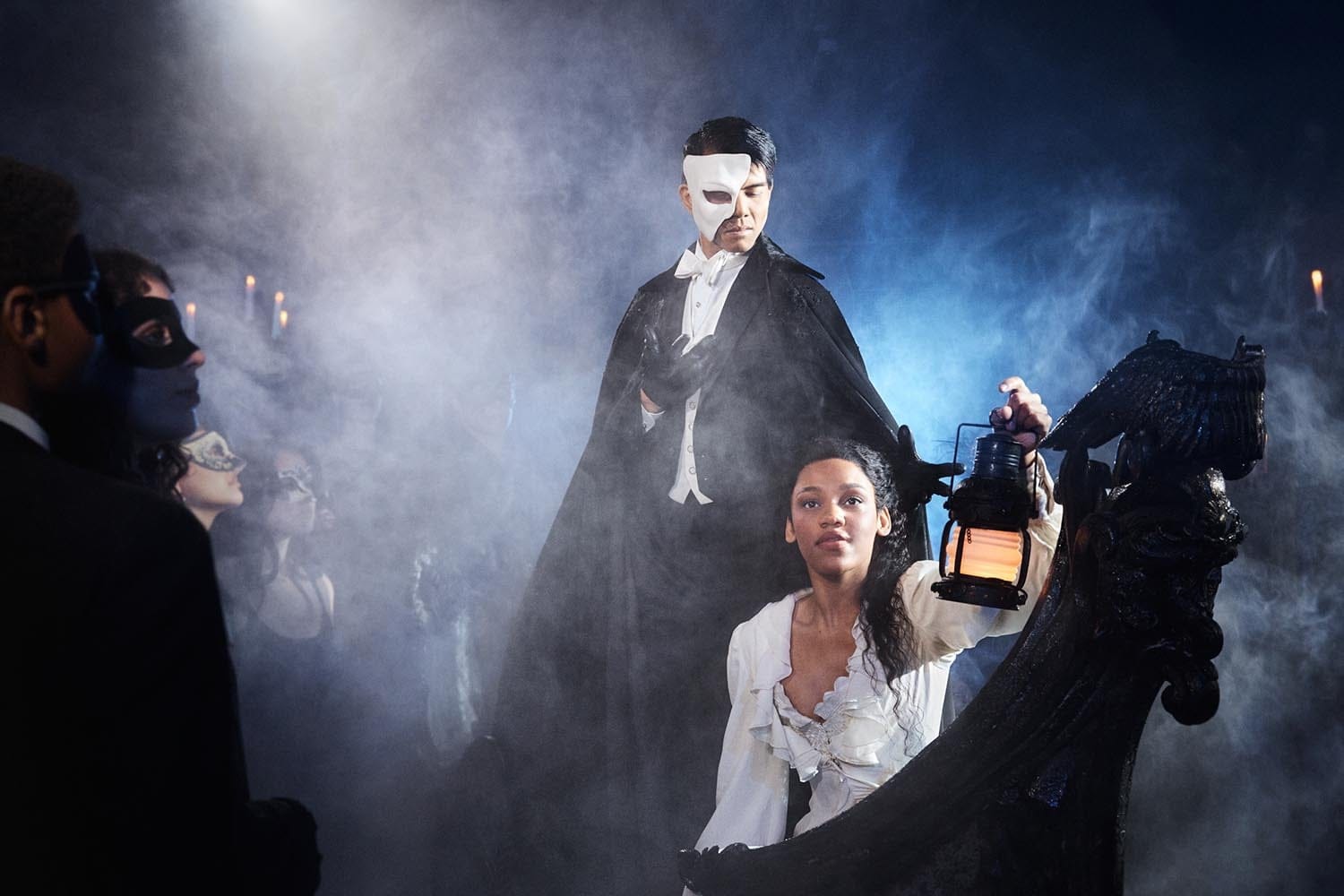
Audiences are instructed to dress extravagantly and wear masquerade masks, as they’re ostensibly attending a ball hosted by the Phantom himself. Compressed to two hours with several scenes out of order, the story remains that of chorus ingénue Christine Daaé (Haile Ferrier) and her rise to the upper echelon of the Paris Opera, thanks to a few vocal lessons and a great number of threats from the Phantom (Telly Leung), a composer and inventor with a facial disfigurement who haunts the tunnels beneath the opera house. The Phantom has the hots for Christine, but she’s just reconnected with a childhood crush, the opera patron Raoul (Francisco Javier Gonzalez), who hopes to rescue Christine from her weird underground relationship.
As directed by Diane Paulus, the performances are seldom subtle, especially at close quarters, but the cast brings the requisite heat and vocal stamina for Lloyd Webber’s strenuous score, sung to pre-recorded instrumental tracks. Making her New York debut, Ferrier delivers a deeply felt Christine who seems to grow in strength alongside her blossoming voice. There isn’t much room for star-is-born moments in a show like this, where actors often play second fiddle to environment, but Ferrier still electrifies among the chandeliers.
Besides, it’s not so easy to anoint a breakout star when five out of six audience members at Masquerade aren’t seeing Ferrier’s Christine at all. There are six Phantoms and six Christines, but the three Raouls bounce between pulses and other actors rotate roles. Most wildly, each pulse’s Meg Giry, Christine’s confidante, will play Christine in the next pulse. Which means that Ferrier, in the midst of Christine’s psychosexual drama, must briefly leap out of character to play a scene opposite a different Christine.
None of that, of course, is visible to a single Masquerade audience. But understanding the show’s mechanics—which “Phans” on the show’s sub-Reddit have pieced together through multiple performances in excruciating detail and, presumably, at excruciating expense—makes Masquerade more wondrous. That such a feat of exacting operational precision can still conjure up such sense of graceful atmosphere is the show’s greatest achievement.
Where Masquerade falters isn’t in its adventurous, peripatetic storytelling but in the reworking of the story itself. This reimagining of The Phantom of the Opera extends Lloyd Webber’s 20-year attempt to redeem the Phantom, first in the 2004 film’s sympathetic flashback to his tortured boyhood as a circus freak and then in the 2020 sequel musical Love Never Dies, in which Christine realizes the Phantom is the father of her child and her true soulmate.
Following in the film’s footsteps, Masquerade’s extended flashback featuring the Phantom’s younger self goes on and on, even repurposing a song performed by Minnie Driver as a credits track, “Learn to Be Lonely,” within the story as an anthem for the Phantom’s humanity. But upending the character’s standard reputation as the pervy antagonist of a Stockholm syndrome horror plot just isn’t persuasive, even if there’s an added sequence making it clear that one of the Phantom’s murder victims was a backstage predator and, therefore, had it coming. It’s unconvincing that Christine’s romantic allegiances are highly ambivalent now, with the staging of the final scene suggesting that she genuinely can’t bear to leave her assailant behind.
By demanding the audience feel sorry for—and, ipso facto, not afraid of—the Phantom, Masquerade drains the story of its rightful frights. Leung sings the Phantom’s high-flying music muscularly, but he never seems all that threatening, especially when buddying up to audience members in ill-advised moments of interaction. (He gently stroked my mask while we rode an escalator out of his lair.) Elegance, not horror, is the prevailing ambience. Still, Paulus converts that aggressively compassionate reframing into a moving final gesture of communal recognition that involves the audience in the Phantom’s journey towards self-acceptance.
Even if it’s not remotely scary, Masquerade is inexhaustibly cool. Anyone with even a passing affection for Lloyd Webber’s stage musical will be awed by watching from the shore as the Phantom’s boat sails across his underground lake during the title song or in standing just outside the crash zone for the chandelier’s famous fall. Across its reimagining of The Phantom of Opera, Masquerade offers a refreshingly vibrant music of the night.
For more information about Masquerade, click here.
Since 2001, we've brought you uncompromising, candid takes on the world of film, music, television, video games, theater, and more. Independently owned and operated publications like Slant have been hit hard in recent years, but we’re committed to keeping our content free and accessible—meaning no paywalls or fees.
If you like what we do, please consider subscribing to our Patreon or making a donation.