For a ghost story, writer-director Ratchapoom Boonbunchachoke’s A Useful Ghost strikes a tone that’s far from spooky. From the score’s harp melodies to the deadpan performances, the serene flatness that pervades the film couldn’t be better suited to its hybrid of absurdist black humor, Buddhist cosmology, and Brechtian alienation effect. As the glue holding together a fiddly plot, this unlikely mood is saved from monotony as much by its sheer incongruity with the genre as by a mold-shattering final sequence.
The gothic device of nested stories does some heavy lifting in Boonbunchachoke’s feature-length directorial debut. The frame story, set in the aftermath of the Thai military crackdown on pro-democracy protests in 2010, follows a self-identified “academic ladyboy” (Wisarut Homhuan) as he buys a vacuum cleaner to deal with all the dust filtering into his apartment, generated by the demolition of a nearby city square to make way for a shopping mall. When the appliance’s unmistakably human coughing keeps him awake at night, he calls in a repairman (Wanlop Rungkumjad), who informs him that it’s the product of a haunted factory.
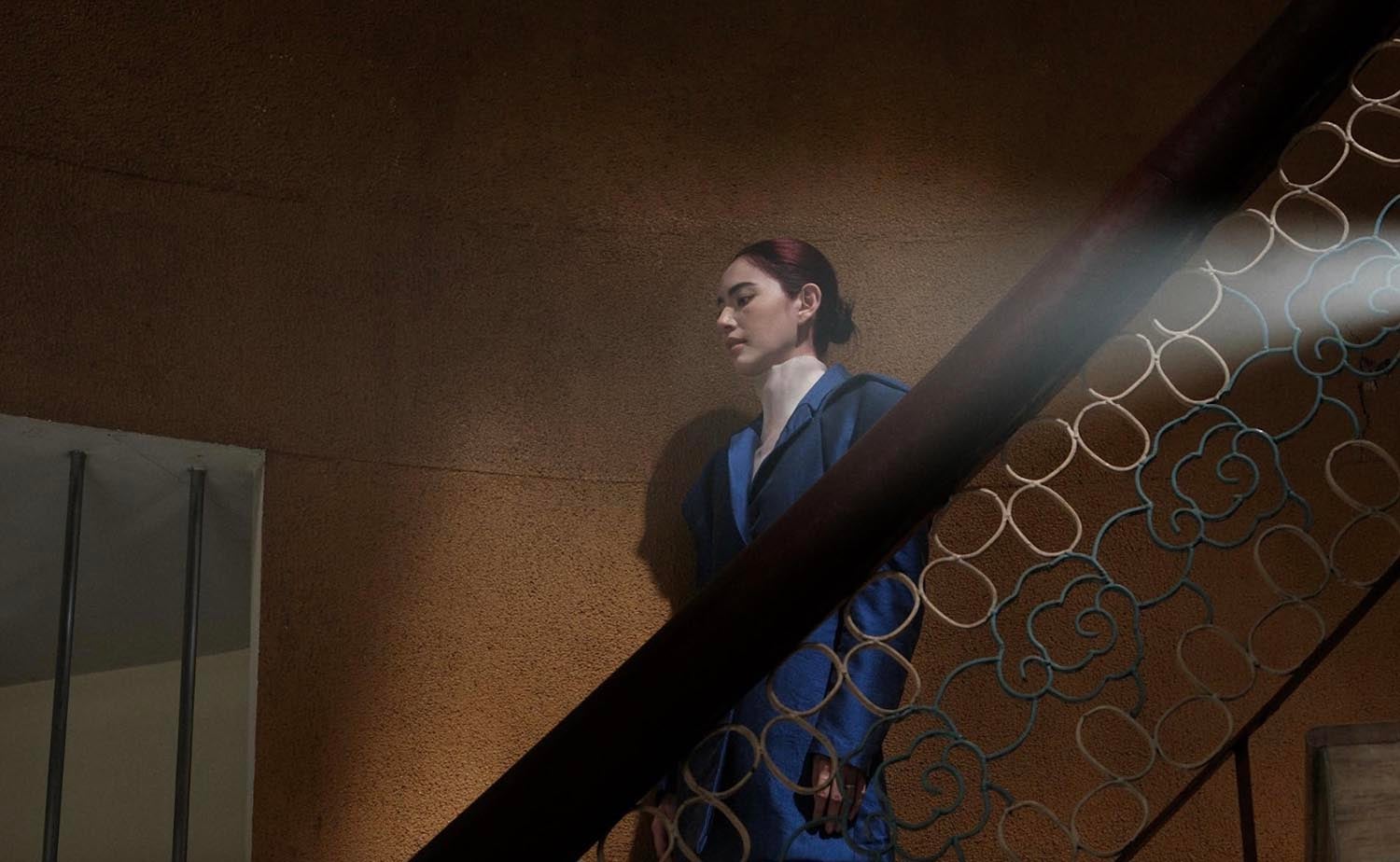
This kicks off a story within the story involving a slew of haunted commodities, including another vacuum cleaner possessed by Nat (Davika Hoorne), the dead wife of March (Wisarut Himmarat), whose mother, Suman (Apasiri Nitibhon), owns the factory in question. March’s refusal to forget Nat in spite of electroshock therapy grants her a unique permanence, which Suman—and, later on, the prime minister—exploits in order to infiltrate factory workers’ dreams. As a consequence, outer and inner narratives begin to merge.
Boonbunchachoke takes magical realism to a point where the characters aren’t only unfazed by magic, their reactions to just about everything are muted. The Kaurismäkian acting, no mere affectation, shows how capitalism strips people of agency while conferring it on commodities. Hoorne especially stands out for the expressiveness she wrings out of microexpression. Those rare moments where emotion breaks through, as in a shot where she slowly fades away while gazing at a husband who’s finally forgetting her, are that much more poignant as a result.
While A Useful Ghost succeeds in fitting two or even three films’ worth of plot into its 130-minute runtime, it makes for a somewhat overstuffed, unfocused whole. The conceit of the haunted vacuum cleaner, for instance, is abandoned halfway through. And while he takes the ghost story in fresh, intriguing directions, Boonbunchachoke seems too at pains to deliver a political message that leaves little room for interpretation.
At times, the film comes across as a fictional encoding of hauntology and reification. While there are exceptions, such as a dream sequence in which a worker assembles a double of himself, the symbolism is largely overt. Despite its radical sympathies, A Useful Ghost overexplains itself, undercutting its own intent by treating us as passive receptacles of meaning.
That said, Boonbunchachoke’s defense of historical memory couldn’t be more timely. Those in power, the filmmaker forcefully suggests, are always on the hunt for “good” ghosts, whom they can make “useful” in directing attention away from massacre and exploitation. Hauntings, paradoxically, can only be dispelled by a continual effort of bringing history, however traumatic, back to the surface. As A Useful Ghost’s long-deferred catharsis renders unmistakable, nothing short of revolution can redeem the restless dead.
Since 2001, we've brought you uncompromising, candid takes on the world of film, music, television, video games, theater, and more. Independently owned and operated publications like Slant have been hit hard in recent years, but we’re committed to keeping our content free and accessible—meaning no paywalls or fees.
If you like what we do, please consider subscribing to our Patreon or making a donation.