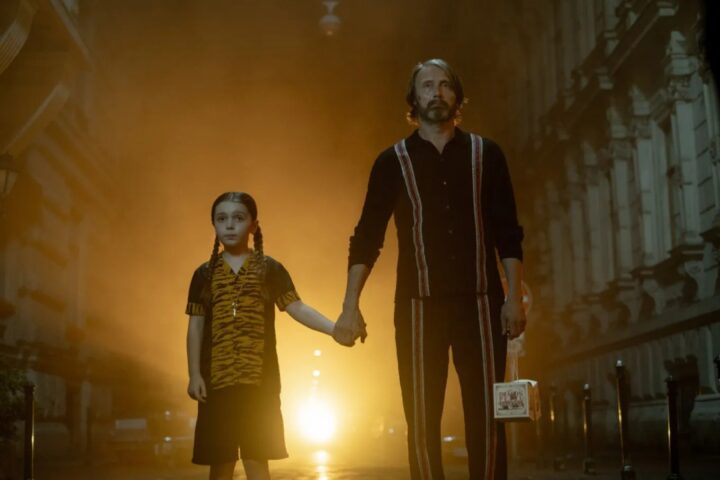

On paper, anime master Hosoda Mamoru’s Scarlet sounds positively electrifying. The film reworks Hamlet as a fantasy epic about a young princess (Ashida Mana), after winding up in a realm known as the Otherworld, seeking revenge against her uncle Claudius (Yakusho Koji) for killing her father and usurping the throne. Traversing a land unstuck in time that contains souls in limbo from various years of human history, Scarlet must find a way back to the land of the living, or at least drag her uncle into this world with her.
This promising setup stumbles, though, with a narrative that rushes through its hero’s quest at such a breakneck speed that whatever growth Scarlet experiences feels unconvincing. The young woman, introduced as a demure princess in 16th-century Denmark, instantly morphs into a deadly warrior, which turns many of her duels with attackers into a foregone conclusion.
Hosoda’s film more successfully handles the relationship that forms between Scarlet and Hijiri (Okada Masaki), a paramedic from the 21st century whose dedication to doing no harm leads him to tend to the injuries of their assailants, much to Scarlet’s disgust. The narrative’s Ophelia stand-in, Hijiri urges the princess to let go of her hatred, and Scarlet’s slow thaw in the face of his indefatigable humanism reveals itself as the film’s true emotional core.
Hijiri’s gentle appeal to the better angels of Scarlet’s nature, though, is swiftly overrun by more bluntly stated illustrations of the film’s moral theme. The nebulous nature of the Otherworld’s reality is complicated by the arrival of Claudius’s conspirators, who seek both to finish the job of killing Scarlet and to find a fabled stairway to heaven that the denizens of the land think exists in some remote location. One of these attackers, a bullishly reimagined Polonius (Yamaji Kazuhiro), claims that he heard the murdered king’s final words as an invocation to “forgive.”
Setting out to illustrate the difference between planes of existence, Hosoda renders the real world in traditional two-dimensional animation and the Otherworld in three-dimensional animation. But for the first time in his storied career, Hosoda’s animation is so photorealistic that it ventures into the uncanny valley, particularly in the way that character movement looks disjoined against perfect-seeming backgrounds. The awkward clash between the elements of the frame recalls the primitive limitations of full-motion video games of the 1990s. For a film driven so much by its action, this alienating effect undermines the epic sweep of the story.
In quieter moments, the animation is more successful, drawing our eyes toward varied landscapes in the Otherworld and small details concentrated in facial expressions. These moments also lead to some lovely exchanges, as in a scene where Scarlet and Hijiri stumble across people from various countries and eras who’ve created a community united against the indignities of the Otherworld. Hijiri provides first aid to injured villagers, and the way they repay his kindness in moments of repose speaks far more deeply to Hosoda’s desire for a better world than the rather confused depiction of Scarlet’s desire for revenge against Claudius.
Since 2001, we've brought you uncompromising, candid takes on the world of film, music, television, video games, theater, and more. Independently owned and operated publications like Slant have been hit hard in recent years, but we’re committed to keeping our content free and accessible—meaning no paywalls or fees.
If you like what we do, please consider subscribing to our Patreon or making a donation.