From the start of his career with the direct-to-video Hellraiser: Inferno and onward through The Exorcism of Emily Rose, Sinister, and The Black Phone, Scott Derrickson’s understanding of sin and repentance have colored his work in ways both vital and strange. But Black Phone 2 might be his most blatantly devout film to date—a faith-based supernatural slasher that expands the first film’s mythos into a realm of frostbitten dream logic.
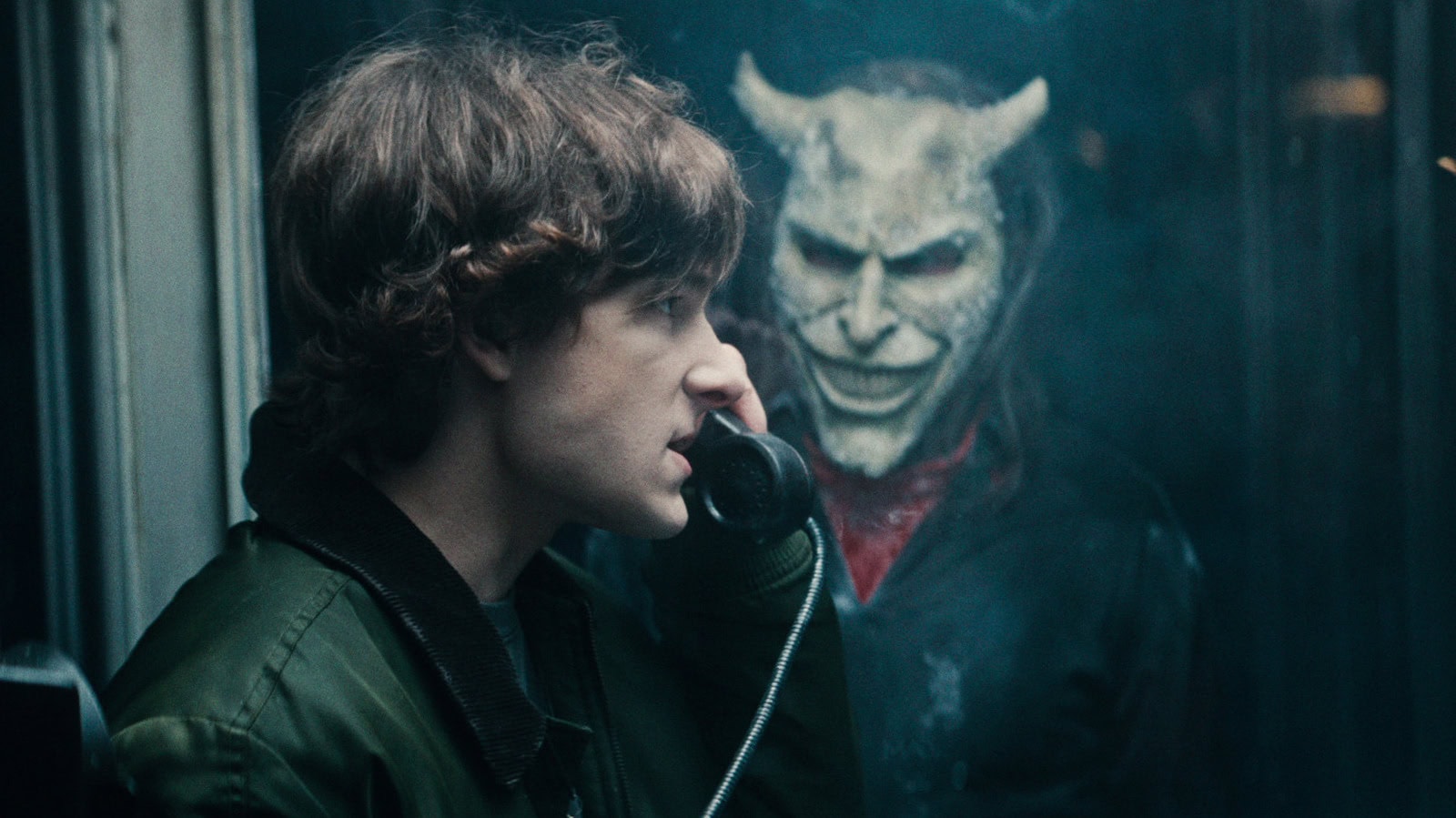
Three years after killing the serial murderer known as the Grabber (Ethan Hawke), Finney (Mason Thames) is a high school student getting into fights, smoking marijuana, and ignoring the spectral calls he continues to receive from every phone booth he passes. His behavior upsets his sister, Gwen (Madeleine McGraw), who’s still grappling with disturbing, pre-cognitive visions, this time of three boys being stalked at a winter camp.
In one such state, Gwen receives a message from her long-dead mother directing her to Alpine Lake, the site of a Christian youth camp nestled in the Rocky Mountains where the woman worked as a counselor in the 1950s. Though initially reluctant to go, Finney accompanies Gwen and her boyfriend, Ernesto (Miguel Mora, returning as the brother of the character he played in the first film), to the camp, only to find himself once again face to face with the Grabber.
Black Phone 2 is an experimentally juiced-up version of the first film, and it glances back to Sinister with a heavy reliance on 8mm footage. Derrickson presents Gwen’s visions as boldly abstracted night terrors that feel like snuff footage spilling over from some somnambulic ghost dimension where tree stumps seep blood and dead boys reach out from across the void. The hisses, pops, flares, and detectable scratches of the temperamental film stock add a tactile old-school creepiness to these sequences. Throughout, Derrickson collapses dreams, reality, past, and present sidelong into a singular cinematic haunted space.
Black Phone 2 does its best to get some distance from the first film’s pedophilic undertones—a choice that makes sense on paper but also somehow leaves it feeling defanged. Here, the Grabber is driven by revenge for his dead brother, the most rudimentary motivating force possible, despite his obvious and continuing obsession with Finney. The first Black Phone could be accused of glossing over the central villain’s obvious unsavory sexual predilections, but the sequel’s approach feels like the scriptwriting equivalent of playing dumb.
Still, this is an unmistakably personal vision. Derrickson has spoken about growing up in a non-religious household and undergoing a conversion experience that’s shaped his life and work, and the themes of adolescent trauma and spirituality cut deep for how lived-in and fully embodied they feel here. Some viewers may bump up against Black Phone 2’s unconcealed Christian bent, but the film is also not in the business of proselytizing. The Grabber calls himself “a bottomless pit of sin,” and this is a film that finds faith in the resilience of its young protagonists, who fall through that blackness to see if they can find the light at the other end.
Since 2001, we've brought you uncompromising, candid takes on the world of film, music, television, video games, theater, and more. Independently owned and operated publications like Slant have been hit hard in recent years, but we’re committed to keeping our content free and accessible—meaning no paywalls or fees.
If you like what we do, please consider subscribing to our Patreon or making a donation.