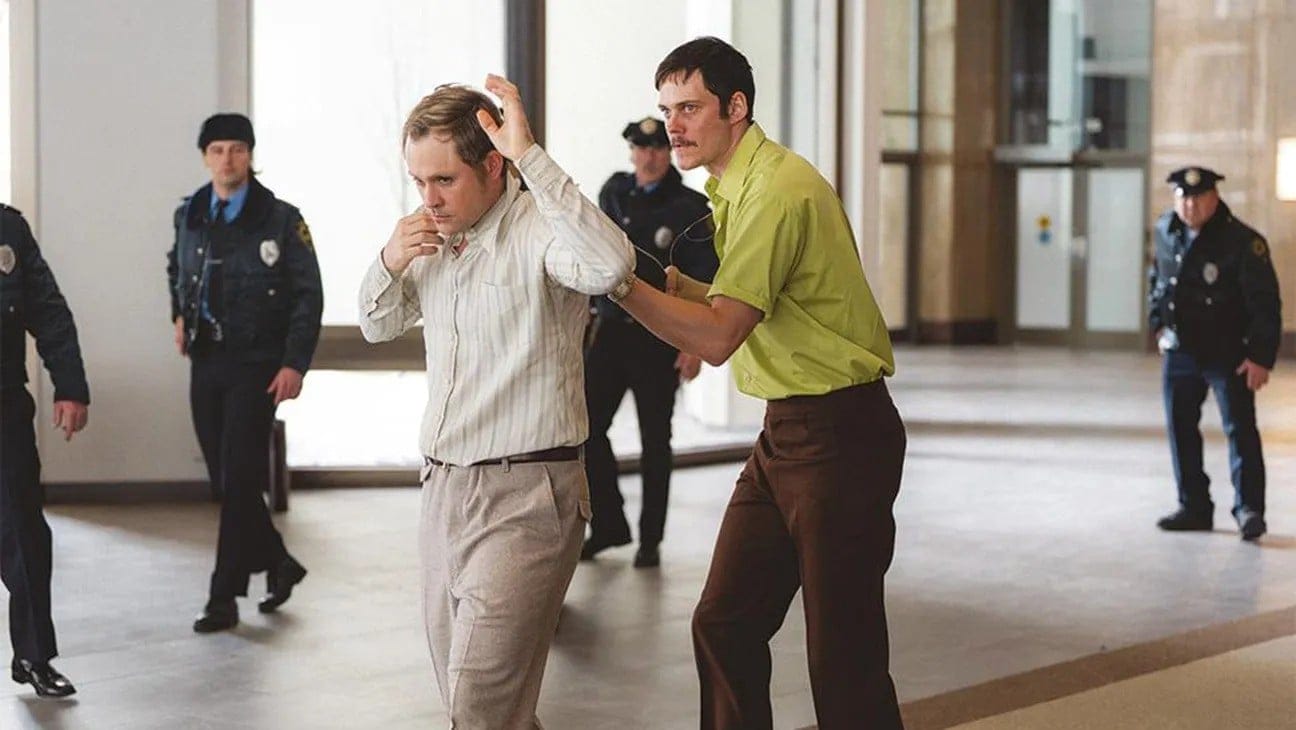
The movies have long recognized the eroticism of being held at gunpoint, and Gus Van Sant cheekily toys with this in Dead Man’s Wire. In the opening scene, a scorned entrepreneur, Tony Kiritsis (Bill Skarsgård), takes Richard Hall (Dacre Montgomery) hostage, demanding a public apology and five million dollars in compensation from the mortgage company that’s wronged him. Tony has rigged a shotgun to the base of Richard’s skull that will fire if the wire noose around his neck is pulled. Tony and Richard will spend the better part of the film attached to each other—sweating, contorting, grappling, heaving.
The physical absurdity of Tony’s plan is merely a textural detail in this breathlessly satirical thriller, which is based on Kiritsis’s 63-hour standoff with the police in 1977, but it’s the kind of human touch that captures Van Sant’s distinctive flair as a filmmaker. Dead Man’s Wire isn’t exactly the decisive comeback that audiences might be expecting, but it’s a memorably wonky take on the real-time and retrospective spectacles we make of crime and punishment.
Tony’s daring abduction quickly draws the attention of the whole of Indianapolis, roping in his detective friend Michael Grable (Cary Elwes), his brother Jimmy Kiritsis (Daniel R. Hill), ambitious young reporter Linda Page (Myha’la), and popular radio DJ Fred Temple (Colman Domingo). At every turn, the media flocks around the sites of this spiraling incident, spinning Tony’s actions to fit their chosen narratives. Some paint him as an avaricious thug, while others regard him as a folk hero. Tony, who shacks up with Richard in his apartment, has almost constant access to these interpretations, which variably stroke and strike his snowballing ego.
At first, Tony’s big stand against a corporation that bleeds everyday people dry is painted as a David-versus-Goliath struggle for justice. Decades of crime narratives depicting perpetrators who act out of desperation have trained us to identify instinctually with the person holding the gun. Van Sant and screenwriter Austin Kolodney play knowingly into these conditioned sympathies, drawing us into Tony’s crusade before peeling back the layers of his psyche.
A pivotal rupture occurs when Tony finally gets M.L. (Al Pacino), Richard’s father and the original intended hostage, on the phone. M.L., unbothered on vacation in Florida, refuses to apologize to Tony, claiming that someone out to make money with no mouths to feed isn’t a real man. “My businesses are my children” is Tony’s habitual rejoinder, a mantra that recasts his ambitions and underlines his conspicuous bachelorhood (his adulation of Colman Domingo’s Fred Temple, too, pushes his neuroses in the direction of latent homosexuality).
The film’s main critical target isn’t the callous capitalism that Tony is set against—these men are blatantly corrupt, and they do “have it coming,” as Tony claims—but the frenzy of opportunistic interpreters and speculators that circle the negotiation like vultures. While nowhere near as structurally audacious as To Die For, its thematic predecessor in Van Sant’s filmography, Dead Man’s Wire is built upon subtle flourishes that complicate its more conventional modes of presentation. Reverse freeze-frames dot the first half, giving the impression of photographs sputtering to life, and strategically placed archival materials remind the viewer that official histories are being written in real time as the story unfolds.
All that said, Kolodney’s screenplay lends considerable humanity to the people in its satirical crosshairs. Richard is conscious of his privilege but shaped by a loveless upbringing; Linda comes off as principled in comparison to the other reporters (who we see repeatedly fumbling takes) even as she doggedly pursues a position in the primetime; and, most crucially, Tony is a figure whose righteousness masks a deeper, and all too human, greed.
But more than his desire for personal wealth emerging from a lifetime of poverty, Tony is obsessed with his image. He continually emphasizes that the apology from M.L. is the most important part of the deal. In the climactic sequence, he parades and emasculates Richard on live television before reading from a prepared statement to set the record straight. It becomes clear that this entire ordeal has been an attempt to resuscitate his self-image on a public stage. The scene is cross-cut with this broadcast’s competition: John Wayne winning a People’s Choice Award, punctuated by clips of his straight shooting met with thunderous applause.
If Dead Man’s Wire adds up to less than the sum of its vicarious jolts and sardonic jabs, it’s perhaps a result of Van Sant’s style fading into the background. He’s always been a capable hired gun—conveying stories he didn’t write with a similar acuity to ones he penned himself—but what buoyed even the most smug passages in To Die For was the unshakable impression of a distinct perspective being asserted behind the camera. Dead Man’s Wire is sturdily directed, but it may leave you wishing that Van Sant had complicated its true-crime spectacle a little more.
Since 2001, we've brought you uncompromising, candid takes on the world of film, music, television, video games, theater, and more. Independently owned and operated publications like Slant have been hit hard in recent years, but we’re committed to keeping our content free and accessible—meaning no paywalls or fees.
If you like what we do, please consider subscribing to our Patreon or making a donation.