Ronald Reagan, Arnold Schwarzenegger, Shirley Temple, Donald Trump—pivoting to politics from entertainment is a longstanding tradition, and not just in the United States. Performers are predisposed to this transition, as they’re used to the pressures and pretenses of the spotlight, but behind every charismatic demagogue is a crack team of handlers and spin doctors even better versed in the currency of a public image. This stage-managing of power is the subject of Olivier Assayas’s The Wizard of the Kremlin, which chronicles the ambitious, artistically inclined life and career of a fictional advisor to Vladimir Putin.
We’re introduced to Vadim Baranov (Paul Dano) via narration by an American journalist, Rowland (Jeffrey Wright), who tracks down Putin’s retired advisor in 2019. (Rowland is a stand-in for Giuliano da Empoli, who wrote the 2022 book of the same name from which the film is adapted.) Their exchange of ideas and information serves as a framing device for unfurling Baranov’s professional history, relayed to us as a series of personal betrayals and moral compromises that catapult him from a creative nobody to a crafty somebody.
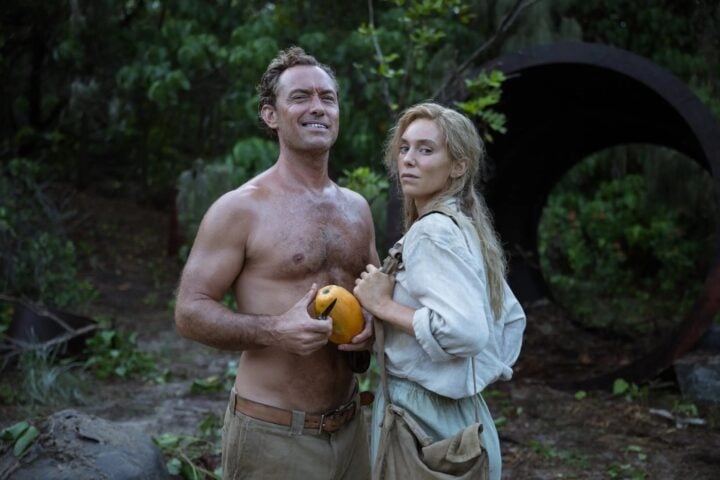
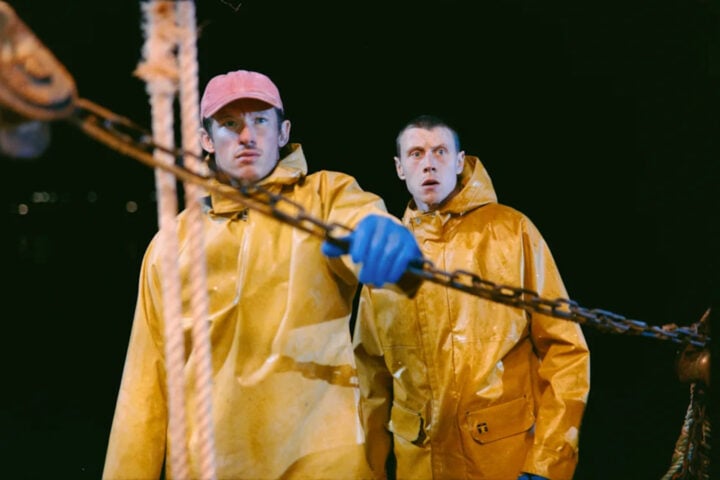
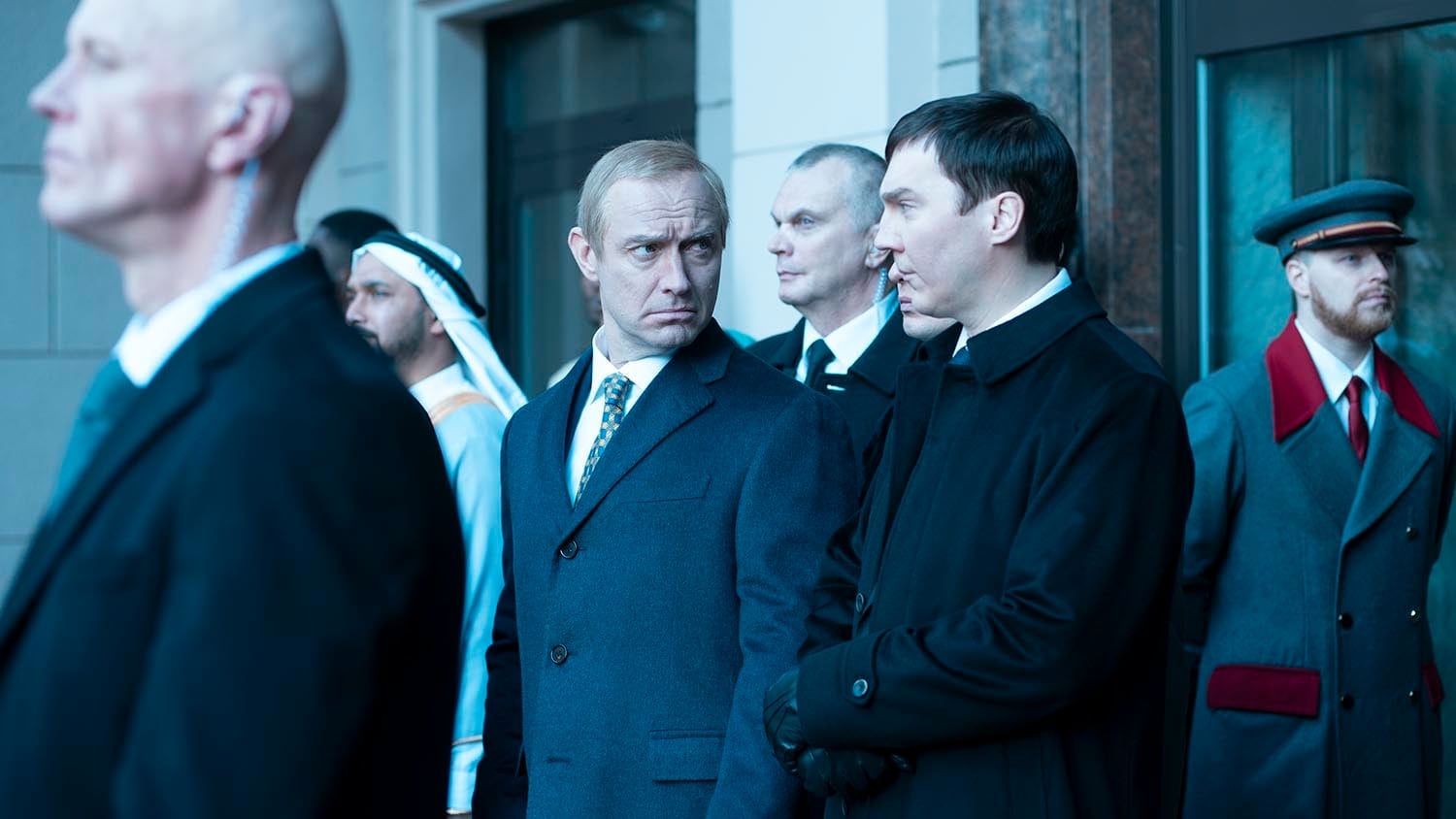
Vadim starts out as an idealistic theater director in the early ’90s and later gets his first taste of power as a TV producer for a state-run network, where he schemes with his boss, Boris Berezovsky (Will Keen), to install a replacement puppet for the aging Boris Yeltsin. It doesn’t take long for him to realize that the ex-FSB director Putin (Jude Law) is no puppet, but Baranov is determined to play an active role in history, and in the wake of his girlfriend, Ksenia (Alicia Vikander), ditching him for their wealthier friend, is fed up with “the artist’s inability to affect reality.” So he helps create a monster. It’s a provocative premise that—uncharacteristically for Assayas—this tediously self-satisfied and leaden film thoroughly squanders.
Anyone can see what attracted Assayas to this story of a creative selling his soul to slake his ego. Many of the French auteur’s films are either mired in the foibles and frailties of tortured, myopic artists (Clouds of Sils Maria, Non-Fiction, Suspended Time, and Irma Vep, both the film and the miniseries), or morbidly intrigued by the everyday scheming of people perpendicular to power (Demonlover, Wasp Network, Carlos), and here’s a story that does both.
But you’d be hard-pressed to find any evidence of passion in The Wizard of the Kremlin, given its striking resemblance to so much streaming sludge. (Take the Disney+ logo that precedes the film as a warning.) Early on, Baranov quips that everything in Russia is gray, and it’s as if cinematographer Yorick Le Saux used the line as a pretext to coat the film in drab, ashy tones meant to signal “Eastern European.” The Wizard of the Kremlin is as formally incurious as it is narratively strained and thematically strident, lumbering for two-and-a-half hours through a texture-less world that strives—in its own arch, italicized way—to reflect the one we live in.
Assayas and Emmanuel Carrère’s script is repetitive and obvious, its dialogue bizarrely intoned by the actors in British or vaguely European accents. Its musings on Russian art and politics mesh poorly with its attempts to humanize Baranov’s climb up the social ladder. Ditto its half-hearted efforts to acknowledge the real-life horrors still occurring in Ukraine as a result of Putin’s power-grab. Writerly flourishes are lobbed between characters defined exclusively by their rhetorical function, reducing a rich tangle of ideas to a tacky exercise in ahistorical cosplay.
The Wizard of the Kremlin’s ambitions and preoccupations are clarified in its final section, when Baranov is tasked with coordinating the opening ceremonies for the 2014 Winter Olympics in Sochi. He masterminds it as a grandiloquent tour through the history of Russian art, featuring a performance by the chart-topping—but unknown to Putin—electronic duo Daft Punk that would appeal to the masses. A professional rival decries this as a mockery, but Baranov insists that the ceremony should be “the apotheosis of kitsch,” playing into modern sensibilities while also honoring the decadent artistry of their countrymen past and present.
A filmmaker with a penchant for kitsch, Assayas understands the thrill of an off-kilter line reading, the thrall of an arbitrary fade-out, and the value of quotation marks. Which makes it all the more disappointing that his knack for fostering insight through irony is nowhere to be found in The Wizard of the Kremlin. Setting aside the ethical quandaries of painting topical tyrants with a tawdry brush, Assayas’s film does the unthinkable: failing on its own tasteless terms.
Since 2001, we've brought you uncompromising, candid takes on the world of film, music, television, video games, theater, and more. Independently owned and operated publications like Slant have been hit hard in recent years, but we’re committed to keeping our content free and accessible—meaning no paywalls or fees.
If you like what we do, please consider subscribing to our Patreon or making a donation.