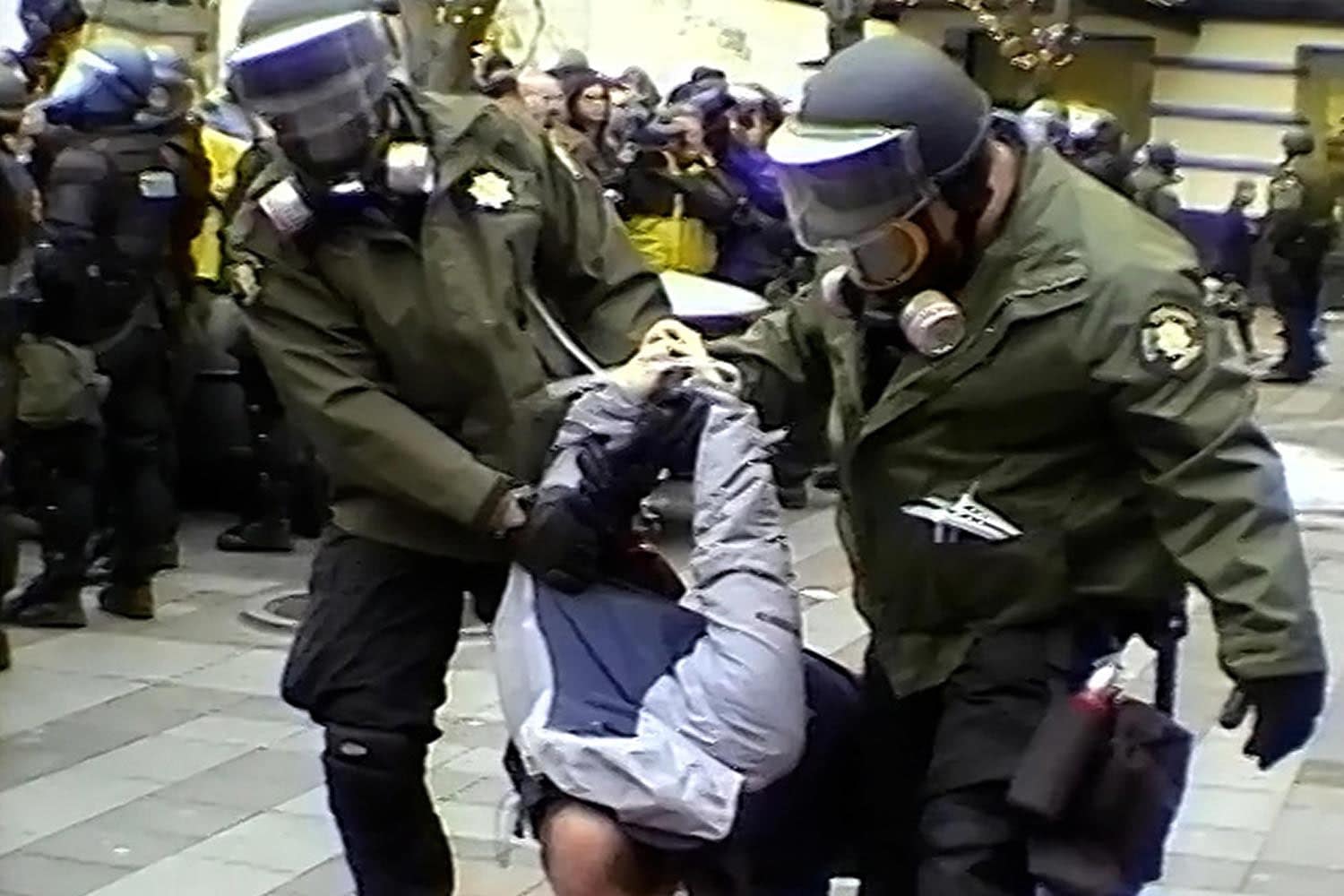
Between November 30 to December 3, 1999, upward of 40,000 protestors from around the world gathered in Seattle to protest the then-nascent World Trade Organization. Through archival footage, Ian Bell’s documentary WTO/99 reflects on this epochal event. Bell may not offer direct comment in the form of voiceover, but from the way he splices footage together, his sympathies clearly lie with the protestors. That sympathy only takes us so far, though, with emphasis placed on the spectacle of protest, as opposed to its organization.
Where a film like Guillaume Cailleau and Ben Russell’s Direct Action attends to behind-the-scenes community building that transforms protests into sustainable mass movements, WTO/99 takes a more intuitive, conventional approach. Leading with exciting images of the street protests themselves, it’s not so dissimilar from their coverage in the media at the time. Inspiring as they may be, such images perpetuate the myth of protests as leaderless, spontaneous expressions of outrage. Precisely how so many people of such disparate ideologies and affiliations came to converge on Seattle in this moment is a question that goes unasked.
WTO/99 sets out to correct misrepresentation by corporate media about the aims of the movement, but that attempt is hampered by so much recycling of footage from news broadcasts. The overriding thrust of these images is the disproportionate police reaction. While this effectively decries law enforcement’s handling of the situation, it may also have a dampening, demobilizing effect on viewers, despite Bell’s intention to further the tradition of protest.
It might be more politically useful to show the hard, thankless work of organizing, or the countercultures that keep alive the spirit of rebellion between protests. Neither does WTO/99 take time to seriously address debates in activist communities over tactics (holding intersections, black bloc, tactical frivolity, and so on). Intentionally or not, the film seems to echo the corporate effrontery at property damage, which the police used as a pretext to justify escalation. This may be a case where adherence to archival footage restricts WTO/99’s scope.
Bell’s documentary also makes the claim that 9/11 singlehandedly derailed the anti-globalization movement, of which the protest in Seattle was a high-water mark. But while there may be some truth to that, it also seems like a radical oversimplification.
As one interviewee points out, after the civil rights movement, social control became more a matter of “perception management” than outright repression. In other words, convincing people that protesting is a waste of time. Documentaries like this one have an important role to play in un-managing perception by showing the power, the courage, the dynamism of protest. But if the idea is to supply us with the tools and insight protest effectively now, it’s equally important to show how that power is cultivated, and here WTO/99 falls short.
Since 2001, we've brought you uncompromising, candid takes on the world of film, music, television, video games, theater, and more. Independently owned and operated publications like Slant have been hit hard in recent years, but we’re committed to keeping our content free and accessible—meaning no paywalls or fees.
If you like what we do, please consider subscribing to our Patreon or making a donation.