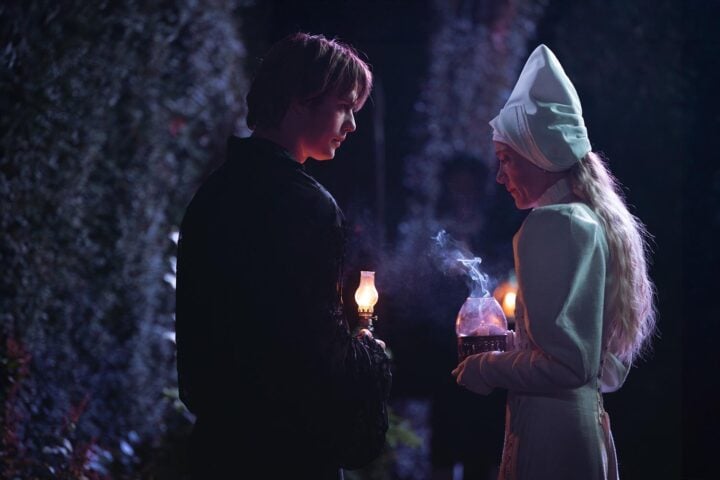
Early in Urška Djukić’s Little Trouble Girls, a brief montage strings together images of shrines to the Virgin Mary scattered through the mountains, forests, and villages of Slovenia, where the action takes place. For a film set in the Catholic milieu of a girls’ choir, a preponderance of Marys isn’t in itself surprising. But with the lack of corresponding images of Jesus (with one arguable exception), it takes on a heretical tinge, gesturing at the absorption by Catholicism of pagan fertility cults. For the teenage protagonist, Lucija (Jara Sofija Ostan), Mary becomes not only an object not of veneration, but of desire and identification.
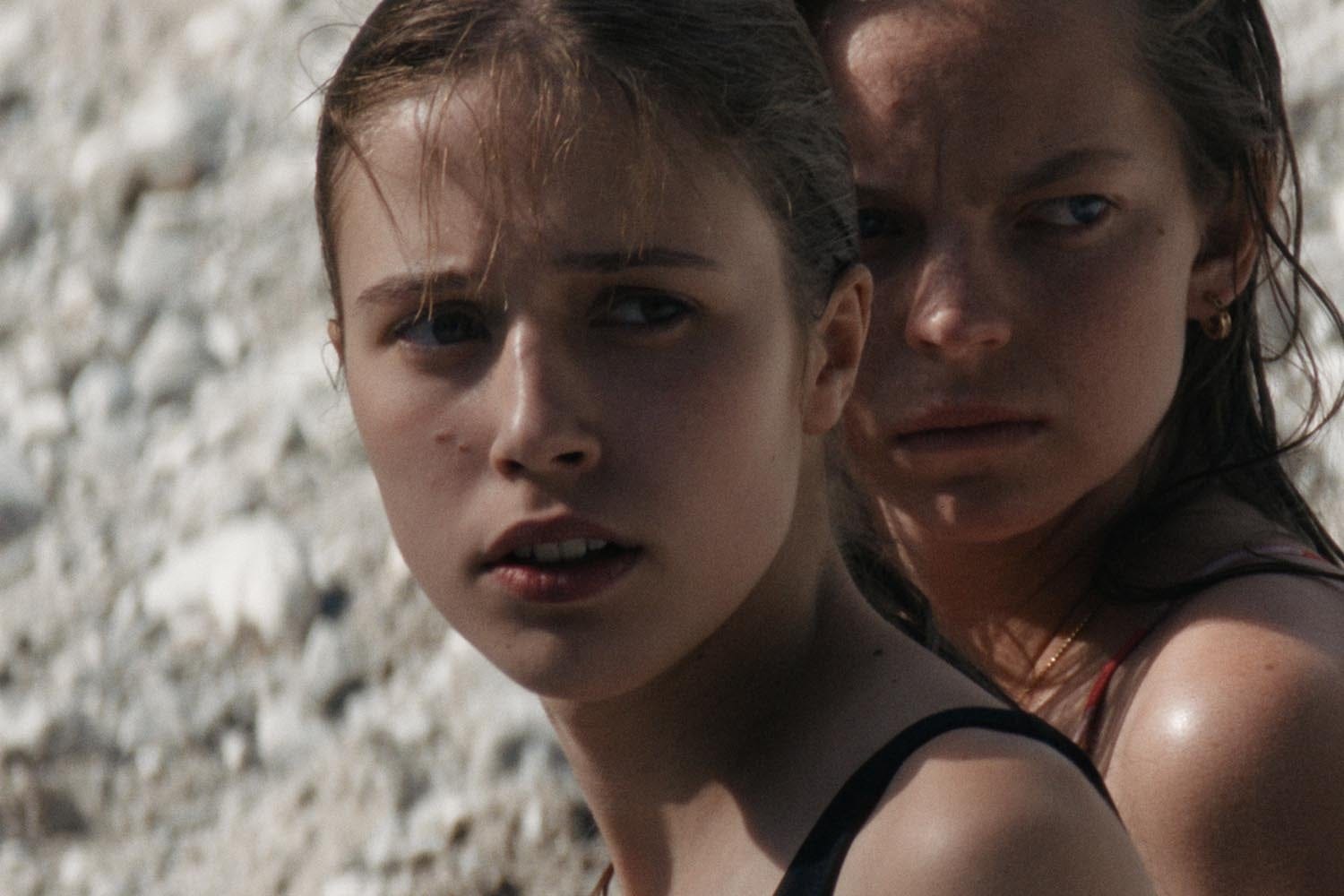
On a summer trip to a convent, Lucija befriends Ana-Marija (Mina Švajger), a girl her age but much less sheltered. An ambiguous attraction simmers between them, as the knowing Ana-Marija coaxes Lucija into the mysteries of desire and transgression. When, in a game of truth or dare, Lucija chooses dare to avoid outing her inexperience, Ana-Marija tasks her with kissing someone. In an innocently sacrilegious manner, Lucija kisses a statue of the Virgin Mary—a prelude to more flouting of Catholic taboos on the part of both girls. But their relationship comes under threat when Lucija mistakenly confides in the choir conductor (Saša Tabaković), who chastises her indirectly by singling her out for ridicule in front of the whole choir.
The film’s dreamy cinematography often places the viewer in the perspective Lucija, prone to trance-like reveries at the sight of beauty. The sound design is just as intimate, simulating the sound of blood ringing in her ears, for instance, when she comes face to face with a naked laborer (Casson Matia) who bears a striking resemblance to certain depictions of Jesus.
Throughout Little Trouble Girls, Ostan performs her character’s “virginity” as an ignorance of prejudice, a pre-indoctrinated state of grace. The girl is moved by beauty in all its forms, without quite knowing which are considered appropriate for good Catholics. Lucija doesn’t yet recognize a distinction between religious and physical ecstasy, or between friendship and romantic love. She knows no shame or grief, only curiosity. Her desire is unformed, not yet tamed, and this makes her coming of age a bitter one, if not entirely tragic.
The hallucinatory final scene leaves perhaps too many dangling plot threads, but Djukić’s film fascinatingly shows how Catholic moral strictures and an underlying paganism where desire is holy are two sides of the same coin. Disconcertingly, Djukić seems to hint that it’s precisely the intensity of such prohibitions that inspires and gives meaning to the transgression of them. In a society where everything is permissible, the film suggests, desire might be unable to flourish, but in a roundabout way, this could be read as justifying religious cruelty.
Since 2001, we've brought you uncompromising, candid takes on the world of film, music, television, video games, theater, and more. Independently owned and operated publications like Slant have been hit hard in recent years, but we’re committed to keeping our content free and accessible—meaning no paywalls or fees.
If you like what we do, please consider subscribing to our Patreon or making a donation.