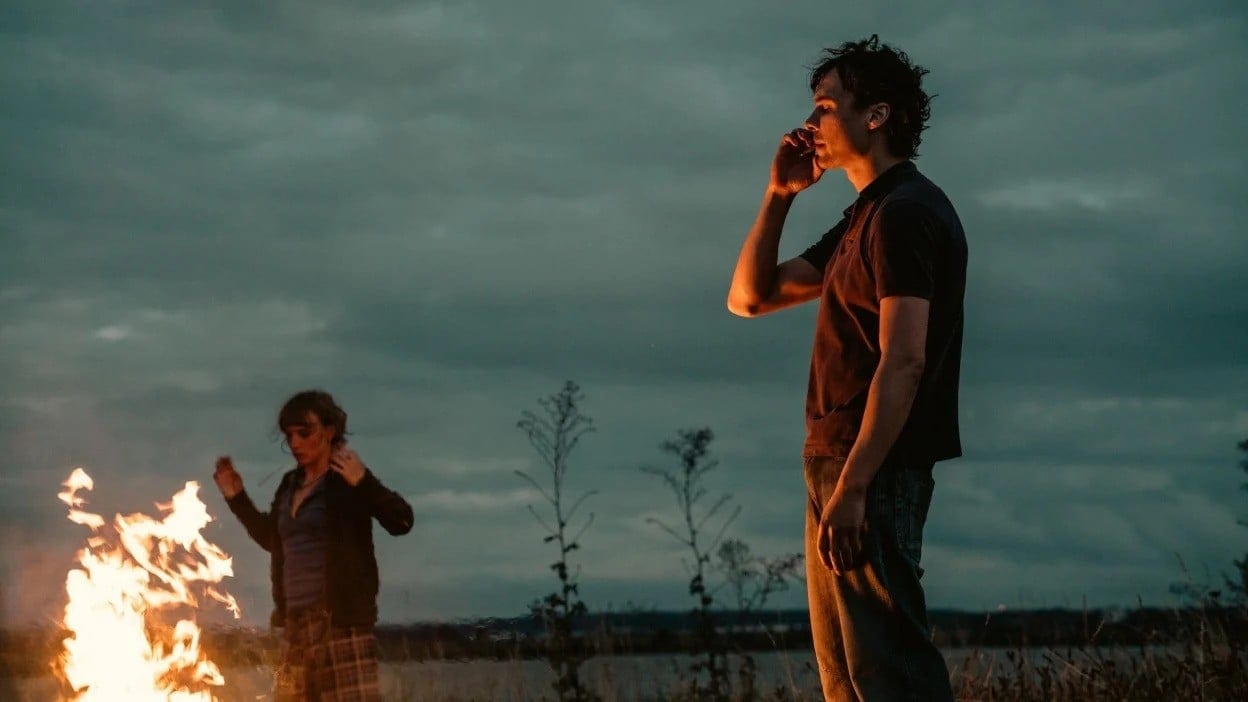
In a certain light, Harris Dickinson’s feature-length directorial debut, Urchin, suggests a 21st-century spin on Boudu Saved from Drowning. Centered on an unhoused protagonist, it could have been capsized by sentimentality, fixation on misery for misery’s sake, ham-fisted moral messaging, or even a lead performance calling too much attention to itself. For the most part, Dickinson sidesteps these traps while bringing to the film a singular style, as well as a self-awareness that’s introspective without stooping to outright self-flagellation.
The story picks up with the “urchin,” Mike (Frank Dillane), living on the streets of London. To scrape together enough money for his next fix, he takes advantage of a sympathetic stranger, Simon (Okezie Morro), and mugs him for his wristwatch. Contrite and sober after an eight-month stint in prison, he’s put up at a hostel—provisionally—by social services. He dutifully attends rehabilitation meetings, listens to meditation tapes, and takes a job as a line cook at a cheap hotel restaurant. Still, it’s by no means clear whether the welfare state can redeem him.
Urchin’s narrative feels as if its predictably heading toward either Mike getting his life together and becoming a citizen or him winding up back on drugs and living on the streets. Shots that grant access to the images inside Mike’s head, such as the cave that appears on screen when he meditates, offer a welcome rupture of expectation even as they darkly hint at his tendency toward escapism. When he loses his job after failing to cooperate during a mediation with Simon, we seem to be in store for back half of unremittent bumsploitation.
It’s not until Andrea (Megan Northam) comes on the scene that the film opens out a little and begins to explore some farther-afield themes. Through their conversations, Mike starts to give some thought to what his displacement from society means in the larger picture. For a few tantalizing scenes it looks as though, like Andrea, who chooses to live semi-nomadically, he may find some other way of being in the world, dependent neither on drugs or impersonal bureaucracy. He may even get a chance to love and be loved for a change.
This shift also clears some space for the film to interrogate the matter of its own representation, particularly in a scene where Mike, Andrea, and a couple of Andrea’s friends attend a dance performance at an art gallery while high on ketamine. The erratic flailing of the dance, in tandem with the drug’s dissociative effect, provokes in Mike repressed memories of his violent encounter with Simon. This is a far cry from typically naïve portrayals of art. Here, art isn’t only a sequestered commodity but a volatile stimulant, and people in Mike’s marginal position are neither its creators nor its intended audience, but its unwitting playthings. If there’s a boundary between art that’s transformative and exploitative, triggering or curative, it’s a porous one.
Though of secondary importance, Mike’s encounters with Nathan, a fellow addict, become even more charged with the awareness that he’s played by Dickinson himself. The pair have a mirroring, almost parasitic relation to each other. When one is on the upswing, the other is on the down. Even when Urchin appears to toss aside its more promising themes in favor of cliché as Mike spirals out of control, the film’s harrowing, surreal ending, in which a toga-clad Nathan shoves Mike into a starry chasm, reframes this apparent surrender to plot determinism while raising further discomfiting questions about the role of the artist.
Artists should have license to imagine the perspectives of characters with radically different experiences from their own, assuming the depiction that results is sufficiently sympathetic and complex. Yet the more fully realized, the more “alive” the character, the more responsibility the artist has to their creation. On the flipside, as Urchin shows, there’s also a risk of the artist overidentifying with—or becoming identified with—their character in the eyes of their audience. The artist may find themself at the mercy of a person, albeit fictional, with a mind and a life of their own. In Urchin, Dickinson quietly upends the assumed pecking order between creator and creation, depicting their relationship as one of sympathy, at times, but also cruel co-dependence.
Since 2001, we've brought you uncompromising, candid takes on the world of film, music, television, video games, theater, and more. Independently owned and operated publications like Slant have been hit hard in recent years, but we’re committed to keeping our content free and accessible—meaning no paywalls or fees.
If you like what we do, please consider subscribing to our Patreon or making a donation.