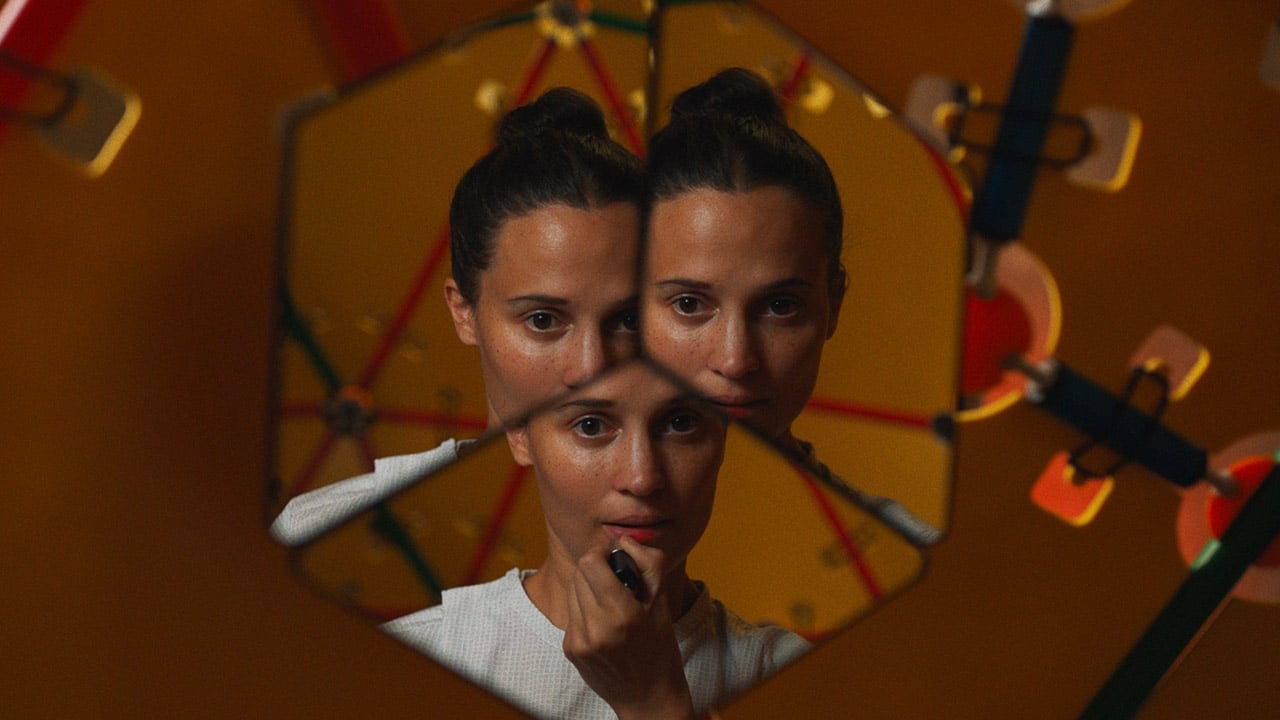
Fleur Fortuné’s near-future-set feature-length directorial debut, The Assessment, prods at current-day anxieties around having children amid a recrudescence of fascism and dress rehearsals for the climate apocalypse. Even as these two forces refuse to recognize each other’s authority, they skip into the future hand in hand.
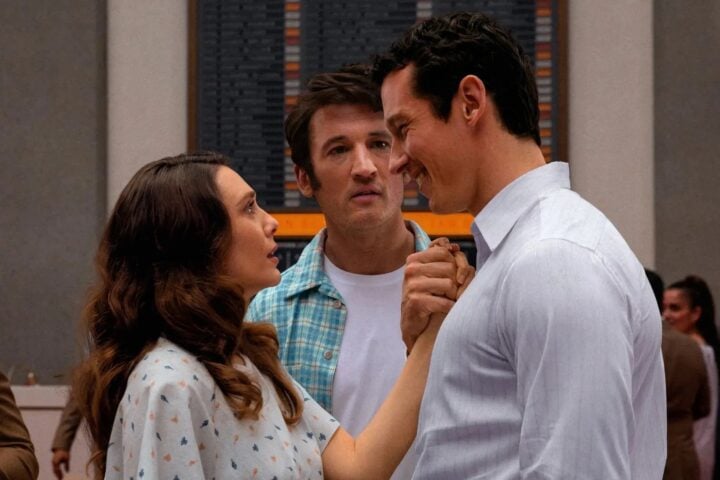
Owing to their wealth and obedience, Mia (Elizabeth Olsen) and Aaryan (Himesh Patel) live in a coastal modernist villa, insulated from the largely off-screen ravages of a dystopian climate apocalypse by an atmosphere-controlled forcefield. Mia cultivates gourmet algae in a greenhouse of her own design, where she also keeps an orchid that’s all she has left of her mother, who was exiled to the “Old World” for political dissidence. Aaryan is a programmer who, in a nod to Philip K. Dick, designs artificial pets to replace those lost in the “pet cull.”
Mia and Aaryan decide that what’s missing in their life is a kid, so they apply to the state for permission to reproduce, since in this near-future society population is strictly regulated. The state dispatches Virginia (Alicia Vikander) to determine the couple’s eligibility for parenthood, and so begins the titular assessment, which quickly takes a turn toward the demented, as the would-be parents’ rationalizations and idealizations break down under Virginia’s relentless assault on not only the cracks in their relationship, but their egos as well.
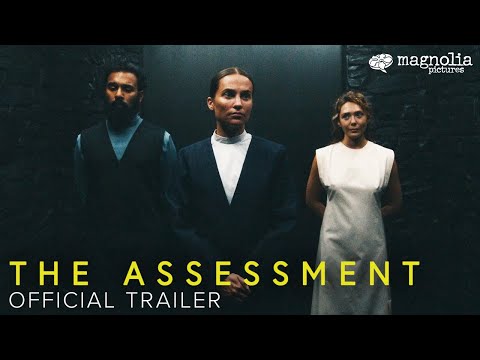
The Assessment works its way through intriguing conundrums about the motivations and qualifications of parenthood, as well as the power dynamics at play between parents and children. In the fulfilment of her duties, Virginia takes it upon herself to act as Mia and Aaryan’s child, and Vikander disconcertingly dots the line between adult and child until it can be difficult to tell which age she’s inhabiting at a given moment. One moment she’s playing the bureaucrat for whom nothing is private, the next a chaotic child who cannot take care of herself, leading to some highly cringey scenes. (For much of the film, Virginia wears a black-and-white clerical getup reminiscent of a Puritan frock that, at the same time, evokes a child’s school uniform.)
The film’s emphasis on isometric décor and architecture, exemplified by the stained-glass window in Mia and Aaryan’s house that all but screams Piet Mondrian, finds strange parallels between certain strains of high modernist rationalization and the paraphernalia of childhood. In its simplicity, a geodesic jungle gym or playpen isn’t merely child-friendly, it also embodies a utopian free interplay of abstract form and primary color.
The film depicts such innocent objects as an attempt by adults to impose rationality, and not just on children, to discipline irrationality away. This is the same “rationalism” that justifies pet culls and turns the decision of kids-or-no into an intrusive, Kafkaesque trial by the state that, as it turns out, dehumanizes the assessor as much as, if not more than, those being assessed.
Between The Assessment and Ex Machina, Vikander seems to thrive in the uncanny valley and similar unnerving liminal states. She has a way of simultaneously elevating while also breaking a film that she’s attached to, since her performances can tend to show up everything around her as anemic by comparison, and, to a degree, The Assessment is no exception.
If it’s ultimately another film about acting, The Assessment manages to evade meta-cinematic self-absorption by broadening the idea of performance to encompass simulation. “I don’t want right, I want human,” Mia says, rejecting the holographic, odorless baby that Aaryan presents her with and dismissing his promise to program a suitable smell. Ironically, what’s human here is tangled up with simulation and pretense, and quite possibly for the worse. Rationality and irrationality, adulthood and childhood, are all interlocking parts of a contradictory performance.
What’s more, The Assessment also upends an age-old cliché, and depicts the state less as an overbearing parent than a spoiled child—or at least a hideous chimera of the two. Although institutionalized power can hardly survive without people to sacrifice themselves for its nourishment, it nonetheless subjects us to its whims.
Since 2001, we've brought you uncompromising, candid takes on the world of film, music, television, video games, theater, and more. Independently owned and operated publications like Slant have been hit hard in recent years, but we’re committed to keeping our content free and accessible—meaning no paywalls or fees.
If you like what we do, please consider subscribing to our Patreon or making a donation.