
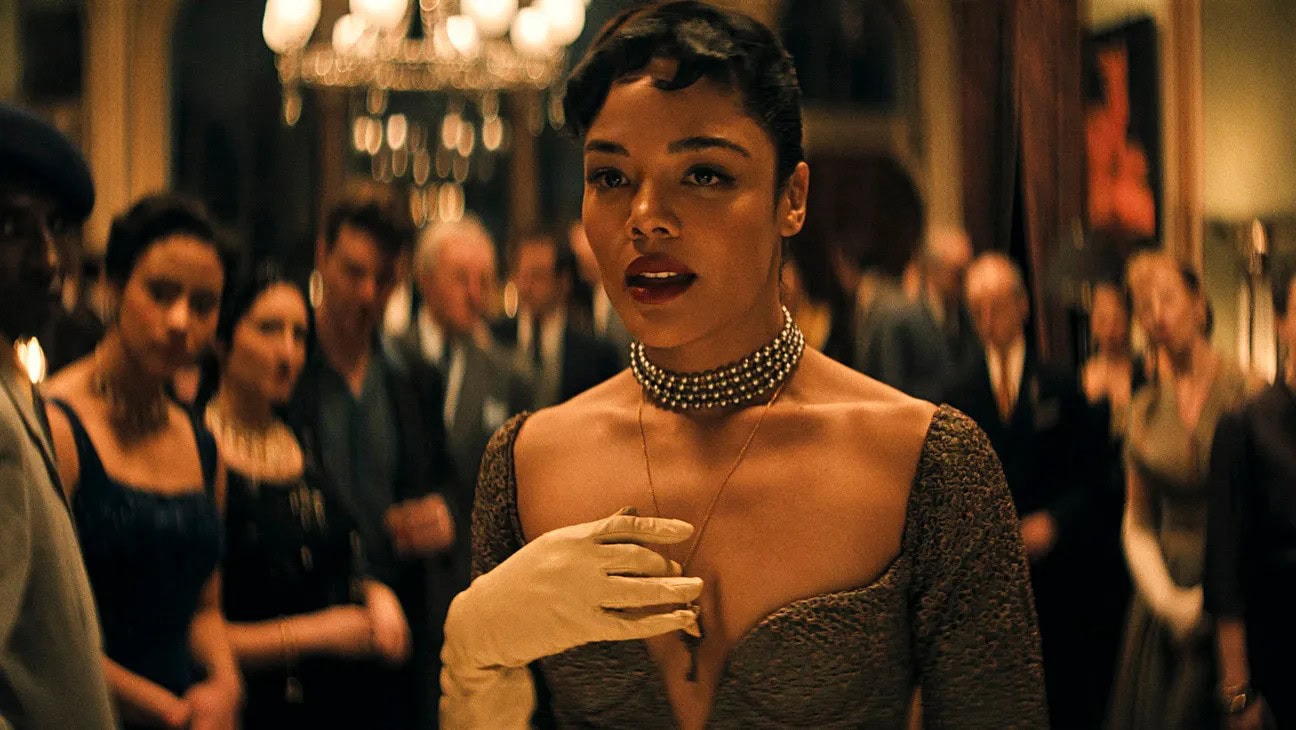
First performed on stage in 1891, Henrik Ibsen’s Hedda Gabler is a psychological chamber piece that’s been interpreted in a variety of ways, from a scathing class critique to a more despairing portrait of existential absurdity. Nia DaCosta’s Hedda updates the action from late-19th century Norway to 1950s Britain, bringing a contemporary pulse to its telling of the tale that, despite losing some thematic complexity, is rarely less than entertaining.
Played by Tessa Thompson, the eponymous socialite is the bored, manipulative wife of George Tesman (Tom Bateman), a struggling academic hoping to land a prestigious position at a university, in part to pay for the country estate that helped him win his ex-bohemian spouse’s hand in the first place. Unlike in the play, the couple decide to throw a lavish party, ostensibly to celebrate their recent marriage, but primarily to help George gain some traction within his upper-class professional milieu. Following the arrival of Eileen (Nina Hoss), her husband’s academic rival and—unbeknownst to George or most of the guests at their party—her former lover, Hedda’s scheming becomes increasingly cruel and outlandish.
Perhaps the most significant—or at least the most headline-grabbing—updates that DaCosta makes to Ibsen’s work are reimagining Hedda as mixed race and gender-swapping the male character of Eilert for Eileen. The repressed sexuality that this latter alteration brings to the table certainly emphasizes the contrasting personalities of the two former lovers, as Hedda’s calculated disguising of her desires seems both a necessary defensive strategy and a kind of betrayal of the openly lesbian outsider Eileen’s own struggle for liberation.
But besides this added psychological conflict, these modifications to the play ultimately seem somewhat redundant. While a few particularly unpleasant party guests make the odd euphemistic remark, it’s difficult to gauge the full relevance of Hedda’s racial and sexual otherness within the film’s setting. What would the consequences be if her relationship with Eileen was revealed? How has her experience of racism shaped her as a person?
The surface-level rejigging of Ibsen’s text is of a piece with a certain flatness to Hedda, with the main character’s motivations proving particularly one-dimensional. Despite the occasional hint at Hedda’s troubled, tumultuous past, there never seems to be much in the way of nuance to her single-minded, sociopathic pursuit of her own goals at the expense of everyone around her.
Fortunately, Thompson’s presence is consistently captivating, as she relishes in exploring her character’s gleeful and occasionally anxious villainy. She’s upstaged only briefly by the even more impressive Hoss, whose affecting portrayal of Eileen’s fierce independence and stubborn, self-destructive impulses makes Hedda’s final defeat of Eileen the only true tragedy in our protagonist’s otherwise enjoyable dismantling of their morally bankrupt social circle.
Matching the vitality of these two central performances is Sean Bobbitt’s camera, which stalks corridors and circles rooms deftly, elevating the tension in what can often be arch, stilted conversations between partygoers. For better or worse, the sense that every character interaction is a duel of sorts never lets up, with DaCosta fully embracing the latent melodrama in the original text. More of a fun exercise in inventive adaptation than a fully-realized work, Hedda might miss the mark somewhat in turning the play’s era-specific mind games into a universal tale of a woman doing whatever it takes to get ahead in a hostile world, but the assured craftsmanship on display makes it futile to protest too much.
Since 2001, we've brought you uncompromising, candid takes on the world of film, music, television, video games, theater, and more. Independently owned and operated publications like Slant have been hit hard in recent years, but we’re committed to keeping our content free and accessible—meaning no paywalls or fees.
If you like what we do, please consider subscribing to our Patreon or making a donation.