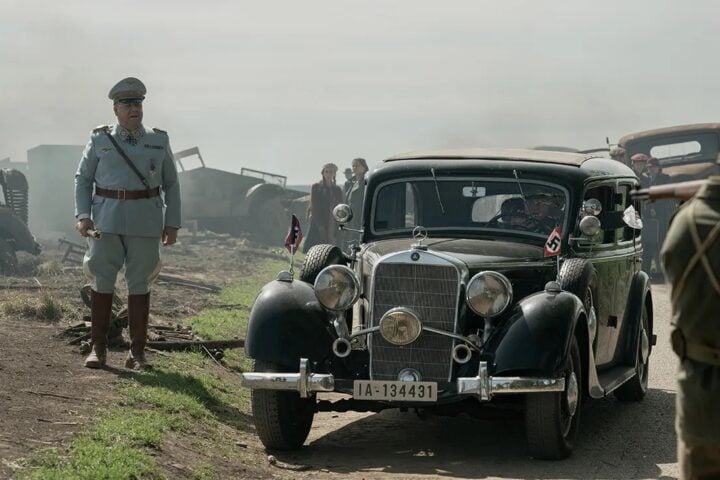
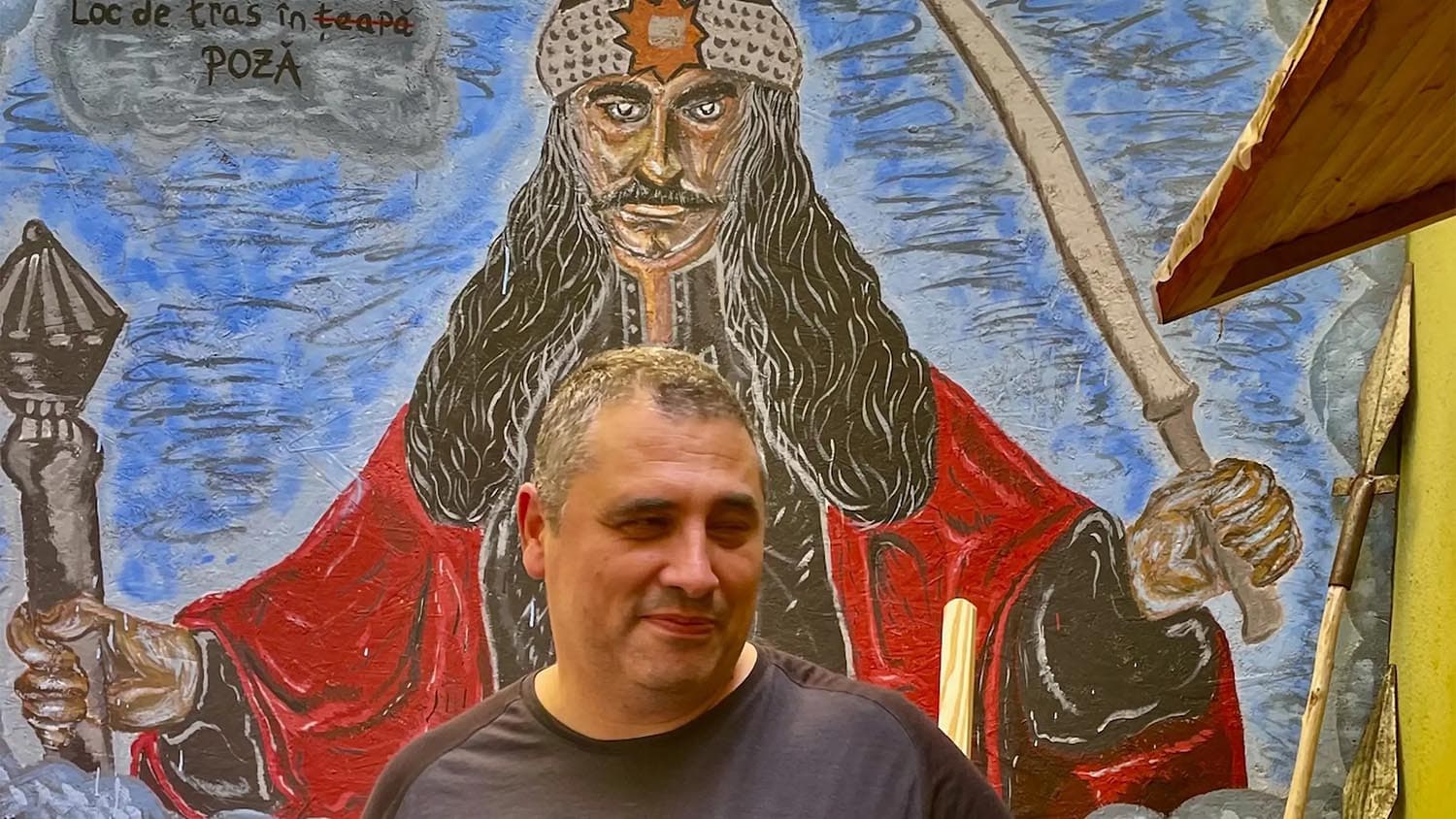
Panic-inducing headlines about A.I. technology have become omnipresent in 2025, and with them come the cries of filmmakers denouncing its advances into their work. One voice who won’t be heard in that chorus is Radu Jude, the writer-director who leverages A.I. as both topic and tool in Dracula. It’s but the latest instance of the Romanian iconoclast behind Bad Luck Banging or Loony Porn and Do Not Expect Too Much from the End of the World employing the defining elements of the 2020s, be it Covid protocols or TikTok aesthetics, and using them to create works both about and from contemporary life.
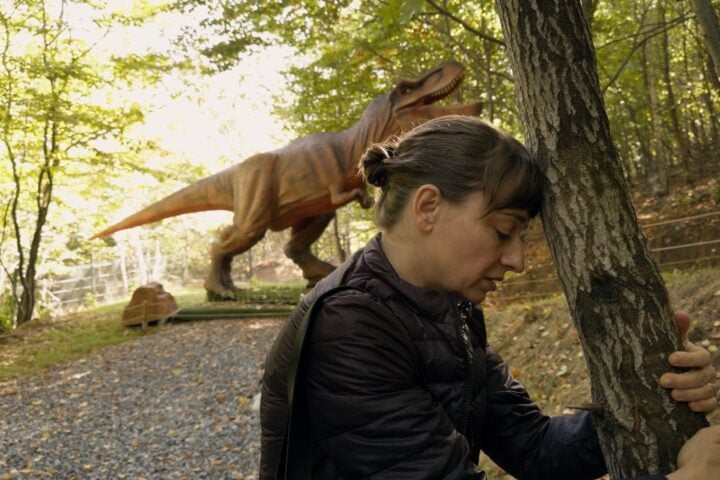
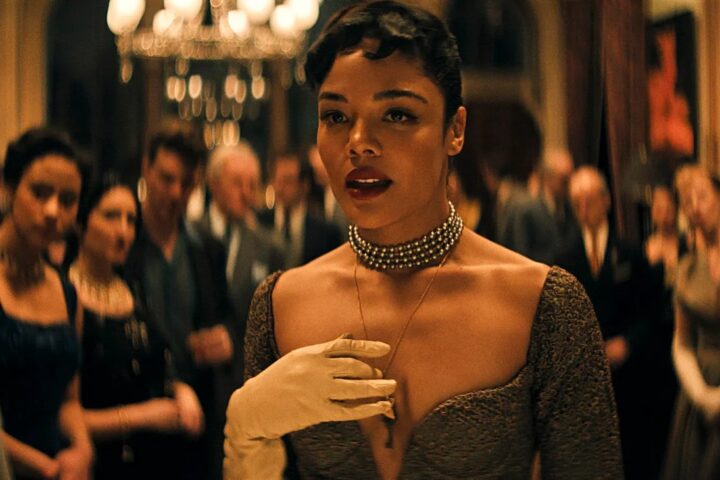
Jude’s imagination is the true creative force behind Dracula. He uses these newfangled tools of image-making, albeit in their most degraded and destabilized form, to explore the legacy of his country’s most storied export. The film, which stays in a state of constant reinvention for nearly three hours, collapses Romania’s past and present into a farcical cinematic fantasia.
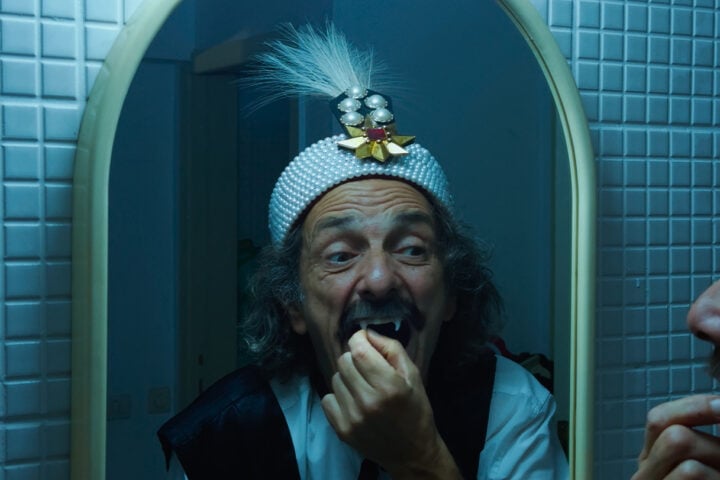
Tying together all the disparate and zany episodes of Dracula is a film director (Adonis Tanța) narrating his attempts to leverage a fictional cutting-edge A.I. tool in the creation of a commercially viable Dracula film. His output, which was crafted by Jude in a style meant to imitate a prevailing “slop” aesthetic, coalesces into an outright Dadaist portrait of Romanian national mythology. Jude gleefully explodes any dichotomies of taste as he engages with history, ideology, and genre through dick jokes and deliberately ramshackle A.I. effects work.
I spoke with Jude ahead of Dracula’s stateside theatrical opening. Our talk covered how A.I. tools became such a crucial part of this long-gestating project, what TikTok videos teach him about filmmaking, and why cinema being in a state of constant crisis exhilarates him.
Whenever you were asked about your next project, you would joke about making a Dracula film. At what point did the vampirism of A.I. feeding off other creative work come into the picture and help you find a real match of form and content?
Well, it was several steps into that. First of all, I wanted to make the film. I think I wrote one or two versions with only one story, so to speak, like a regular film. One was some things that I gave up, and the other one was the story, which is now with the factory [scene] with these people working on the computer, etcetera. At some point, I wasn’t pleased, because I wanted to tell more stories and engage [with] this myth in more ways than one. I couldn’t find a way. And it was early 2023 when ChatGPT appeared, and I started to test it a little bit, just out of curiosity. I didn’t have any clear idea how to make the film. Maybe at some point I even thought of a letter structure; I don’t remember, I had so many ideas and couldn’t focus on any one.
I started testing ChatGPT and said, “Write me a Dracula story.” They weren’t very good. At some point, I started to ask things I didn’t know. There are limits to saying, “Write me a porn Dracula film in the Holocaust,” or something like that. The machine was answering, “This is not possible,” or “We should use it in a responsible manner.” If you ask for more things like that, you would not be allowed to use it anymore. The eureka moment was when I said, “I can become the A.I. machine!” In a fake way, of course. So, in that moment, I just had the structure of the movie: a filmmaker is asking the A.I. machine, which is me, to generate stories, and I would try to generate as much as I’m able to. Little by little, I started to compose the film like that.
Although the structure involved a fake A.I. machine doing it, I still didn’t think of using real A.I. imagery. For budget reasons, we realized we had to cut the budget. I cut and I cut, but it was still impossible to make the film. And then I found out someone I knew, Vlaicu Golcea, who’s a composer and jazz musician, was doing some A.I. experiments in an amateur way. We teamed up together, and little by little, I started to love this trashy digital poetry of A.I. images and started to place them in the film here and there, just as another tool of narrative.
What’s the nature of creating A.I. art? Were you giving prompts?
It wasn’t the same thing for all the scenes. In some cases, it was like you said. We wrote prompts and [would] see what came out. I always used the worst images. Vlaicu was a bit, “Are you sure? Because now, look, it’s a better one, more formal and realistic.” And I said, “No, no, let’s keep the broken one.” With this one, you would generate a video, sometimes very short. I think Midjourney, at some point, could do only four seconds of video that then you could slow down to eight [seconds]. If you wanted longer, you had to move that into some Chinese software that would reanimate them. But with that logic, we never got there because sometimes they were changed and impossible to recognize. In the Chinese ones, there’s always a fake camera movement. Other times, we started with real photos or real works of art that we wanted to animate a little bit. So was something like that. It was a mix of both. It involved back and forth.
The current attitude toward A.I. in the film industry tends to be very absolutist. Guillermo del Toro, for example, went viral for saying, “Fuck A.I.!” How do you think about using it responsibly in the service of art?
Well, why responsibly? That’s the first thing. I wasn’t aware that in the industry of images in cinema and TV in United States. Since Romania doesn’t have an industry, really, [there’s] no discussion about that. I think I’m the only one [who] made a film using these A.I. images, and there’s no discussion about it. But I understand that there are so many career stakes, financial stakes, institutional stakes in the industry in the United States that make people afraid of losing their jobs, money, control, or aesthetic. That’s why I think there’s this huge backlash.
But, in my case, I don’t have anything to lose. I’m from a peripheral country of Eastern Europe where there’s no real film industry. If I’m able to make the film with any tool whatsoever, including A.I., I’m happy to do it. While I [leave] the serious people like Guillermo del Toro or others to really suffer and be unhappy about this, for me, it’s just another tool. Of course, I understand there’s a need to regulate that because I can see there’s a lot of legitimate worries about the ecological aspect, the work ethics, and the rights ethics.
But I think that’s largely exaggerated, in my opinion. Until they’re regulated like any new technology, you can freely use it, and I happily took advantage of it. I would take advantage of anything that’s on the market—of course, in a legal way—that you can use to make the films. One of my heroes, Roger Corman, was always someone who would find ways to make films. Sometimes using stock images, making two films at the same time, buying a Soviet film and putting Peter Bogdanovich to shoot parts of it and make it American. There are always ways to make films. That’s what I learned from Corman and from other independents.
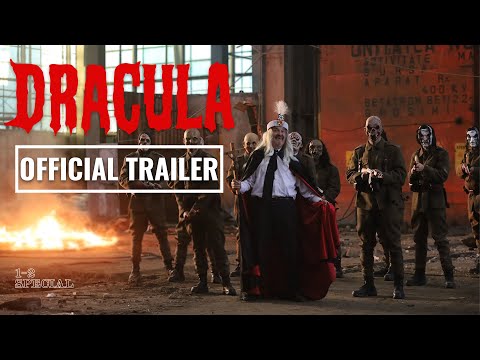
Since you were writing the portions of the film that are supposedly generated by A.I., how do you approach writing as if you were an A.I.? One of the things that I always think about the large language models is that they’re designed to provide the most probable response to anything.
I wanted to make a little bit of fun of that. You have this freedom when you play another role. I felt that on my name, so to speak, I wouldn’t have made these stories. In a way, I needed an intermediary. You put on a mask and, all of a sudden, you have the right to do whatever. I think that’s acting, in a certain way. Actors feel like doing all kinds of stupid things when they get into a character. I felt exempt from responsibility, so to speak, so I could let my imagination free in the direction opposite of what a real A.I. machine generates but still pretending I’m somebody else. It felt good to do it in this way. I’m not responsible. It’s not me. Somebody else did it. Of course, in the end, it’s a film I sign. I totally accept responsibility for it. But, somehow it’s, it’s like I’m behind a mask…and easier to take the blows, somehow. It’s like writing a love letter for somebody else. I think that would be very easy to do. I always found it very easy to ask for things for somebody else. But for me, I always find it difficult.
You’ve cited some literary examples that inspired the film’s structure, but is it also something inspired by the algorithmic nature of content consumption today—or even just switching between browser tabs?
You’re totally right. Boris Groys wrote an article about what if the greatest novel of today is the internet? Of course, it’s very metaphorically put, but there’s something there. I see the connection between when these early novels included everything. It felt like the beginning of the internet, in a way. I think there’s a connection between these literary modes of early novels and the way we browse now on the internet. It’s a film that has something from this. Maybe it’s something from how I myself do [it]. Even for books, I’m not able to read only one book at a time anymore. It’s impossible. I need to read three or four or five, and sometimes I forget about one. It’s all coming together in a mix like that, it’s true.
I was lucky enough to attend your “TikTalk” at the New York Film Festival, where you presented a curated program of videos from TikTok. Why do you think cinema seems so scared of the “vernacular” images in places like TikTok? What have you learned from them that’s influenced your own practice?
I cannot generalize that much because I don’t know. First of all, I think people creating images—filmmakers, photographers—were always a kind of respected profession, if you want. All of a sudden, you discover that basically everybody can make decent or great photos and put them on Instagram, and you can see professional photographers sometimes doing much worse work than an amateur photographer. I think it happens the same with these vernacular images that, on one hand, you can discover that some of these creations are, in my opinion, really entertaining and engaging. They have a lot of creativity that you don’t find in real filmmakers’ films, sometimes.
Then, there’s a huge audience response to that. We can talk about the toxic part of TikTok or other platforms, about the addiction they create, but it’s true at the same time that some people find their visual entertainment there, and they don’t need your film. I think that shows that there’s some crisis in what we do, or a general crisis altogether. But I think it’s a good thing because it forces us, if we’re serious filmmakers, to really think about how we can react to that and incorporate that in our work but not ignore it. I think the worst is to ignore or just despise.
I can see why [people say it’s bullshit], but at the same time, I’m so curious about everything that appears. It makes me not enthusiastic, but curious. If you’re curious, you discover that it’s not only what it seems. It can be much more complex, spectacular, creative, and useful. There’s a book by Kirk Varnedoe and Adam Gopnik, a catalog of an exhibition that took place in the ’90s in MoMA, called High & Low, about how high culture or high art has always, since modernism, been in a powerful relation with what is called low, not serious art.
Dracula contains silent-film-era aesthetics alongside A.I. slop and TikTok content. Are you suggesting the possibility of a parallel trajectory? Are we in the zoetrope or the cinema of attractions stage of these tools?
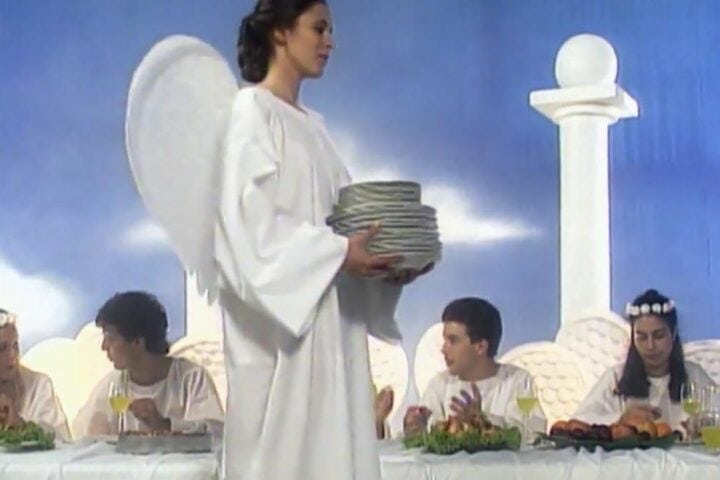
I think A.I. images have, at this moment, a feeling of [the] beginning of something. I don’t know what it’s going to be. Maybe it’s going to be a fashion that disappears in a few months or a year. Maybe it will really develop into something much more interesting than it is now. I have no idea; I hope for the second. This is one of the advantages that I spoke of before. It’s a bit like when digital cameras appeared. With [the advent of] small cameras, people said everybody can make a film. Which is largely true, but, of course, not everybody becomes a great filmmaker just because he or she has a digital camera. I think it’s going to be the same with A.I. Some of the images that we use in Dracula made me think of George Méliès. His fantasy films weren’t always perfectly made. You could see the mistakes. I think there’s a connection with the beginnings [of cinema].
Could the film’s closing quote about the nature of progress looking bigger than it actually is apply to the development of A.I.? Are these A.I. images not as big a change as people are making them out to be?
I think that’s the challenge for all the fields, but I speak for my field of work, which is cinema. You have to take these things into consideration and come up smarter than them. Maybe that’s not easy, but I think it’s our only chance. I find it quite exhilarating that cinema is in a certain crisis. Cinema is always in crisis. You mentioned the silent film, and then, sound film appeared and changed everything. Color film changed everything, partly. Then, television put cinema into a crisis again. Then the VHS industry, cable, streaming, and now A.I. I think cinema is always in a string of crises, which, whenever it was solved, made cinema more interesting.
Since 2001, we've brought you uncompromising, candid takes on the world of film, music, television, video games, theater, and more. Independently owned and operated publications like Slant have been hit hard in recent years, but we’re committed to keeping our content free and accessible—meaning no paywalls or fees.
If you like what we do, please consider subscribing to our Patreon or making a donation.