
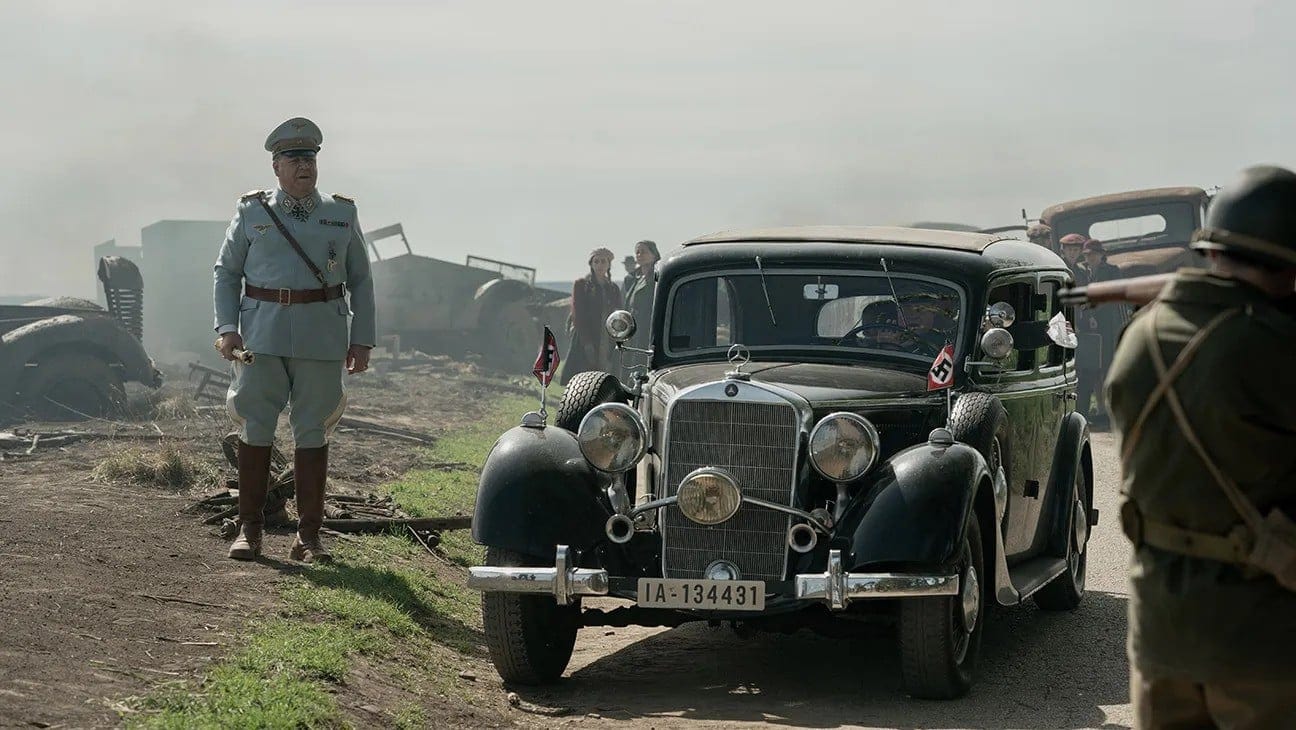
Written and directed by James Vanderbilt and based on Jack El-Hai’s 2013 book The Nazi and the Psychiatrist, Nuremberg looks back at a crucial, world-shaping moment in human rights history. The film understands that cornerstone to be inseparable from the emergence of the United States as a global superpower, and at its shrewdest, it regards that rise with a deflating sense of grim inevitability and disappointment at how easily we’ve forsaken the principles that history would have us believe we fought so hard to uphold.
At the close of World War II, Douglas Kelley (Rami Malek), chief psychiatrist at Nuremberg Prison, is tasked with interviewing surviving members of the Nazi high command in the lead up to the Nuremberg trials. He’s quickly transfixed by Adolf Hitler’s second-in-command, Hermann Göring (Russell Crowe), who seems certain that he’ll avoid prosecution. Kelley sees an opportunity to make a name for himself and begins planning a book about Göring and what made men like him susceptible to Hitler’s influence, but as the trials commence, his obsession with the charismatic Nazi brings personal morals into conflict with the search for justice.
Vanderbilt’s script largely allows dialogue and theme to be born in naturalistic ways, though there are moments when the film’s seriousness is kneecapped by a distinctly Hollywood-ese snappiness, as when John Slattery, as Burton C. Andrus (John Slattery), the prison’s commandant, says, “Welcome to Nuremberg,” showing great restraint by not winking to the camera. The film’s biggest speed bump is Sgt. Howard Triest, a translator for the Allies during the trials. Though ably played by Leo Woodall, the characterization is pat and emotionally manipulative—a springboard for weepy pathos in a film that’s notably light on such things.
Like many period dramas, Nuremberg is in direct conversation with the moment in which it was made. Just as Stanley Kramer’s Judgement at Nuremberg explored the Nuremberg trials against the backdrop of the emerging Cold War, Vanderbilt’s film holds the trials up as a mirror to our current era of authoritarianism. You’re likely to feel a clammy recognition watching Crowe’s performance. While it initially feels as if the role might have benefited from being played by a German actor, it turns out to be a smart bit of casting that plays on our comfortable familiarity with the Oscar winner. His Göring is slippery, soft-spoken, and seductive—an all-too-human monster that can hold all the contradictions the film is turning over in his hands.
How does a “civilized” country become a slaughterhouse? And how does a family man become a butcher? Vanderbilt’s clever sleight of hand is humanizing this Nazi so as to allow us to see the folly of history, of how there’s a rush to characterize those who commit atrocities as mustache-twirling villains rather than fallible people susceptible to the influence of bad actors, and thus fail to recognize just how far down the rabbit hole we’ve already tumbled.
No one wakes up in the morning and chooses to do the unthinkable, and Vanderbilt wants us to ruminate on the thousands of small, individual, and collective decisions that lead societies to disaster. “What if we could dissect evil,” says Kelley early on. “What sets these men apart from all the others? What enabled them to commit the crimes that they did?” He concludes by saying that his mission is to answer the question: “What makes the Germans different from us?” Though the truth is apparent from the start, it doesn’t make the film’s climax any less impactful.
There’s much talk in Nuremberg about the importance of the trials. The first of their kind, they brought the global community together to reset the arc of history toward justice after the atrocities of the Holocaust. But much as in Judgement at Nuremberg, Vanderbilt’s film sees justice as a nebulous, perhaps unachievable goal, and the damnable thing about arcs is that they bend back around. As Nuremberg concludes, and the question of moral rectitude is deflated by the grim business of hangings and voided bowels, we’re left less with a stern warning than a resigned sigh. “Never again,” the film seems to assert, was never a promise. It was always a plea.
Since 2001, we've brought you uncompromising, candid takes on the world of film, music, television, video games, theater, and more. Independently owned and operated publications like Slant have been hit hard in recent years, but we’re committed to keeping our content free and accessible—meaning no paywalls or fees.
If you like what we do, please consider subscribing to our Patreon or making a donation.




Ok..you think that The Bad Orange Man is an authoritarian.🤣 Give me a break…it just shows that your Derangement keeps you from understanding what happened in Nazi Germany.
THE WORLD WAS SILENT IN 1939,THE WORLD IS STILL SILENT IN 2025
Yes, Democrats are doing everything they can do destroy our individual freedoms…right along with the nuclear family and Christianity!