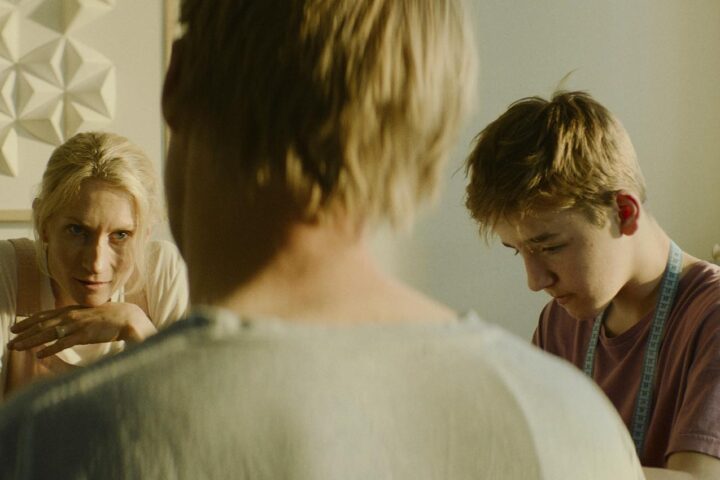
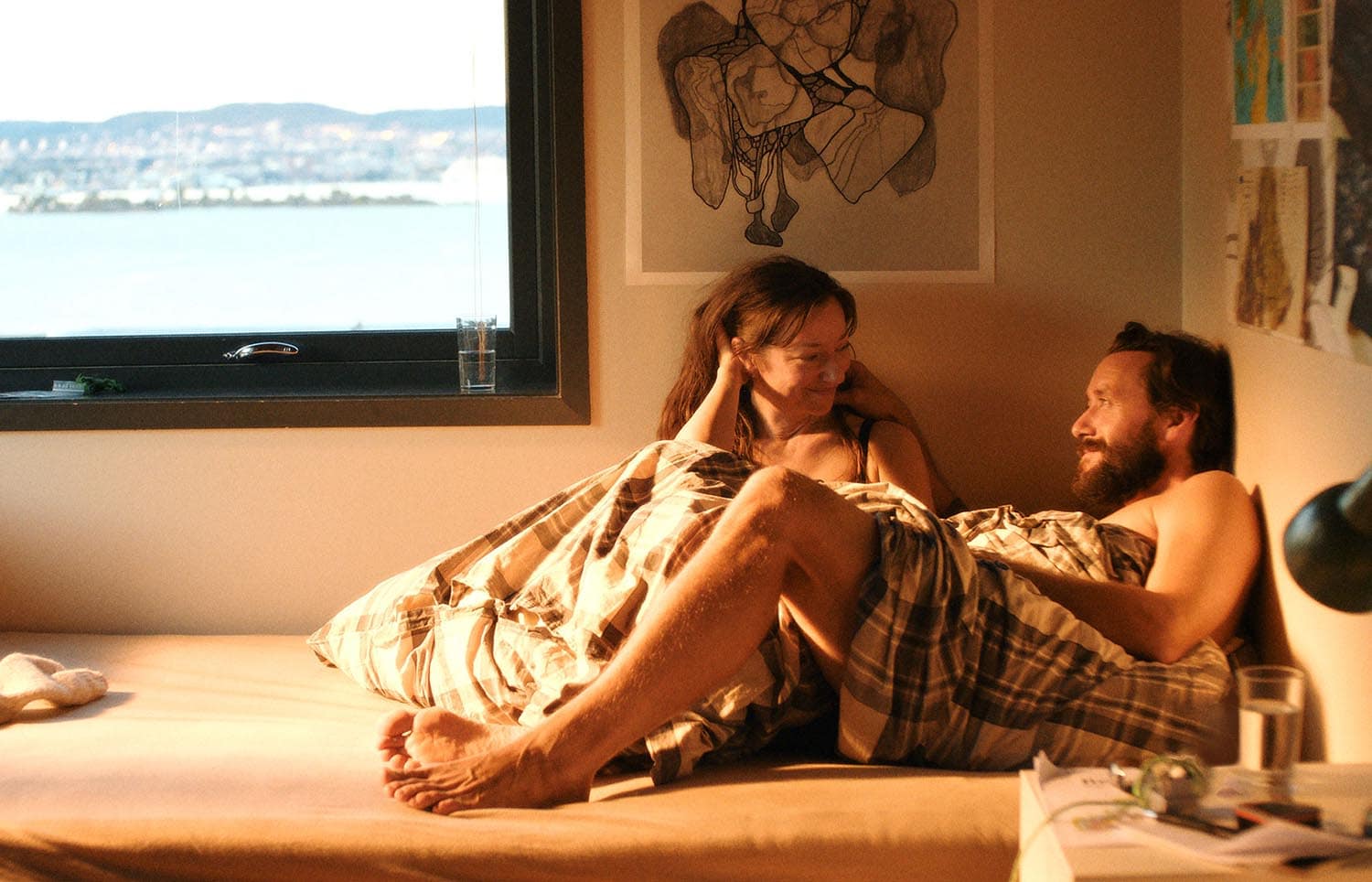
The insistent warmth of Dag Johan Haugerud’s Love, one third of his Oslo Stories trilogy, can be off-putting at first. The characters smile and wait for each other to finish speaking before faultlessly articulating what’s on their minds. The camera gazes lovingly at the Oslo skyline in symmetrical compositions taken from offshore. The scenes are lit and staged with a clarity so stark that the aesthetics almost verge on the plainness of daytime TV. Peder Kjellsby’s score seems to be running in overdrive, flagrantly outlining the emotional valence of a scene.
But once one surrenders to the gentle rhythms of Jense Christian Fodstad’s editing, to the frankness with which Haugerud’s characters approach life and which he approaches the material, the film is utterly enrapturing. The apparent simplicity serves to highlight the rich complexity of human emotion that Love celebrates. By the end, it’s tempting to take a gentle admonishment issued by one character to another—“You should have more faith in people”—as an equally gentle chiding of audiences looking for high drama.
The opening scene introduces us to proctologist Marianne (Andrea Bræin Hovig) and her nurse, Tor (Tayo Cittadella Jacobsen), who’ll go on to form unconventional romantic connections around Oslo. The genesis of Love’s gloriously modest plot comes when the two meet outside of work, seemingly for the first time, on a ferry that shepherds people from downtown to the residential periphery. Marianne proves fascinated by Tor’s midnight round-trips on the boat, which he does both to ease his racing mind and, when in the mood, casually pick up men.
Tor’s feeling that casual sex can be a means of real, if fleeting, connection constitutes the praxis to the theory of Heidi (Marte Engebrigtsen), a friend of Marianne’s who we see giving a tour of public art around Oslo’s center. Heidi points out the way that ambivalent glances and postures in the engravings adorning the exteriors of 19th-century buildings can be read as encoding marginal sexual practices and implicit feminist thematics. “Isn’t this a bit too niche?” complains one of politely exasperated sightseer under her charge.
If this big-hearted movie has an ounce of sneer, it’s reserved for Heidi, whose unrealized desire to break out of sexual conventionality is fraught with irony that, on the small dramatic scale of this film, reaches almost tragic proportions. She insistently tries to set up Marianne, who is ambivalent about getting into a relationship or taking care of kids, with Ole Harald (Thomas Gullestad), a friend who has two children and an ex-wife who lives next door. When Marianne leaves a date with Ole and that very night has a satisfying sexual encounter with a rando (Morten Svartveit) she meets on the ferry, Heidi can barely contain how scandalized she is—despite preaching about sexual openness to strangers on a regular basis.

To Heidi’s credit, she recognizes her hypocrisy, though it does turn out a bit like a tragic hero recognizing the jig when it’s already up, as Marianne and Tor’s parallel explorations of human connection leave her in the dust. On the ferry, Tor meets Bjørn (Lars Jacob Holm), a somewhat older gay man who seems to have given up on sex even before, coincidentally, he has his prostate removed at Marianne and Tor’s practice. Feeling a kind of spontaneous but profound sympathy for Bjørn, Tor bends professional and ethical lines to see to the lonely man’s care.
Is Tor’s interest in Bjørn sexual? Well, it’s certainly a kind of love, no less deep and affectionate for being based on a sensed but sexless connection on a midnight ferry ride. Just as Marianne, who decides to date Ole for a while even though she’s certain she doesn’t want to end up with him, loves Ole in some sense. This kind of love, admiring but somehow detached, seems to make it easier for her to have an open conversation about life’s hurdles with his next-door ex, Solveig (Marian Saastad Ottesen), on her way home one postcoital morning.
Love criticizes Heidi’s thesis-heavy understanding of the world, which is perhaps to be expected from a film whose compelling, slightly overwritten conversations revolve around a few theses of their own. Perhaps being open to love wherever and however it presents itself, even if it’s temporary, allows us to greet the rest of the world in that same spirit. Haugerud’s camera certainly gazes upon Oslo in a spirit of love, emphasizing the serenity of its bay, the ascetic cleanliness of its buildings, the placidity of the denizens who casually bike and trek across it.
If there’s a needling issue with Love, it’s the cleanliness with which it presents many of its subjects—including not just Oslo but Tor. Pretty explicitly the story’s ethical guiding light—his semi-sexual ethos of care proving faultless even when it involves following a patient home to offer him nursing and a cuddle—Tor is identified with the serenity of the city. As Marianne’s mind wanders during another conversation, the camera fades to a montage of Tor swimming in the sea, toweling himself off, sitting and observing the skyline through his window.
While the perfectness of the gentle, mellow Tor approaches a kind of fetishization, though, perhaps this can be counter-balanced by thinking of Love in terms more allegorical than realistic. Perhaps few people are as sexually self-assured as Marianne, and perhaps few people can be as purely empathetic as Tor. But, then, are these real people? Of course not. They’re movie characters—stand-ins for the human experience through which we might explore both real and possible aspects of living in the world. They represent a quasi-utopian imagining of what it means to be a sexual being in the world today.
Love’s anchoring characters aren’t dissimilar, in the end, from the engravings that Heidi finds such meaning in, as their beauty doesn’t come from a faithful capture of the real but in clearly etched boundaries and simplified traits that help us pick out the ideals they espouse. What Heidi implies about the society that produced those engravings, then, is something we might also take from Love: If we pay close enough attention, we can find utopia lurking in the images we make.
Since 2001, we've brought you uncompromising, candid takes on the world of film, music, television, video games, theater, and more. Independently owned and operated publications like Slant have been hit hard in recent years, but we’re committed to keeping our content free and accessible—meaning no paywalls or fees.
If you like what we do, please consider subscribing to our Patreon or making a donation.