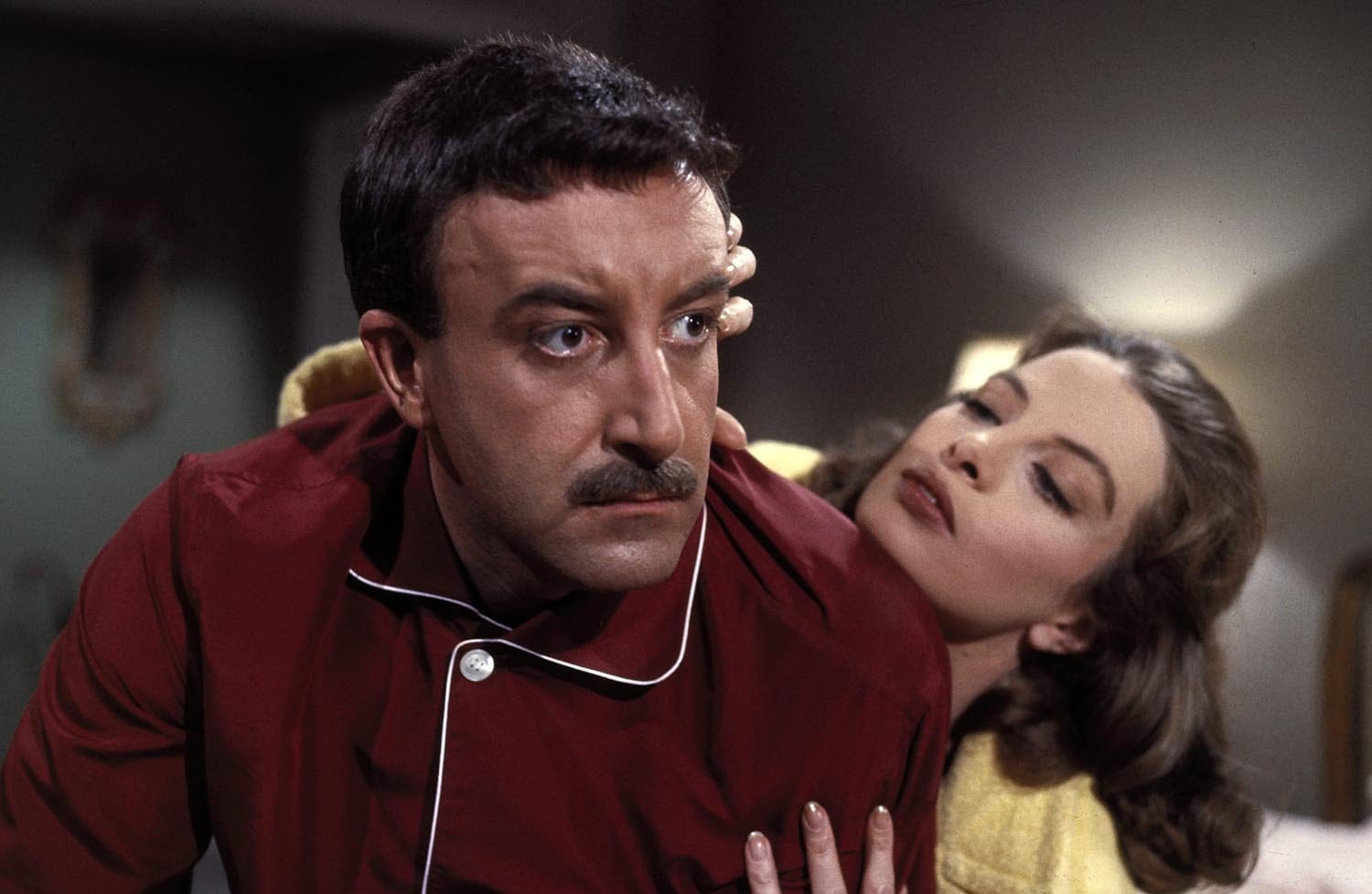
Any attempt to define the first five Blake Edwards-directed Pink Panther films starring Peter Sellers will inevitably privilege one defining element over others. Fixate on Sellers’s caricatured French accent, for instance, and you overlook that Clouseau’s voice and persona didn’t achieve a kind of complete consistency until the third entry, 1975’s The Return of the Pink Panther. In the first film, 1963’s The Pink Panther, Clouseau functions as an accessory to Sir Charles Lytton (David Niven), a jewel thief who’s having an affair with Clouseau’s wife, Simone (Capucine). The comedy stems not from investigative incompetence but from Clouseau’s inability to register events unfolding around him, even in his own hotel room.
In this respect, the first film resembles a drawing-room comedy stripped of any social problem, with the conniving upper-crust characters betraying one another as if to entertain themselves. Preston Sturges’s 1941 comedy classic The Lady Eve, about card sharks who target a socially awkward brewery heir, offers a useful point of comparison: a comedy of manners that becomes progressively unmannered as the characters’ deceptions take center stage.
The first film’s emphasis on elegance and opulence is inseparable from Edwards’s craft. Nowhere is this clearer than in the film’s primary setting, Cortina d’Ampezzo, where snow-covered mountains receive the same glamour treatment as Claudia Cardinale’s Princess Dala. The narrative even pauses for a prolonged musical interlude, as Fran Jeffries looks directly into the camera, seducing the viewer into Edwards’s cozy vision of an upscale screwball caper. Clouseau is almost incidental to the proceedings, suggesting that Edwards’s initial approach to these films lay less in developing the character than in how he’s entangled in schemes.
By 1976’s The Pink Panther Strikes Again, nearly every sequence is organized around Clouseau’s escalating pratfalls. Yet Edwards’s use of the anamorphic frame allows these gags to unfold within carefully arranged compositions, the screen densely decorated with color and architectural detail. The comedy grows louder and more violent, but the visual intelligence—the careful orchestration of space, movement, and timing—never collapses into mere disorder.
The structural pivot toward sustained physical comedy arrives in the second film, 1964’s A Shot in the Dark, which introduces Cato (Burt Kwouk), Clouseau’s manservant. Clouseau’s belief that he’s a master detective whose only flaw is complacency becomes the pretext for Cato’s surprise attacks, helping to transform the films into a series of self-contained slapstick encounters.
Where the first film exudes a dapper sophistication, the subsequent entries are defined by a Looney Tunes-esque energy. The most extreme expression of this tendency arrives at the end of The Pink Panther Strikes Again, when Cato attacks Clouseau as he lies in bed with Olga (Lesley Anne Down), causing the pull-down bed to snap back and send all three characters hurling into the air, and in slow motion, through a wall and into the Seine. By this point in the series, the escalation of slapstick has become the organizing principle of the films. Cato’s role, drawing on mid-century Western caricatures of Asian martial discipline, is consistently contrasted with Clouseau’s bombastic European buffoonery, and the collision between these modes of performance is a significant part of the series’s comic propulsion machinery.
Given this sustained emphasis on slapstick buffoonery, it’s hardly surprising that the series’s mysteries are rarely meant to withstand scrutiny. Narrative logic becomes secondary to the construction of set pieces, and narrative coherence gives way to the delights of visual invention. The Return of the Pink Panther pushes this logic to its limit when it’s revealed that Chief Inspector Dreyfus (Herbert Lom), driven mad by Clouseau’s shenanigans, has spent the entire film attempting to murder him and is subsequently committed to an asylum.
By 1978’s Revenge of the Pink Panther, the pursuit of the diamond has been abandoned altogether, and the animated panther—relegated to appearances in the opening and closing credits throughout the series—comes to feel like a conceptual North Star, as the film fully embodies the logic of a live-action cartoon. Edwards and Sellers work to push the films so far into madcap lunacy that coherence becomes beside the point, and the filmmaking becomes indifferent to anything beyond chasing the next expertly framed and composed gag.
The Pink Panther, A Shot in the Dark, The Pink Panther Strikes Again, and Revenge of the Pink Panther are now available on 4K UHD Blu-ray from Kino Lorber. The Return of the Pink Panther is available on 4K UHD Blu-ray on March 3, also from Kino Lorber.