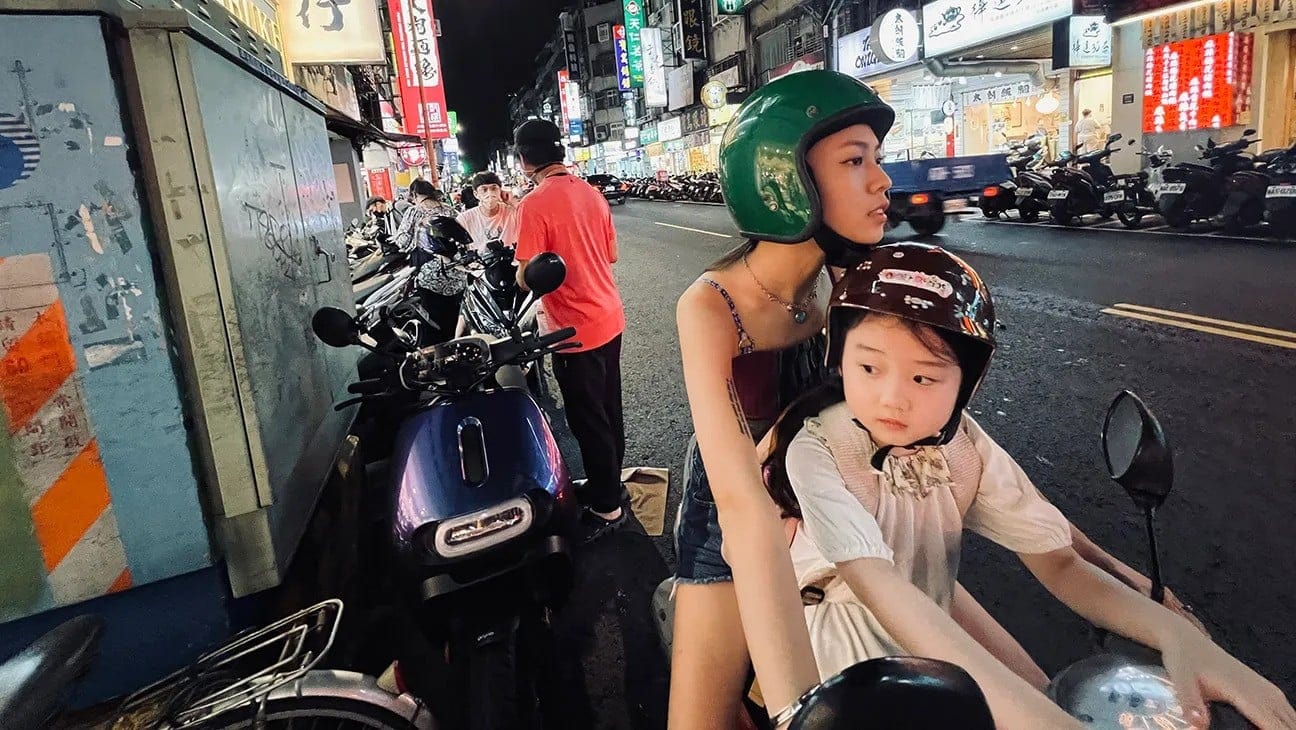
Shih-Ching Tsou co-wrote her solo directorial debut, Left-Handed Girl, with Sean Baker in 2010, which makes it feel like something of a long-lost prequel to the films that put Baker on the path to Oscar glory with last year’s Anora. Like The Florida Project, it stays close to a child’s point of view, and like Tangerine, it was shot exclusively on an iPhone. It also doesn’t lack for raucous comic set pieces and trenchant economic commentary.
Baker tends to center his films on scrappy protagonists with a single-minded focus on achieving success for themselves. Tsou’s multigenerational tale, though, isn’t out to turn the Horatio Alger myth on its head. Long before its climax, the film reveals a devotion to melodrama as it teases out the intersecting ambitions and intertwined fates between the characters on screen.
Against the bright neon lights of Taipei’s night market, single mother Shu-fen (Janel Tsai) opens a noodle stall in an attempt to scrape together enough money to crawl out of debt. She’s uprooted her family from their home in rural Taiwan and moved back to the country’s bustling capital. Yet this long-suffering matriarch gets more than she bargains for when the actions of the two children in her care, impressionable five-year-old I-Jing (Nina Ye) and rebellious 20-year-old I-Ann (Ma Shih-yuan), disrupt the lives of their extended friends and family.
The film’s most outsized character, I-Ann could have sprung from a Tennessee Williams play. But while Shu-fen’s eldest daughter, who throws responsibility to the wind in her pursuit of some kind of independence, might propel the story forward with the dilemmas created by her insolence, it’s the cherubic I-Jing who’s the gentle heart of Left-Handed Girl.
I-Jing doesn’t see her left-handedness as a badge of honor. Shu-fen’s old-school father (Akio Chen) is superstitious, believing that I-Jing’s dominant left hand is possessed by the devil. Like any child taught to see what comes instinctively to her as abnormal, this causes her to suffer from profound existential angst. Children tend not to swallow shame as easily as adults do, and I-Jing’s desire to suppress her true self spirals outward into a web of destruction.
Unwittingly, the girl’s attempts to deny what she’s inherited create a vortex that sucks down everyone around her. The naturalistic rhythms of the film’s more expository opening sections, made dynamic by Baker’s editing, disguise just how intricately plotted the screenplay is as it builds toward its grand finale. As consequences of I-Jing’s innocent antics mount, the bubble of her childhood naïveté bursts. Her point of view, which earnestly takes in the dilemmas faced by the women in her household, becomes a mirror of Tsou’s own curiosity and compassion.
The film moves from humanistic observation of the characters in constant motion to a climax that stops in a single location for a cavalcade of revelations. Tsou punctuates this airing of long-buried secrets by ending the sequence on an extended close-up of I-Jing processing her newly upended reality. It’s a remarkably nuanced journey to convey in one look from any actor, much less one so early in their career. In this face is all of Left-Handed Girl, as Ye, like Tsou behind the camera, translates the immensity of this sprawling saga into immediate, intimate detail.
Since 2001, we've brought you uncompromising, candid takes on the world of film, music, television, video games, theater, and more. Independently owned and operated publications like Slant have been hit hard in recent years, but we’re committed to keeping our content free and accessible—meaning no paywalls or fees.
If you like what we do, please consider subscribing to our Patreon or making a donation.