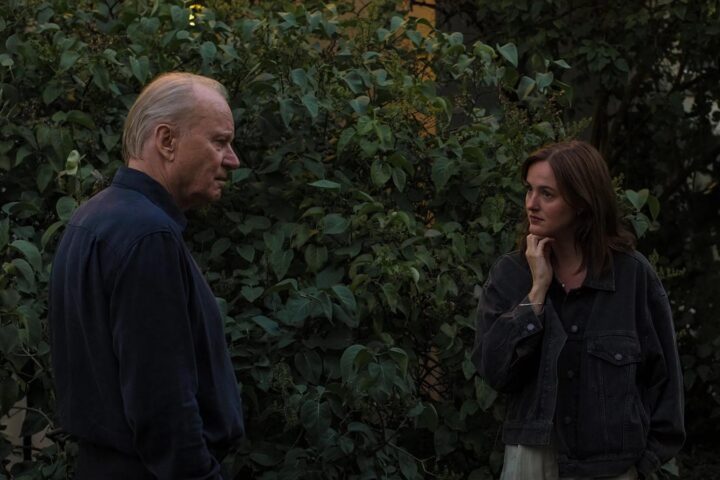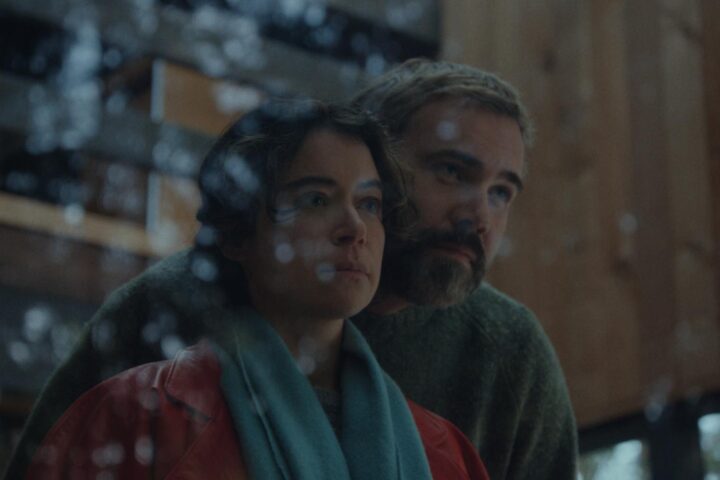
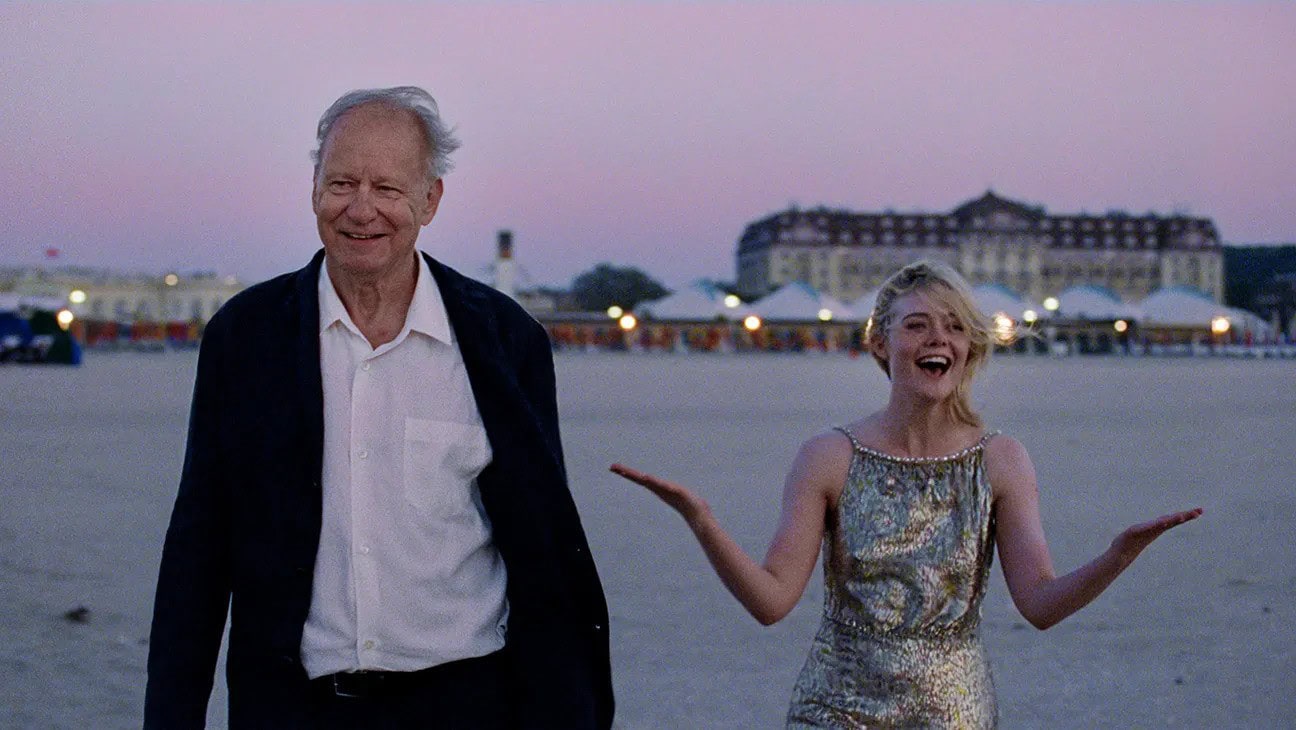
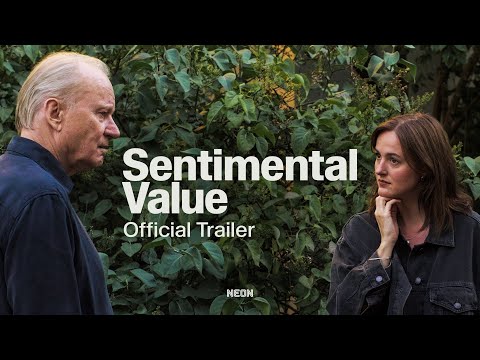
Within Joachim Trier’s Sentimental Value, it may initially seem that Stellan Skarsgård and Elle Fanning are starring in their own mini-movie. Skarsgård’s Gustav Borg, an acclaimed director, needs a new actress to headline his latest script after his estranged daughter, Nora (Renate Reinsve), turns him down. Gustav changes course and recasts the role with Elle Fanning’s Rachel Kemp, an American actress eager to dig her teeth into a meaty role.
The collaboration that ensues between Gustav and Rachel illuminates their approaches to their craft. Rachel’s struggles to crack open the character that Gustav casts her to play raise profound questions about the nature of working relationships between actors and directors. The role is based on Gustav’s late mother, and Rachel comes to the revelation that she’s interpreting a part that he wrote not just for, but also about, a disinterested Nora. Skarsgård and Fanning follow the lead of their own director, keeping their minds as open as their hearts when navigating situations where the boundaries between art and life prove porous for their characters.
I spoke with Skarsgård and Fanning shortly after Sentimental Value began its U.S. theatrical rollout. Our conversation covered what they look for in their directors, how they approached the lightly satirical elements of the film’s showbiz story, and why they don’t need their characters to relate to their own lives to find them worth playing.
When I interviewed Emily Watson a few years ago, she recalled Stellan’s advice during the making of Breaking the Waves: “Don’t aim for anything. Just let go.” She said she’s found it useful elsewhere, and I’d love to know if there were any moments where either of you were able to let go during the making of Sentimental Value…perhaps in one of Joachim’s infamous “jazz takes.”
Elle Fanning: I feel like that [advice] is very right for this whole experience. When you’re working with actors of this caliber and [greatness], you have to stay present and be able to react to each other. You do have to let go of any kind of preconceived notions of the scene, of how you wanted it to go, to be able to surprise yourself and stay spontaneous. Joachim welcomes that so much as a director. He creates this environment where you want to be vulnerable, and you can let go. So I think that wasn’t just in the jazz takes. That was the whole process for me.
Stellan, what about you, since you’re the originator of the quote?
Stellan Skarsgård: I listen to myself! I follow my own advice, thank you.
I loved when Gustav toys with Rachel about the supposed suicide stool just being something from IKEA. Art is all about lies in service of the truth, but what level of transparency do you need as actors when it comes to approaching your work?
SS: I don’t think I need a lot of transparency, but I don’t like to be manipulated. Then, I close up and start to fight against it. They’ve got to be honest with me, the directors. The less he says, the better. He can create an environment that’s fruitful and fertile for creativity, and we use that. He’s still the director. He’s in control. He’ll make us bigger or smaller, angrier or happier, or whatever. He can do that in the editing.
Gustav gives the direction “Find your own reason” as to the “why” of the suicide for the character Rachel plays. How do you balance discovering a character for yourself but also wanting guidance from your director?
EF: Joachim doesn’t overanalyze or over-intellectualize. As an actor, I don’t try to do that either. I think, particularly with the Rachel and Gustav relationship, it’s more that Rachel is discovering in real time that it actually isn’t about his mother. It’s about his daughter. So, there’s some truth when he says it’s not about my mother. Her realizing that she’s caught up in a family drama that she didn’t ask to be a part of is a little more why she’s confused. She’s starting to realize that maybe she isn’t the right or best person for the part.
But, for me, I also don’t need a ton of answers. I need to have a connection with the director. In the rehearsal period, we share stories together. We don’t look for a result in the acting sense of rehearsing the scene to death. That is not good to do. You want to have a nice rapport, and then it almost becomes telepathic in a way. Joachim is right next to the camera. He really sees you. He’s not off somewhere else. He sees every minute detail in your facial expression, and it all means something. For me, it just matters about the relationship more than anything.
SS: Yeah, I want them to say as little as possible. It’s in the script, and I want them to let me try to interpret the script and be free to do it. They can choose afterwards. The worst thing they can do is to come with detailed instructions like, “No, you say it like this!”
EF: Yeah, that’s very limiting. You might not have something that you could have discovered in real time! Those are the best moments.
SS: You have to surprise even yourself.
I think there’s sometimes a notion that films are things that need to be solved, and characters are people who, with enough digging, can have every contradiction resolved. Especially as I’m watching both of your heads nod, I’m guessing you don’t think that’s the right approach at all.
SS: That calls for simplifying humanity to cartoons. Art is good at expressing things that can’t be said in words and can’t be totally understood, like a painting or music. You have to be able to act that way too. There are a lot of things that I do that I don’t understand why, and that’s fantastic! Because that’s the mystery of it.
Do you ever go back and look at work you’ve done and realize the performance was actually serving to communicate something else?
SS: I don’t revisit them. I can’t enjoy seeing myself in a film, because I can’t feel anything.
Is it that you’re seeing all the artifice behind the film?
SS: It’s not even if I see the artifice behind it. Even if I don’t see the artifice, I still can’t emotionally get connected with it. [To Fanning] How about you?
EF: Yes, I agree. If I see something [I was in] from when I was very young, it’s more like I’m thinking about myself and what was happening in my life at that time. “I had a crush on that boy,” “I was in that grade,” that’s what I’m thinking. [The films] are almost like this album of baby books because they tracked my growing up, in some ways. Similarly, I don’t really lose myself in the character [when watching past work]. But there’s a tender place when I’m really young, I’m like, “Oh, that’s what she was going through!”
SS: We’re both child actors!
EF: Yeah, we can relate!
There’s another vision of acting expressed in the film through Rachel: the idea of her part being “good enough,” but it “just doesn’t have anything to do with me.” Do the parts you take need to have something to do with you?
EF: I don’t. I mean, acting is make-believe. It’s pretending, it’s putting yourself in environments and experiences that you’ve never experienced before. So I don’t completely feel that way, actually, but Rachel’s a different actress than me.
SS: I don’t think that. For instance, Baron Harkonnen [from Dune], I don’t think, has much to do with me.
Gustav’s mother is such a haunting mystery looming over the film, and I loved how the characters have different approaches to trying to solve her: Agnes through the archival material, then Gustav and Nora through artistic imagination. When you’re approaching a role, especially those with some tie to real people, how do you balance those two sources of inspiration?
SS: Well, if you want to do a school play, then you have to do the character as a historical character and be as factual as possible. I don’t believe in biopics. Everything has to be so subjective. The director has to have a passion about something within this character that happens to be a historical person, and then you find something there. Otherwise, it’s tedious.
EF: And it can be like a caricature of something. I agree. I always feel like the script is the bible for the story. But I mean, if you’re trying to play someone and they really have specific mannerisms and stuff, then…
SS: I think it could be fun to copy something and try to be exactly like the person! But that’s a different thing.
Your side of the story has some elements of show business satire, but it never feels overly goofy in a way that compromises the sincerity of Sentimental Value on the whole. How were you navigating that tonal balance?
EF: Well, we know what a press day feels like. We’re sitting next to each other doing the same thing, so you can’t help but want to make it accurate because we’ve both been in rooms in those situations. It does lend itself to knowing what that’s like.
SS: It’s also a comic-relief thing. We know the comic side of it, and we also know the tragic side of it.
What did Joachim’s casting of Cory Michael Smith and Catherine Cohen as Rachel’s team signal to you about the character?
EF: Oh my gosh, that look [imitating Cohen’s stare playing Rachel’s publicist] that she gives! My agent and manager watched the film at Cannes for the first time, and they were just dying. I think they saw a lot of themselves in them as well!
It was done with love, I could tell.
EF: Oh, completely!
There’s a quote I read from a Croatian director, Georgij Paro, who said, “A director acts in front of the actor, shows them the effect of the actors acting—which is what an audience does too.” Is there anything you will carry from the experience of analyzing the actor-director relationship in this film to other roles?
SS: That’s a complicated question. I haven’t thought about it. Can you give me five minutes? Oh, you can’t! [laughs]
EF: I don’t know if it’s specific to that, but I think the relationship of working with Joachim, I now feel quite spoiled. It was such an incredible film set and experience, and I want every director to be like him now. But he’s one of one in that regard.
SS: It’s the director, and then, of course, it’s the co-actors. You eat, swallow, and devour every expression they make to make you better.
Since 2001, we've brought you uncompromising, candid takes on the world of film, music, television, video games, theater, and more. Independently owned and operated publications like Slant have been hit hard in recent years, but we’re committed to keeping our content free and accessible—meaning no paywalls or fees.
If you like what we do, please consider subscribing to our Patreon or making a donation.