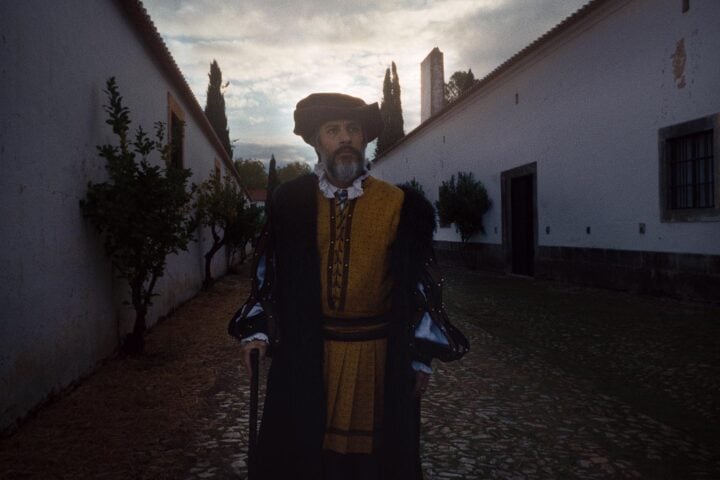
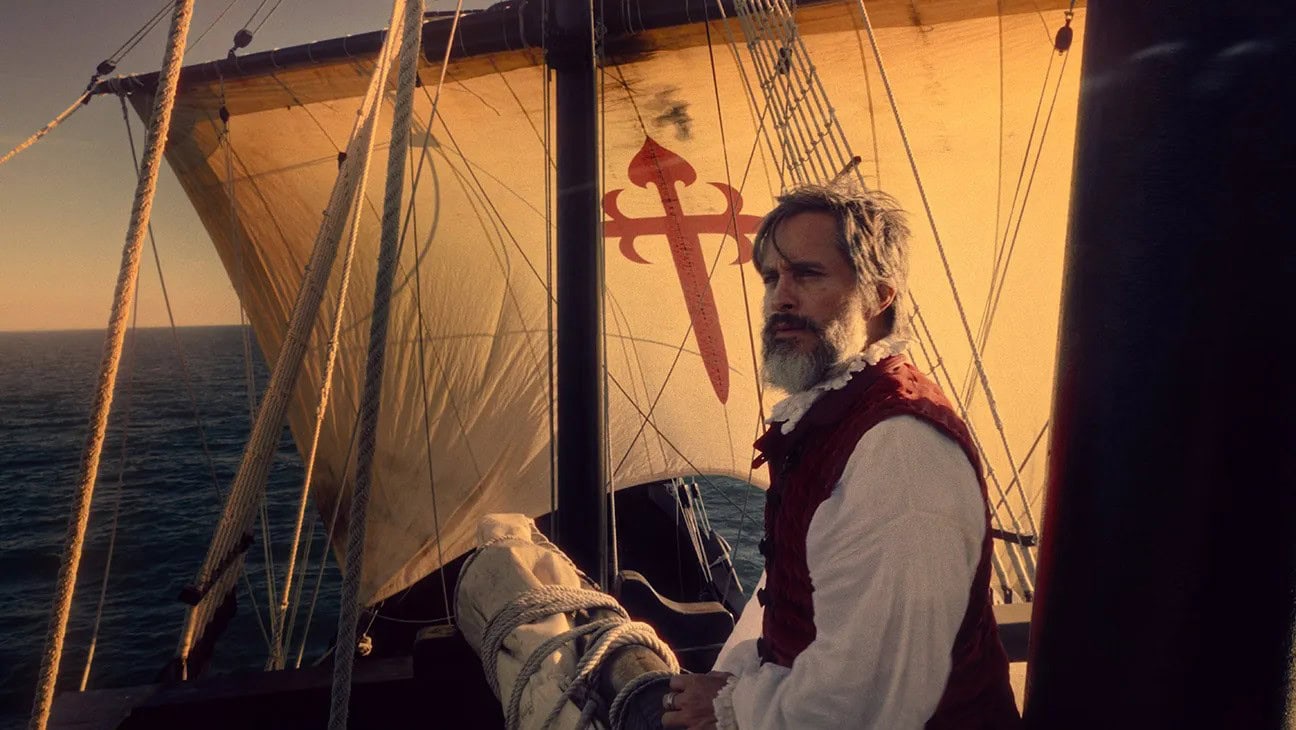
Lav Diaz has built his reputation making cheap, black-and-white, epic-length portraits of everyday Filipinos, so when his Magellan was first announced, it raised eyebrows among his fans. This is biopic made in color, and at least in its present 160-minute form, it hardly qualifies as an aesthetic endurance test. And at the center of it is an honest-to-God movie star, Gael García Bernal. But fears that Diaz has surrendered to the conventional are quickly assuaged by the film, which toys with expectations of what a biopic from the filmmaker would look like without turning into an insular meta-commentary on his work.
Magellan opens with the Malaccan people scurrying about, praising their gods, and readying their spears, and it’s quickly revealed that they do so after having sighted a white man. A sudden cut reveals a young Fernando Magellan (García Bernal) voyaging through a sea of dead Malaccan bodies as he looks for governor Afonso de Albuquerque (Roger Alan Koza), whose violent conquest in Malacca serves as preamble for Magellan’s own. The aged Portuguese conquistador delivers an address about suffocating the Earth, ridding the world of Islam through the conquering of Medina and Mecca, and bringing on the Second Coming of Christ all before he drops to the ground to thunderous laughter from his victorious soldiers.
Then, another sudden cut, this time to a dead Albuquerque, and now it’s our turn to laugh. Through a series of time jumps, we see Magellan blessed by the church and the Spanish crown to undertake his circumnavigating voyage. At an undetermined later time, his stoic face stands out among the jovial tavern crowd, suggesting a man who has difficulty finding solace, though he does find it in his marriage to Beatriz (Ângela Azevedo), whom the film’s rumored longer version supposedly centers on. As the voyage plods along, Magellan turns into a madman who can no longer tell legitimate mutiny from naïve concern among his crew. He lands in the Philippines, converts several locals, kills many others, and dies. No one, certainly not Diaz’s most ardent fans, will confuse Magellan for a romantic vision.
Are these time jumps, which collapse hours and even years, a deliberate choice to portray Magellan’s career in mere snapshots, or are they holes in the narrative that a longer work may fill? What isn’t shown can easily be assumed, such as Magellan’s further acts of madness aboard the Victoria, or assumed to have been too expensive to shoot, like the actual Battle of Mactan, which is elided in favor of presenting a string of the battle’s fallen along the beach. But why expect Diaz to stage an excessive battle like in Sergei Bondarchuk’s War and Peace or even the guerrilla combat of Apocalypse Now? He excels not in action but in portraiture.
When Magellan first arrives back from Malacca, a half-dozen women sporting their black mourning garb stand erect, unnaturally filling in the white space of the Iberian beach as they await the return of their loved ones. They don’t huddle around each other, bound by a mutual grief, suggesting instead figures in a René Magritte painting.
Diaz also frames the dead in this way, albeit with Francisco Goya’s sense of black humor, as Magellan simply steps and stumbles over them as he would a fallen branch. These strange, haunting compositions hint that Diaz is reaching for the fantastical, and, by the end, he even rewrites history. Magellan often takes the structure of a fairy tale, and fairy tales rarely honor time, often jumping decades in a single sentence and happening outside of temporality.
Which isn’t to say that history isn’t important for Diaz, whose prior works are explicitly political, like 2016’s A Lullaby for the Sorrowful Mystery, an eight-hour epic about the Philippines’s chief revolutionary. Clearly a lot of money went into Magellan’s historically accurate costumes, as well as a model reconstruction of the Victoria. The film bluntly puts its historical horrors on display, but it’s careful not to explicitly posit their causes. Diaz’s Magellan is a distant observer of new lands and customs until the locals’ “heresy” of keeping their idols ignites a rage that only appeared once before: in the mutiny aboard the Victoria. He leaves his priest stranded in what’s presumably the Amazon, which, in turn, leaves us to question whether his violent need to convert the Filipinos stems from actual religious fervor or a more terrestrial mania.
Despite its bevy of corpses, Magellan is one of the most beautiful movies of the year. Cinematographer Artur Tort channels his past work throughout, sprinkling this film with the pink skies of Pacifiction and the blood reds of Afternoons of Solitude. Harsh midday light and even the golden hour are avoided in favor of the pink-orange hue that appears at dusk and diffuses through the ship’s sails, and night scenes are lit with natural light except for the harsh lamp that bathes the victor of the Battle of Mactan in a glow meant for fairies or ghosts.
Similarly, Beatriz’s white dresses shimmer in a Vaseline haze, suggesting an Old Hollywood’s close-up. The ethereal Beatriz appears in Magellan’s dreams, but his reality appears no less strange across the film. Fernando Magellan’s journey and his conquest of the Philippines are historical fact, but Diaz’s Magellan suggests a series of medieval tapestries depicting the knight-errant who, in his dragon-like mania, slew and was slain. That such a tale is woven enchantingly only adds to the mythic quality of historical horror at its center.
Since 2001, we've brought you uncompromising, candid takes on the world of film, music, television, video games, theater, and more. Independently owned and operated publications like Slant have been hit hard in recent years, but we’re committed to keeping our content free and accessible—meaning no paywalls or fees.
If you like what we do, please consider subscribing to our Patreon or making a donation.