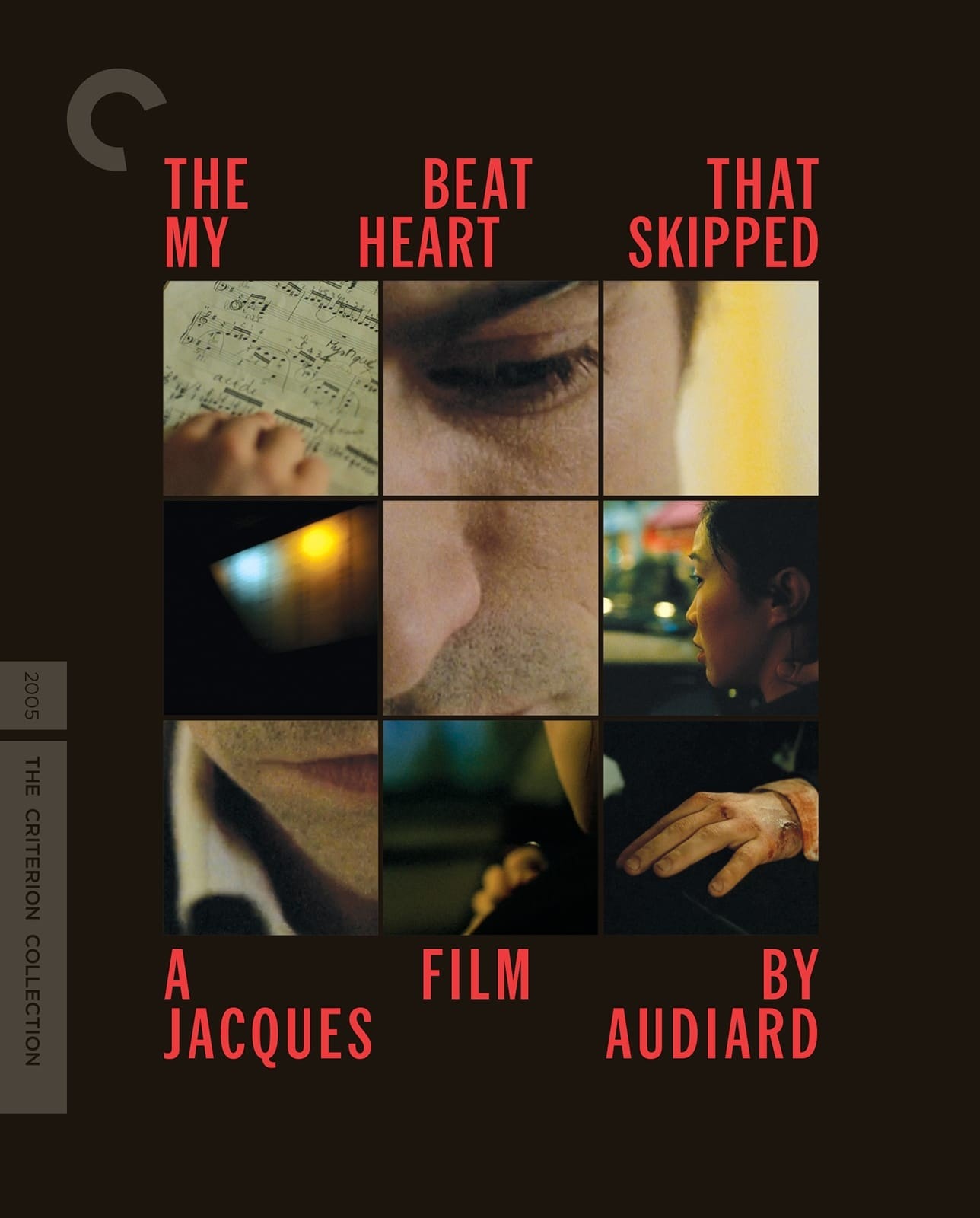
 Jacques Audiard’s The Beat That My Heart Skipped, a remake of James Tobak’s Fingers, substitutes the earlier film’s bleak psychosexual head games with a more straightforward tale of one man’s warring allegiances to his father and mother. Tom’s (Romain Duris) shady dealings as real estate broker stand in stark contrast to his dream of being a concert pianist. He’s a man at odds with himself, his nimble fingers employed for contradictorily aggressive and artistic purposes, and Audiard’s inharmonious mise-en-scène—preoccupied with the contrast between light and dark, moral and immoral, hope and resignation—deftly enhances his film’s meditation on the contrary nature of masculinity and filial loyalty.
Rather than attempt to match Harvey Keitel’s drop-of-a-dime explosiveness from Fingers, Duris is all pent-up jitteriness. It’s hard to fathom such a roughneck obsessing over Bach, yet the dashingly disheveled Duris is a magnetic presence, utilizing his shifty eyes, frantic hand movements, and inscrutable smile to ably convey his characters’ inner strife.
When his late pianist mother’s former manager, Mr. Fox (Sandy Whitelaw), offers him an audition during a chance encounter, Tom, who hasn’t seriously tickled the ivories in 10 years, finds himself at a crossroads. And his situation becomes even more complicated when he decides to openly rebel against his alpha-male co-workers—whose use of rats to scare tenants from their homes speaks to their unscrupulous sleaziness—by beginning a torrid, clandestine affair with his adulterous friend Fabrice’s (Jonathan Zaccaï) wife, Aline (Aure Atika).
As in Fingers, Tom is driven to violence by his father’s (Niels Arestrup) guilt-laden request that his son help collect unpaid debts from a big-time gangster. Audiard and co-writer Tonino Benacquista also retain many of that original film’s key events (including Tom’s expletive-filled phone call at a country club swimming pool, and a bloody encounter in a stairwell), as well as its semi-misogynistic portrait of women as either whores or saints.
This remake’s biggest departure from Fingers involves a Chinese piano teacher, Miao Lin (Linh-Dan Pham), who’s just arrived in Paris and speaks no French. The polar opposite of Tom’s controlling father—who derisively dismisses his desire to resume his dream of playing the piano and hypocritically disparages Mr. Fox as “a pimp”—Miao Lin is Tom’s chance at salvation, and her inability to verbally converse with her pupil serves as a symbolic representation of the aspiring pianist’s cathartic struggle to communicate with his artistic instincts.
Audiard captures Tom’s journey toward maternal embracement (via his music career) and paternal denunciation (and the corrupt real estate business that his old man represents) with a relentlessly subjective camera. He creates an intimate proximity through single-take sequences featuring tight close-ups—regularly positioned just below Tom’s five o’clock shadow-covered face, or on his hands as they caress piano keys or Aline’s body—and handheld tracking shots from behind his protagonist’s back. Photographed with off-the-cuff immediacy by Stéphane Fontaine, the film depicts Tom’s precarious balancing act between two worlds by way of washed-out cinematography that’s alternately jumpy (during the depictions of real estate work) and measured (during action confined to Miao Lin’s brightly lit apartment).
Often, this bifurcated visual structure mirrors The Beat That My Heart Skipped’s thematic fixations a tad too neatly, and discussions about how sons paradoxically wind up “fathering” their aging, needy dads—an aside which relates to the central subject of manipulative parent-child relationships—feels overly obvious. Yet Audiard infuses his drama with portentous momentum that’s unforgettable, and his rosy-eyed finale involving Tom’s opportunity to alter his wayward course—a conclusion at variance with the story’s preceding cynicism—serves as an ironically apt ending for a film so doggedly steeped in opposition.
Image/Sound
While it’s somewhat disappointing that the film wasn’t digitally remastered for this release, the HD master that was used still offers fairly strong image detail and even grain throughout. The colors are mostly muted, but the flashes of red peppered throughout are vibrant, and there’s a decent range of colors even in the many earthy tones. The 5.1 surround audio track fairs better, boasting depth and resonance both in its presentation of Alexandre Desplat’s lush score and bustling backgrounds of the film’s seedy Parisian locations.
Extras
In a new interview, Jacques Audiard discusses both what he loves and dislikes about Fingers and what drove him to want to remake it. Elsewhere, co-screenwriter Tonino Benacquista discusses how he and Audiard sought to improve on James Toback’s script by expanding the protagonist’s connection to the world outside of the mob. Composer Alexandre Desplat also shares his thoughts in an archival interview, detailing Audiard’s approach to music and the exciting challenges that came with having no references for this particular score.
The disc also includes the press conference from the film’s 2005 Berlinale premiere, some rehearsal footage, and deleted scenes featuring commentary by Audiard. Rounding out the package is a foldout booklet with an essay by critic Jonathan Romney, who teases out the film’s distinctive rhythms as well as its divergences from the source material.
Overall
The Beat That My Heart Skipped gets a long-overdue release on Region 1 Blu-ray, but given Criterion’s high standards, it’s disappointing that the film hasn’t gotten a restoration.
Since 2001, we've brought you uncompromising, candid takes on the world of film, music, television, video games, theater, and more. Independently owned and operated publications like Slant have been hit hard in recent years, but we’re committed to keeping our content free and accessible—meaning no paywalls or fees.
If you like what we do, please consider subscribing to our Patreon or making a donation.