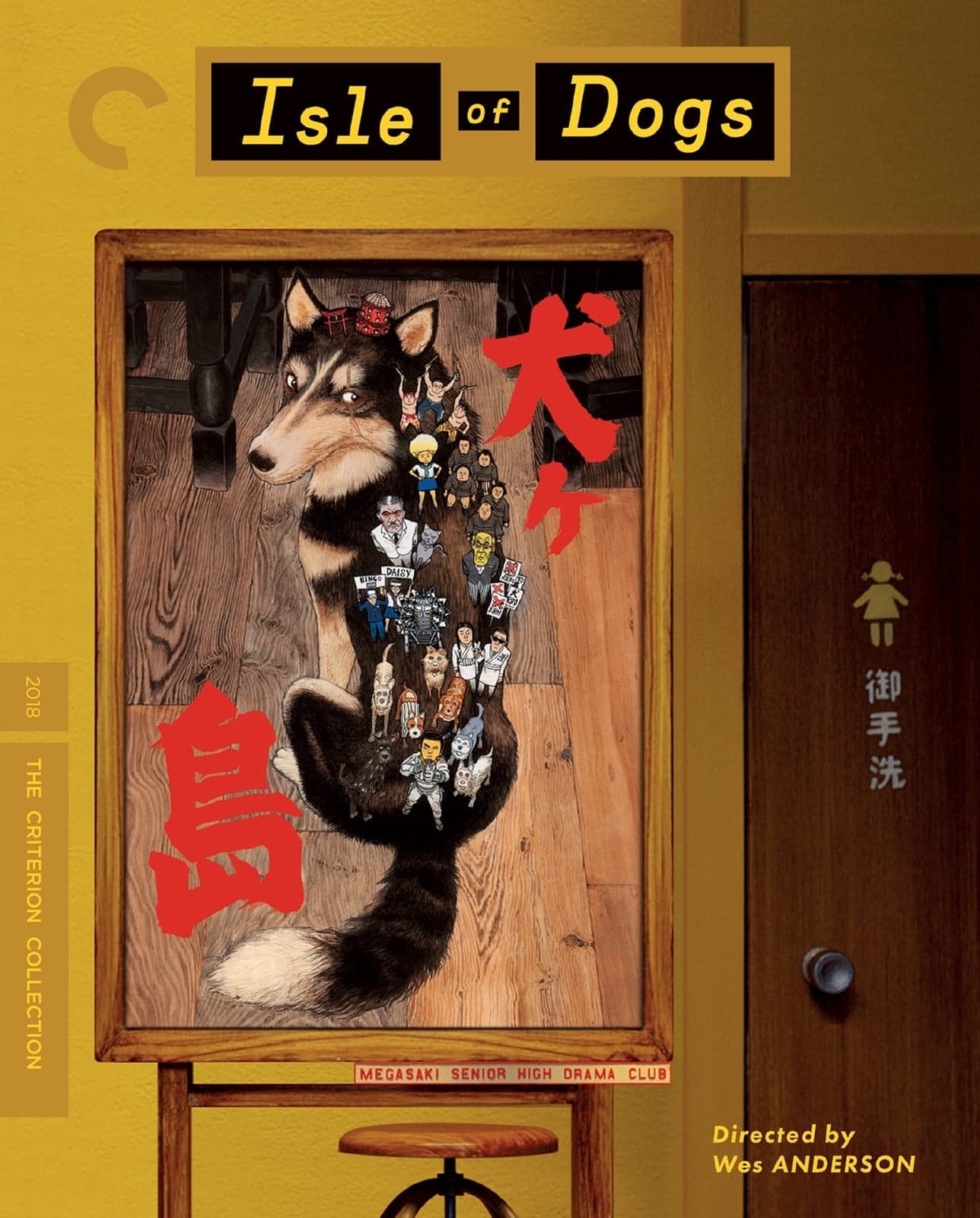
 A seeker and maker of symmetrical images that intuitively please the eye, Wes Anderson may well be the most aesthetically influential filmmaker of the last 20 years. The visual accomplishment of his stop-motion feature Isle of Dogs is practically brain-breaking, a leveling up from 2009’s already gorgeous Fantastic Mr. Fox that will be pored over by animation heads for generations. Naturally, its strongest moments are tableaux: two-dimensional at first glance, yet given extraordinary depth and detail. The innate imperfection of canine hair, matted differently in every frame, gives Anderson’s lovingly crafted dioramas the illusion of life.
From this, one can glean a workable analogy for an auteur whose Achilles’ heel has always been his obsession with fencing human characters inside locked-off, static frames. Even if Isle of Dogs is at once Anderson’s densest and fleetest film to date, it’s nevertheless obsessive-compulsive enough to make the occasional handheld shots from 2001’s The Royal Tenenbaums and 2004’s The Life Aquatic with Steve Zissou seem daring and experimental in retrospect. The film corroborates the joke that Anderson works most confidently with puppets and models, as they’re properly suited to these kinds of immaculately constructed dollhouses of cinema.
Isle of Dogs takes place in a dystopian Japanese city called Megasaki “20 years into the future,” where dogs have been scapegoated for carrying toxic diseases and relocated to a grim island used as a garbage dump, by fiat of the despotic, square-shouldered Mayor Kobayashi (voiced by Nomura Kunichi, who helped conceive the story with Anderson, Roman Coppola, and Jason Schwartzman). Kobayashi’s orphaned nephew, Atari (Koyu Rankin) flies to the island in search of his deported pet, Spots (Liev Schreiber), who the other animals speculate may have in fact been “dog zero.” A band of displaced dogs voiced by A-list celebrities decide to help him, even though their de facto leader, Chief (Bryan Cranston), has his doubts.
The ensuing plot is an elongated workout in finding new ways to cleverly pictorialize what have become Anderson’s signature tropes: the tragically aborted childhood (Atari), the team breaking up and reuniting (the dogs), and the final cathartic breakthrough riffing on both action movies and Hollywood musicals. What’s being innovated is the form—and Anderson’s belief in form as substance nearly absolves Isle of Dogs from anything approaching sociopolitical consciousness.
Then again, Isle of Dogs is surprisingly bleak for an ostensible kids’ film: Kobayashi’s pro-dog scientist opponent is assassinated (a poisoning rebranded by news media as suicide), and three dogs are incinerated in one of the island’s processing plants (spoiler: they survive). Himself a throwback to the autocratic nationalists of imperial-era Japan, Kobayashi sends drones and robot dogs to the island to retrieve Atari and terrorize his newfound posse—and their sinister eyes and gnashing teeth could be modeled after Toho’s Mechagodzilla from the 1970s.
These twee phantasmagorias are finer-grained in their references than Fantastic Mr. Fox or 2014’s The Grand Budapest Hotel (which stole from Soviet-bloc animators Ladislas Starevich and Karel Zeman, respectively), but the conditions of late capitalism worldwide are such that it’s worth asking why Anderson had to set this fairy tale in the real-life country of Japan. Using feudal history (Kobayashi’s hatred of dogs traces back to a feud between shogunates) and remixed anime tropes (the characters appear hand-drawn on TV screens and faux woodcuts), the film yields only aesthetic answers: The images may be rich, but their context is shallow.
Worse still is an American exchange student, Tracy (Greta Gerwig), with a crush on Atari, and who leads a campaign to turn the tide of public opinion against Kobayashi, thus reifying old stereotypes about Japanese passivity. Ostensibly for laughs, one scene sees Tracy throttling a crestfallen Japanese scientist (voiced by—and inexplicably named after—Yoko Ono) by the neck. Given the painstaking frame-by-frame choreography of a film like this, it seems Anderson failed to fully consider how this might come off to an even remotely skeptical audience.
Whatever this plotline accomplishes, it’s unflattering to the Japanese at best. The bulk of Isle of Dogs’s Japanese dialogue goes untranslated unless it’s a public pronouncement, a sticker, or a sign—perhaps an acknowledgement on the filmmakers’ part that they can’t fully “go there.” But just as American audiences can enjoy Godzilla movies or Otomo Katsuhiro’s Akira as pure escapism, their connotations are different for Japanese viewers, harkening back to the country’s never-ending deference to the United States after World War II. If you’re willing to consider Japan beyond the elegant tropes invited by sumo wrestlers, sushi, and cherry blossoms, then this film can only register as a gorgeously baroque failure.
Isle of Dogs’s invocations of corruption and militarism (including multiple punctuative mushroom-cloud gags, as if the crest of a hydrogen bomb were specifically Japanese) should leave a sour taste in the mouth of anyone unable to abandon the thought of the world outside of the film’s perimeters. Anderson is clearly a massive talent working, again, in his prime. However uncomfortable, it’s crucial to ask what gives him the right to romp around in all these signifiers in service of bespoke whimsy—but then the word for it isn’t “right,” but rather privilege.
Image/Sound
Criterion’s transfer of a new 4K digital master is flawless, with every miniscule, carefully curated detail and texture immaculately presented. The remarkable image depth really highlights the intricate layers upon layers of visual information provided by Wes Anderson and his collaborators, while the range of colors is suitably impressive in what may be the director’s most varied palette. On the audio front, the 5.1 surround presentation features a well-balanced mix with a strong separation between the music, sound effects, and crystal-clear dialogue.
Extras
In a new audio commentary, Anderson talks about his love for Japanese cinema and culture as well as the various direct influences on Isle of Dogs. The filmmaker also touches on the many facets involved in the making of a stop-motion animated film, covering the artistic efforts of many members of the production team. Jeff Goldblum pops in a few different times to chime in on his character and memories of making the film.
Outside of the commentary, one of the more intriguing extras is the storyboard animatic, which, at 90 minutes, allows you to see the early concept work of the animation and how much work went into Isle of Dogs even before the cameras started rolling. Elsewhere, a video essay by filmmakers Taylor Ramos and Tony Zhou concisely breaks down the many stripes of visual comedy that Anderson employs throughout his work, and an array of short making-of featurettes offer fascinating insights into the nuts and bolts of the stop-motion production process, as well as glimpses of the actors recording their voice over and visiting the set.
We also get an assortment of animation tests and visual effects breakdowns that further reveal the massive amount of care and craft that went into the film, while a time-lapse video shows how labor-intensive the stop-motion process is. Rounding out the package are a series of studio-produced featurettes, a poster by artist Otomo Katsuhiro, and a booklet with an essay by critic Moeko Fujii, who focuses on Anderson’s fascination with outsider characters and the level of communication between dogs and humans in the film.
Overall
Criterion has outfitted Wes Anderson’s stop-motion film with a stunning new transfer and a slew of extras that attest to the TLC that went into its creation.
Since 2001, we've brought you uncompromising, candid takes on the world of film, music, television, video games, theater, and more. Independently owned and operated publications like Slant have been hit hard in recent years, but we’re committed to keeping our content free and accessible—meaning no paywalls or fees.
If you like what we do, please consider subscribing to our Patreon or making a donation.