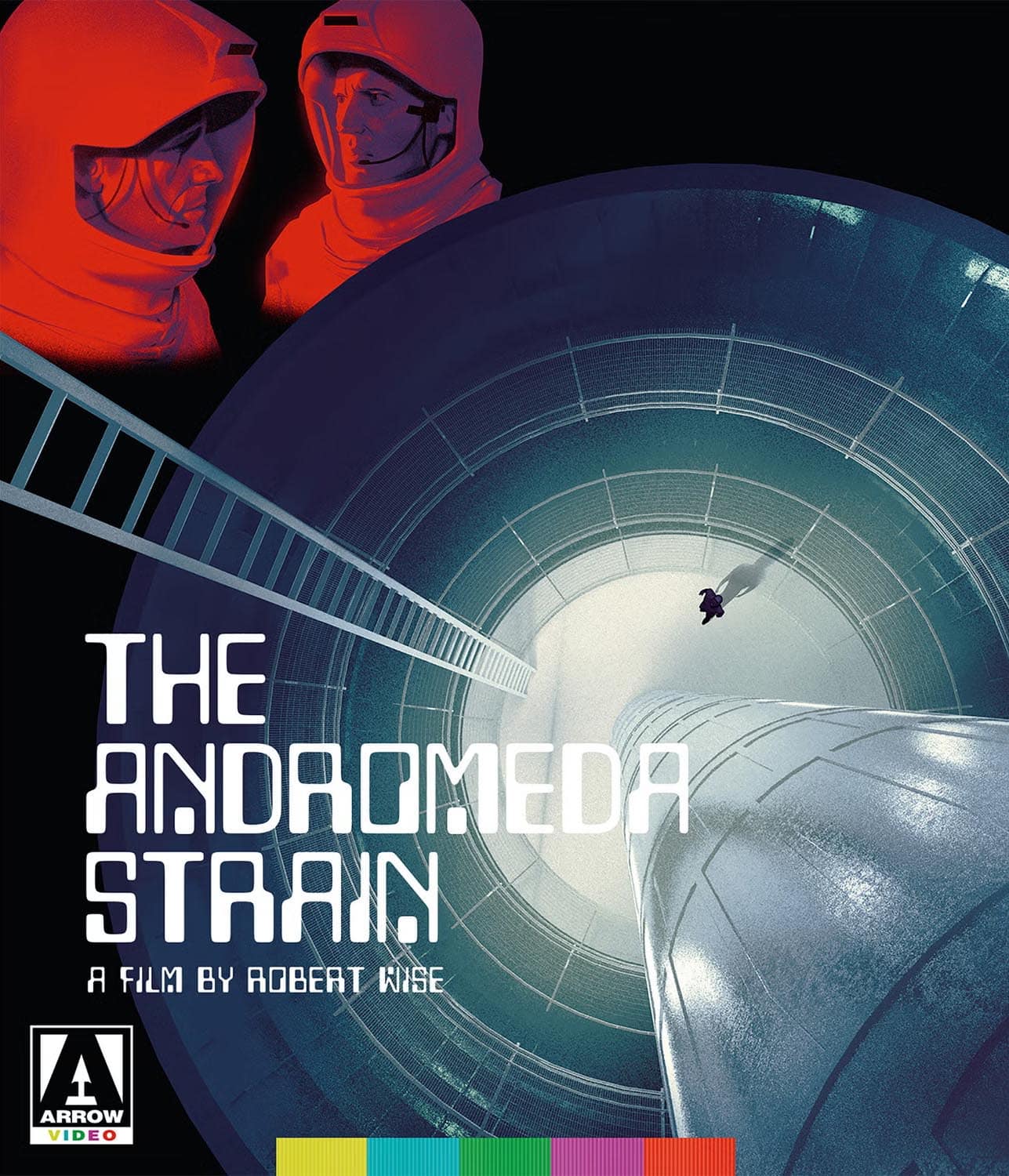
 Robert Wise’s adaptation of The Andromeda Strain retains much of the Michael Crichton novel’s emphasis on the minutiae of efforts to contain a deadly extraterrestrial microorganism while blending in elements of a procedural thriller and a disaster film. As lensed by Richard H. Kline, the Panavision imagery conjures a sense of impending doom, as almost every resident in a small New Mexico town is found dead after a U.S. military satellite crashes nearby, but it’s Boris Leven’s art direction, especially within the laboratory where a group of scientists gather following news of the disaster, that gives the film its distinctively clinical look and feel.
Nelson Gidding’s script methodically moves toward a climax in which the disarming of a bomb inside the lab could prevent humanity’s extinction. Days prior, the U.S. military activates a covert operation involving a team of scientists, foremost among them Dr. Stone (Jeremy Hall) and Dr. Hall (James Olson), to study traces of the alien organism, later named Andromeda, to determine how and why it kills—and, naturally, how to prevent it from spreading.
There are no chase scenes, no shootouts, and hardly even a shouting match among the scientists. Throughout, the filmmakers place particular emphasis on the scientists’ procedure, from the jargon-heavy dialogue about the size and nature of the disease to how the victims’ blood has turned to powder. The initial discovery of a town full of dead people is particularly chilling for how silently the film plays it, surveying the gruesome terrain without aiming to heighten the quiet terror with, say, loud screams or a blaring score.
Wise also employs various visual techniques, such as split-screen and split-diopter shots, to amplify the sense of claustrophobia within the lab. And with the assistance of visual effects artist Douglas Trumbull, whose work on 2001: A Space Odyssey practically invented modern effects work, data displays, simulations, and scientific readouts play less like lectures than light shows, giving striking contrast to the ongoing discussions among the scientists.
In a significant change from the novel, a character rewritten as female for the film, Dr. Ruth Leavitt (Kate Reid), serves as implicit critique of the gendered assumptions of the era’s scientific culture. In fact, Wise reportedly had to be convinced by Gidding that having a female scientist as a clinical pathologist, and not merely as set decoration, would be believable to viewers, let alone to the scientific community. And although gender doesn’t become an explicit point of tension in the film, a number of moments, such as a decontamination sequence where everyone has to disrobe, indicate how The Andromeda Strain pushes the envelope in subtle ways throughout.
Image/Sound
According to the booklet included with this Arrow Video set, “The Andromeda Strain has been exclusively restored by Arrow Films and is presented in its original aspect ratio of 2.35:1 with mono audio.” Arrow previously released the film on Blu-ray in 2019, and while this 4K UHD edition appears to be using the same 4K transfer, the native 4K presentation, combined with both HDR10 and Dolby Vision, is stunning. The upgrade is remarkable for its intricate color detail, allowing the full scope of Douglas Trumbull’s visual effects to be truly appreciated. There are no discernible flaws in the image, and grain remains present throughout while never seeming artificially manipulated. The mono audio track sounds clean and clear, and it packs surprising oomph whenever Gil Mellé’s ambient electronic score fills the soundstage.
Extras
The extras have all been ported over from Arrow’s 2019 release, which is a little bit of a letdown given that a global pandemic happened between then and now. In fact, an interview with critic Kim Newman emphasizes the film’s contemporary resonances with a number of 21st-century outbreaks, all preceding Covid-19. The audio commentary by critic Bryan Reesman is simultaneously an appreciation, a history lesson on the disaster film’s emergence in the 1970s, and an analysis of various scenes for how they’re constructed. There are two featurettes, both directed by Laurent Bouzereau in 2001, that feature interviews with, among others, Robert Wise, Nelson Gidding, and Michael Crichton. We also get a gallery of highlights from the annotated and illustrated shooting script, the theatrical trailer, TV spots, and radio spots. The included booklet also contains writing by Peter Tonguette and some archival materials, such as “A Discussion Guide for Students and Teachers” by Tom Andrews, Director of Dramatics at Kent School, which was part of the original publicity campaign for the film’s release.
Overall
Robert Wise’s The Andromeda Strain, a hard-sci-fi procedural slash disaster thriller, is a fascinating early example of large-scale blockbuster filmmaking with a brain.
Since 2001, we've brought you uncompromising, candid takes on the world of film, music, television, video games, theater, and more. Independently owned and operated publications like Slant have been hit hard in recent years, but we’re committed to keeping our content free and accessible—meaning no paywalls or fees.
If you like what we do, please consider subscribing to our Patreon or making a donation.