
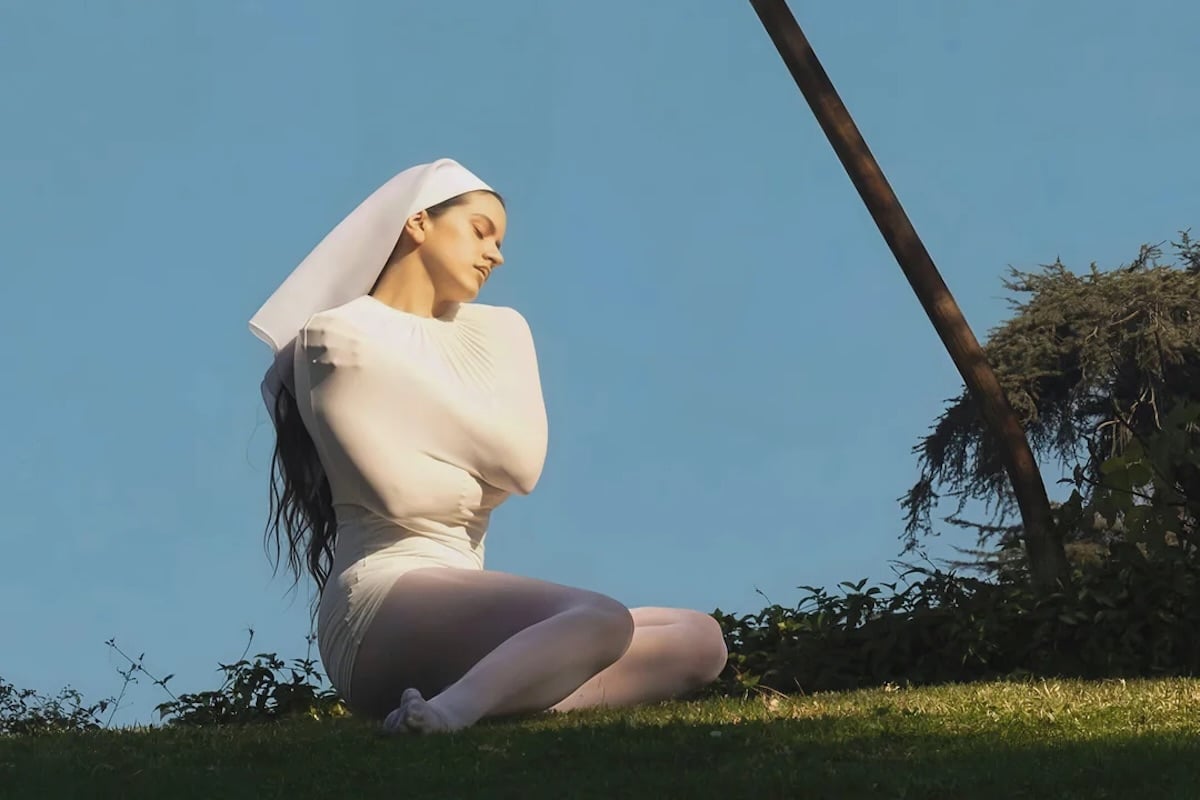
Rosalía is nothing if not ambitious. The Spanish singer-songwriter’s albums have tackled disparate genres, from the new flamenco of her 2017 debut, Los Ángeles, to the eclectic hybrid of pop, reggaetón, and dembow of 2022’s Motomami.
Thematically and structurally, Rosalía’s discography is equally as diverse. Her 2018 album El Mal Querer was inspired by Romance of Flamenca, with each track corresponding to a chapter of the anonymous Occitan novel. And her latest, Lux, takes place across four movements, this time with each song speaking to the experiences of a different female saint.
Rosalía sings in 13 languages throughout the album, accompanied by the commanding presence of the London Symphony Orchestra. Much like Björk, who’s featured on “Berghain,” Rosalía employs these orchestrations in service of rhythm, at times in place of actual drums: The track’s tympani and strings reinforce guest Yves Tumor’s threat to “fuck you till you love me.”
The skittering percussion and distorted samples of songs like “Focu’Ranni” gesture outside this rarified world. The past and the present coexist across Lux’s 18 tracks. Rosalía embraces the more contemporary, glitchy beats of hyperpop on “Reliquia,” but there are also traces of traditional flamenco on “Memoria” and “La Rumba del Pardon.”

Each language featured on Lux provides its own rhythm, and the shifts between them, like the swing from German to Spanish to English on “Berghain,” define the songs’ various moods. The first verse of that song is operatic, and Rosalía’s vocals are breathy and vulnerable on “Divinize” and “La Yugular,” while “De Madruga” and “Novia Robot” see her full-on rapping.
The album’s lyrics find reflections of Rosalía’s own experiences with love and fame in the lives of saints. And her desire to assert her worth as a woman and artist exists in parallel to a fixation on the place of women in Christianity. She makes plain her disappointment with the material world, and the distance between loving God and individual people. On “Novia Robot,” she’s “pretty for God” but “never for you, never for anyone.”
On “La Perla,” Rosalía disses a former lover, calling him an “emotional terrorist.” At one point, she hilariously quips, “His masterpiece is his bra collection.” Elsewhere, the images that Rosalía’s stories conjure are poetic, poignant, and precise: On “La Rumba del Perdon,” she describes a friend stealing her partner’s drugs by hiding them inside a guitar.
Lux is ambitious, challenging, and provocative. But it rewards patience—and repeat listens—as you luxuriate in the breadth of Rosalía’s transcendent world.
Since 2001, we've brought you uncompromising, candid takes on the world of film, music, television, video games, theater, and more. Independently owned and operated publications like Slant have been hit hard in recent years, but we’re committed to keeping our content free and accessible—meaning no paywalls or fees.
If you like what we do, please consider subscribing to our Patreon or making a donation.




What made you give this masterpiece a 4 out of 5? I’m genuinely curious — this album is a groundbreaking bulldozer in a pop scene that’s literally dying before our eyes.
Totally agree, Adler.
Five stars are there to be given on rare occasions, and LUX is a one-off masterpiece. If this one doesn’t get five stars, what does?