The Emmanuelle franchise—comprising seven official films, ancillary projects (including the Black Emanuelle films and the Emmanuelle in Space TV series), and a 2024 reboot—began with the anonymous publication and clandestine distribution of the eponymous book in 1959. It would be another eight years before it was republished under the pseudonym Emmanuelle Arsan, who was eventually revealed to be Marayat Rollet-Andriane, the Eurasian wife of a French diplomat, whose life among the international jet set and embrace of an open marriage very directly informed the contents of the book. Severin has assembled a terrific box set that puts the original trilogy together with a real historical curiosity: an in-name-only Emmanuelle film that predates the 1974 release of Emmanuelle by five years.
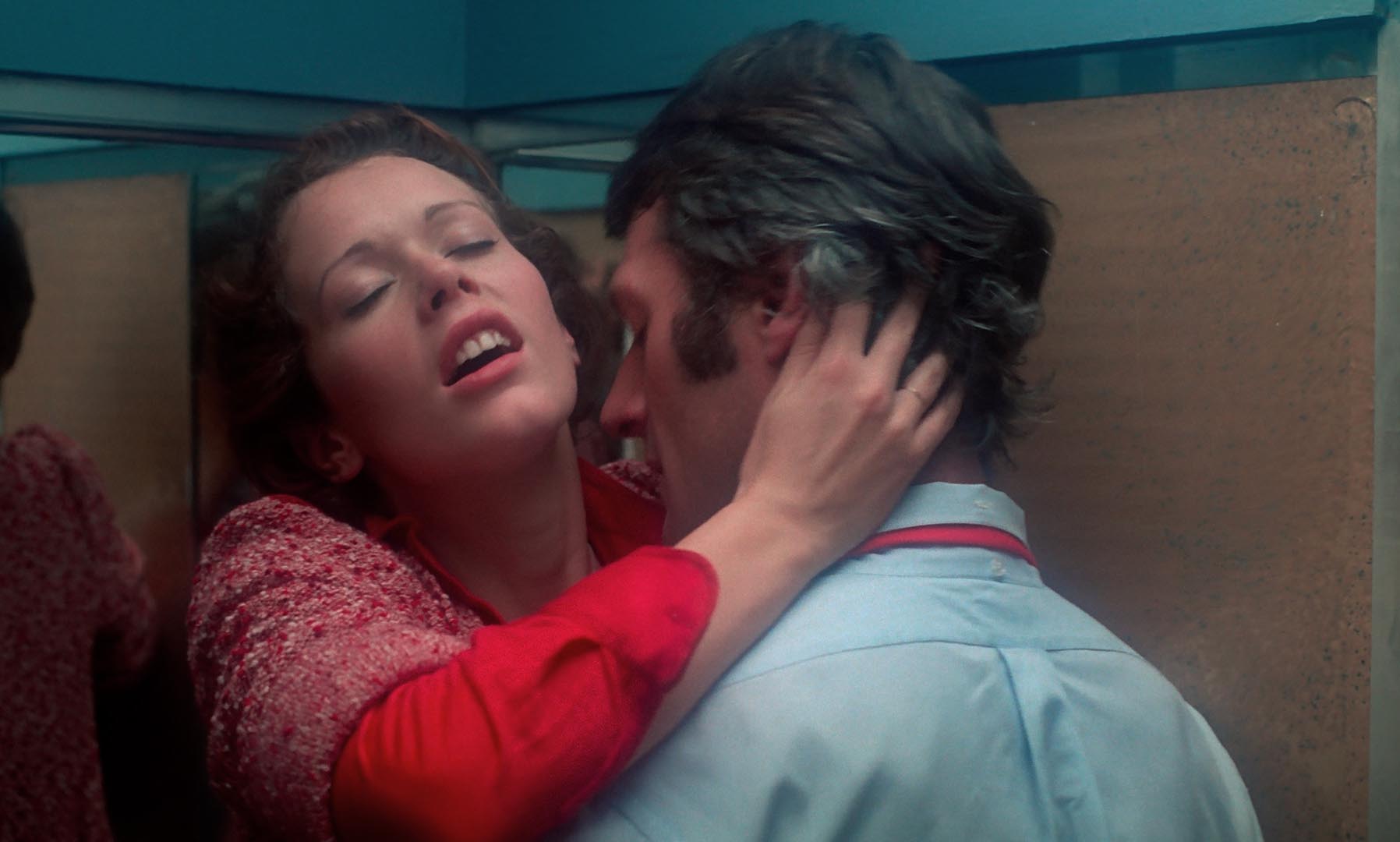
Emmanuelle, from 1974, sets the template for its sequels. Emmanuelle (Sylvia Kristel) travels to an exotic location, in this case Bangkok, to meet her husband, Jean (Daniel Sarky here, Umberto Orsini in the sequels), and engage in a series of sexual encounters. In the first film, these are framed as the erotic education of Emmanuelle under the tutelage of Jean and then Mario (Alain Cuny), a local libertine. Director Just Jaeckin gives the proceedings a gauzy, soft-focus aesthetic that complements both the copious flesh on display as well as the exotic locations.
Because the key word for this series is exhibitionism. Bodies and locations are continually on display not only for audiences but also for the characters. Mario, who only enters the first film in its last stretch, provides a theory of eroticism that carries through all three films, one that’s compounded from equal parts Bataille (limits, transgressions) and Rimbaud (a prolonged “unsettling of the senses). He also espouses a rather unusual take on spectatorship: that sex should include odd numbers to make voyeurism all the easier.
From the very beginning of Emmanuelle, the role of the gaze is emphasized. When Emmanuelle and Jean make love under a mosquito net, two members of the household staff look on, before the houseboy decides to enact what he’s just been watching with the maid. Jaeckin, a former professional photographer, shoots the sex between the married couple largely from a discreet distance, but when the “natives” take over, it’s all handheld camera from alternate viewpoints. This camerawork echoes an earlier scene where Emmanuelle recoiled in horror from the gaze of street urchins and leprous beggars, shot from her cowering point of view.
Each of the characters Emmanuelle encounters over the course of the film represents a different erotic or romantic possibility. Jean offers a guilt-free open marriage. Bee (Marika Green) is an object of Emmanuelle’s desire, but she ultimately offers only friendship and not love. Jailbait Marie-Ange (Christine Boisson) and Emmanuelle engage in masturbatory fantasies, one of which, Emmanuelle’s encounter with two men on the flight over from France, also plays up the predominant role of voyeurism. And, of course, there’s the obligatory predatory cougar, Ariane (Jeanne Colletin), who ends up fucking Jean when she can’t get over with Emmanuelle.
The film’s tone darkens as it enters its third act. As Mario regales Emmanuelle with his erotic philosophy, he arranges for her to be the prize in a bout of Thai boxing and then submits her to what amounts to a gang rape, all in the name of sexual freedom. The last minutes of the film offer two remarkable sequences. In the first, Emmanuelle, Mario, and an unidentified third male engage in the early stages of a threesome, with the surprising detail that Mario is busy behind the male who’s engaged with Emmanuelle. The cinematography and editing work to lend the scene a dreamlike quality, so that viewers might even be unsure whether or not it’s actually happening, much like the earlier airplane sex. But then fantasy plays a pivotal role in Mario’s philosophy, so it ultimately doesn’t matter whether or not it’s real.
The second sequence involves Emmanuelle seated before the mirror in a rattan chair. She slowly wraps a feathered boa around her throat and applies a thick layer of makeup to her face. The makeup represents a mask, a new persona, having gone through an erotic rite of passage. The film ends with Emmanuelle staring directly into the camera eye. The sequels take up this symbol of agency, with the third sounding a rather sad note in this regard.
Hot on the heels of the unexpected success of the first film came 1975’s Emmanuelle II, also known (depending on where you saw it) as Emmanuelle, the Joys of a Woman or, in this set, Emmanuelle: The Anti-Virgin. Taking over for Jaeckin behind the camera is Francis Jacobetti, another high-fashion photographer and the designer of the famous peacock chair-centric poster art for the first film. The action shifts to Hong Kong, with Emmanuelle arriving via tramp steamer and engaging in the first of many (and I do mean many) sex scenes in the horniest of the series, and the one that pushes the limits of softcore the furthest.
The narrative lives up to the onscreen title as Emmanuelle sets out to provide young Anna-Maria (Catherine Rivet) with the sort of sexual education she received earlier. This, of course, leads up to the climactic threesome with Jean. Before that, the film continues the first film’s emphasis on fantasy and spectatorship. The fantasy element often occurs as a flashback that may be more than a little fictitious, such as the steamer passenger (Caroline Laurence) who describes being gang-raped by three Filipino girls at a Macao boarding school, or Emmanuelle informing Jean that she serviced three sailors at a notorious brothel.
The second Emmanuelle really doubles down on the voyeurism. Jacobetti continually emphasizes the play of gazes, reciprocal or otherwise. This is most evident in two scenes: First, Emmanuelle, Anna-Maria, and Jean receive almost risibly protracted erotic massages from a trio of “native” masseuses, and each takes obvious delight in watching the other two pleasured. But the role of spectatorship is nowhere more apparent than at the Jade Garden brothel, where not only can the patrons watch themselves fucking in cleverly placed mirrors but other patrons look on from the mezzanine level. And, once again, the film ends with Emmanuelle, fresh from the climactic threesome, gazing in fulfillment into the camera.
Goodbye Emmanuelle, from 1977, brings the original trilogy to a rather deflated conclusion. If the first two films painted an exotic, erotic portrait of free love, open marriage, and sexual exploration, the third film retreats into the conventions of what it nonetheless repeatedly dismisses as bourgeois complacency. Here it’s the relationships between two other couples that mirror Jean and Emmanuelle’s marriage. Guillaume (Erik Colin) and Clara (Sylvie) are less central, there only to establish that some couples stay together because of the children. Michel Cordier (Jacque Doniol-Valcroze) and Florence (Olga Georges-Picot) are much more fully developed. As Florence tells Emmanuelle late in the film, though she may age and no longer attract Michel, she will stay to be his “accomplice against death.”
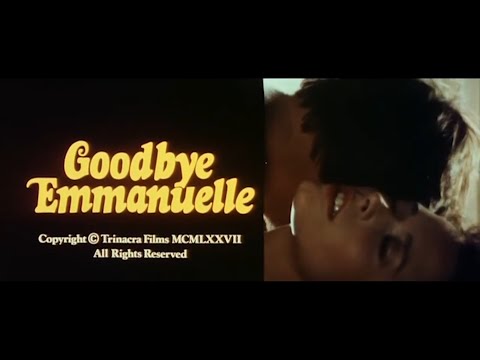
Not only do the Cordiers participate as onlookers in an early fivesome with Jean, Emmanuelle, and their houseguest Chloe (Charlotte Alexandra), but Michel proves to be the film’s Mario analogue when, over dinner, he claims that there is no eroticism without sin, that Don Juan’s greatest pleasure was provoking God. If only the film had taken the trouble to delve into this notion, rather than devolve into rather conventional melodramatics.
The third wheel in Goodbye Emmanuelle is film director Grégory (Jean-Pierre Bouvier), who has come to the Seychelles scouting locations for his upcoming film, which as described sounds like Robinson Crusoe crossed with a François Truffaut movie, and whose plot suspiciously resembles his own conjugal history. Emmanuelle’s exclusive (and romantic) attachment and Jean’s jealousy and subsequent subterfuge sound the death knell for their relationship.
Emmanuelle leaves Jean to return to Paris, to an unknown future with or without Grégory. Goodbye Emmanuelle bids unequivocal farewell to its heroine (at least until the inevitable Emmanuelle 4 in 1984) by directly repudiating the gaze into the camera that concluded the first two films. And it does so without any remote bid for subtlety: Emmanuelle turns to board the plane for Paris, and the shot of her turning her back on the camera is repeated no fewer than four times, three in exaggerated slow-motion.
That last film in the set is I, Emmanuelle, also known as A Man for Emmanuelle, from 1969, an in-name-only attempt to cash in on the reprinting of Arsan’s book in 1967 under her own, if pseudonymous, name. Nevertheless, this remains a fascinating curio of the late 1960s, more a “woman under the influence” film than downright sexploitation. Though there is a fair bit of nudity and sexual situations, the portrayal of sex is far more clinical than the official Emmanuelle series’s titillating eye candy.
Director Cesare Canevari contributed to the script, along with Giuseppe Mangione and Graziella Di Prospero, based on her original story “Disintegration ’68.” And disintegration is certainly the key word here, as Emmanuelle (Erika Blanc) passes through one day in a life spent, by all appearances, in a rather quixotic quest for tenderness, wherever it may be. What she’s offered, in a succession of scenes where she encounters various men who either want or receive sex from her, before being taken down a peg or two by her, is little more than sex and violence.
Canevari uses various techniques—jagged editing, roving camerawork, snap zooms—to register Emmanuelle’s fractured psyche, her benumbed response to the men in her life, but also to the street violence, student protests and other riots, to which she’s subjected. Thought it’s not made clear, or even much of a point of, the ’68 of the story title signals the waves of unrest that followed May 1968 in Paris, and that trigged what are known in Italy as “years of lead.”
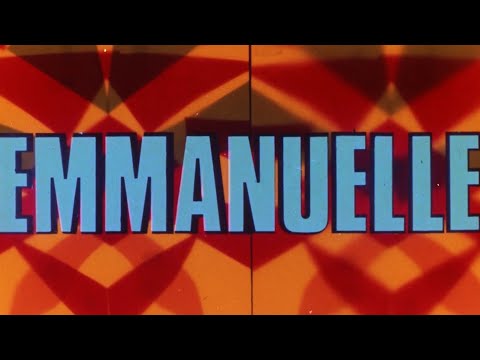
Most of the men Emmanuelle encounters are establishment types: a highbrow writer (Sandro Korso), a women’s fashion salesman (Paolo Ferrari), and a newspaper publisher (Adolfo Celi) whose protestations of social revolt are belied by his obsession with a Virgin Mary medallion his mother gave him. The only countercultural figure she meets is a biker (Ben Salvador), with whom she engages in various games erotic or otherwise but who likewise tips his hand when he demands payment for his services. I, Emmanuelle moves inexorably toward a note of tragic irony, followed by an extremely bizarre final scene involving a ritual baptism by milk.
Severin gathers these four fascinating films in a massive 11-disc box set, including each film on both UHD and standard Blu-ray, Blu-rays filled with extras, and two soundtrack CDs, one for Francis Lai’s work on Emmanuelle II and the other Gianni Ferrio’s often cacophonous score for I, Emmanuelle. All four films, available in the original French (Italian for I, Emmanuelle) or English dubs, have been given stunning new 4K restorations. Finally, the slipcase includes a massive, gorgeously illustrated book called Emmanuelle: Queen of Erotica that’s jam-packed with essays by Todd Gilchrist, Alex Cox, and Camille Moreau, an archival interview with Sylvia Kristel, a gallery of paintings by Kristel, and a gallery of promo materials.
Saga Erotica: The Emmanuelle Collection is now available on Blu-ray.
Since 2001, we've brought you uncompromising, candid takes on the world of film, music, television, video games, theater, and more. Independently owned and operated publications like Slant have been hit hard in recent years, but we’re committed to keeping our content free and accessible—meaning no paywalls or fees.
If you like what we do, please consider subscribing to our Patreon or making a donation.