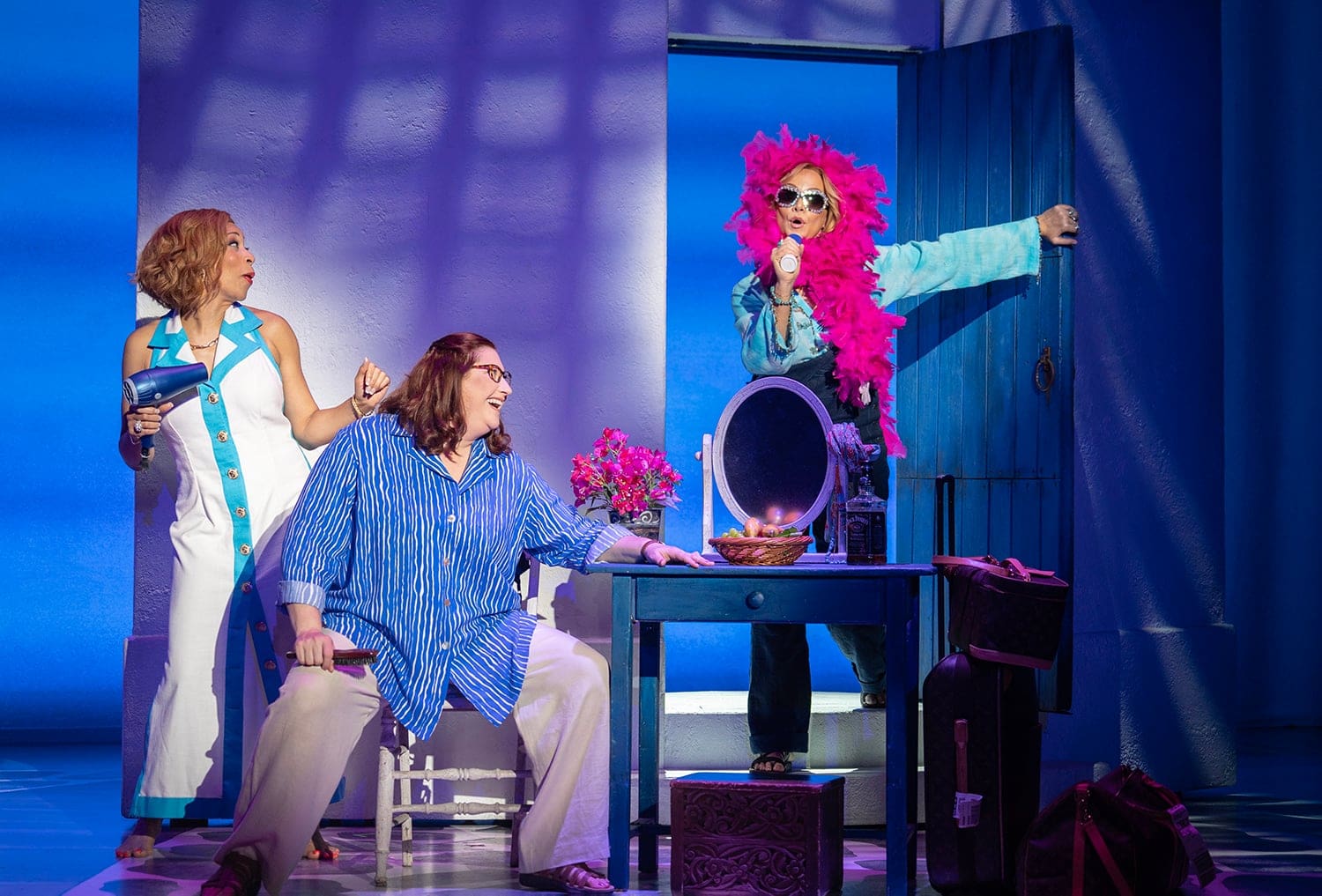
When Mamma Mia! arrived on Broadway in 2001, the only other jukebox musical in town was a revival of 42nd Street, a throwback to a 1930s songbook. For Mamma Mia!’s 2025 return to New York, it’s one of seven jukebox shows on Broadway. Two of those, & Juliet and Moulin Rouge, follow Mamma Mia!’s lead in sculpting a fictional plot around the song catalog, while the other four tell the stories of the featured artists in the mode of Jersey Boys. But bad news, chiquitita: Mamma Mia!, at least in this iteration, which is the New York stop of the show’s national tour, is the weakest of the jukebox offerings available at present.
That’s in part because this production, which replicates Phyllida Lloyd’s original staging but with visibly cheap versions of the sets that stagehands in headsets occasionally push back and forth, never suggests that we’re seeing Mamma Mia! in peak form. Among this long-touring cast, led by Christine Sherill as hardworking single mom Donna, there’s very little chemistry to animate what should be at least an intermittently sexy story.
On the eve of her wedding, Sophie (Amy Walker) welcomes a trio of middle-aged men to the Greek island where she grew up. All three slept with Donna more or less nine months before Sophie’s birth, and the bride is determined to have her father, whomever he might be, walk her down the aisle. Sweet-voiced Sam (Victor Wallace) is the one that got away, while Bill (Jim Newman), a lasso-miming travel writer, and Harry (Rob Marnell), a jolly former rocker who’s apparently a Brit (the accent work is alarming), are less likely suitors for mom’s hardened heart.
One hopes that perhaps a fourth less icky fellow will swoop in with a paternity test at the ready: “You’re a little minx…just like your mother,” Sam tells Sophie before he realizes he might just be her dad. Not that Sophie’s bethrothed, Sky (Grant Reynolds), who fantasizes to his fiancée about pursuing one last night of lap dances, is much better. If these are the only men available on Greek islands, perhaps Sophie and Donna would have better luck on the nearby isle of Lesbos.
All of these sitcom hijinks, put across for the most part with a sprightly flatness, are punctuated, of course, by an onslaught of ABBA tunes, with bookwriter Catherine Johnson’s plotline reverse-engineered so that the songs will make sense. One imagines the story may only center around a wedding so that the ensemble can sing, “I Do, I Do, I Do, I Do.”
And this is where Mamma Mia!’s age and status in the genre has begun to work against it. For many audiences, in the wake of a quarter century of productions and a hit film (plus a sequel), the majority of the show’s songs are just as famous for being Mamma Mia! numbers as ABBA hits. The show has retained its frivolousness but not its sense of surprise.
So thank the Greek gods for Jalynn Steele and Carly Sakolove as Tanya and Rosie, Donna’s best friends and former bandmates, who show up on the island dead-set on reliving their glory days (cue “Super Trouper”) and reinvigorating the show. Steele’s thrice-divorced, wise-cracking Tanya offers an especially miraculous comic intervention. At one farcical high point, Steele launches herself backward into the air on to a bed with slapstick buoyancy. The pleasures of Mamma Mia! remain, chiefly, the pleasures of watching middle-aged besties don their best ABBA outfits and keep on rocking out, no matter how many muscles they pull.
Together, Steele and Sakolove coax the freest moments from Sherill, who belts “The Winner Takes It All” with grounded grit but never elsewhere persuades that Donna is an intimidating local legend renowned for her toughness and vivacity. As the show slips into a second-act declaration, the buddies each rush in with upbeat numbers of their own: “Does Your Mother Know?” for Steele and “Take a Chance on Me” for Sakolove, to keep the pulse from flatlining. Otherwise, act two is slow-going until the explosive final minutes.
Mamma Mia! has always been a mediocre musical with a meteoric encore: After the curtain call, the lighting rig descends while the cast reprises the title song and that galvanizing “Dancing Queen” before offering the show’s only version of “Waterloo,” all with the six middle-aged leads clad in the show’s signature neon look. It’s this five-minute medley, what’s come to be known as the “megamix,” that most defines Mamma Mia! in the cultural imagination and has shaped the jukebox musical most markedly over the past 25 years. The megamix, with the audience standing to join in the dance party, demonstrated—indeed, still demonstrates as the most vibrant section of this production—that the surest way to spell success for a jukebox musical is also the simplest: Scrap character, shed plot, and simply stand and deliver the hits.
Mamma Mia! is now running at the Winter Garden Theatre.
Since 2001, we've brought you uncompromising, candid takes on the world of film, music, television, video games, theater, and more. Independently owned and operated publications like Slant have been hit hard in recent years, but we’re committed to keeping our content free and accessible—meaning no paywalls or fees.
If you like what we do, please consider subscribing to our Patreon or making a donation.