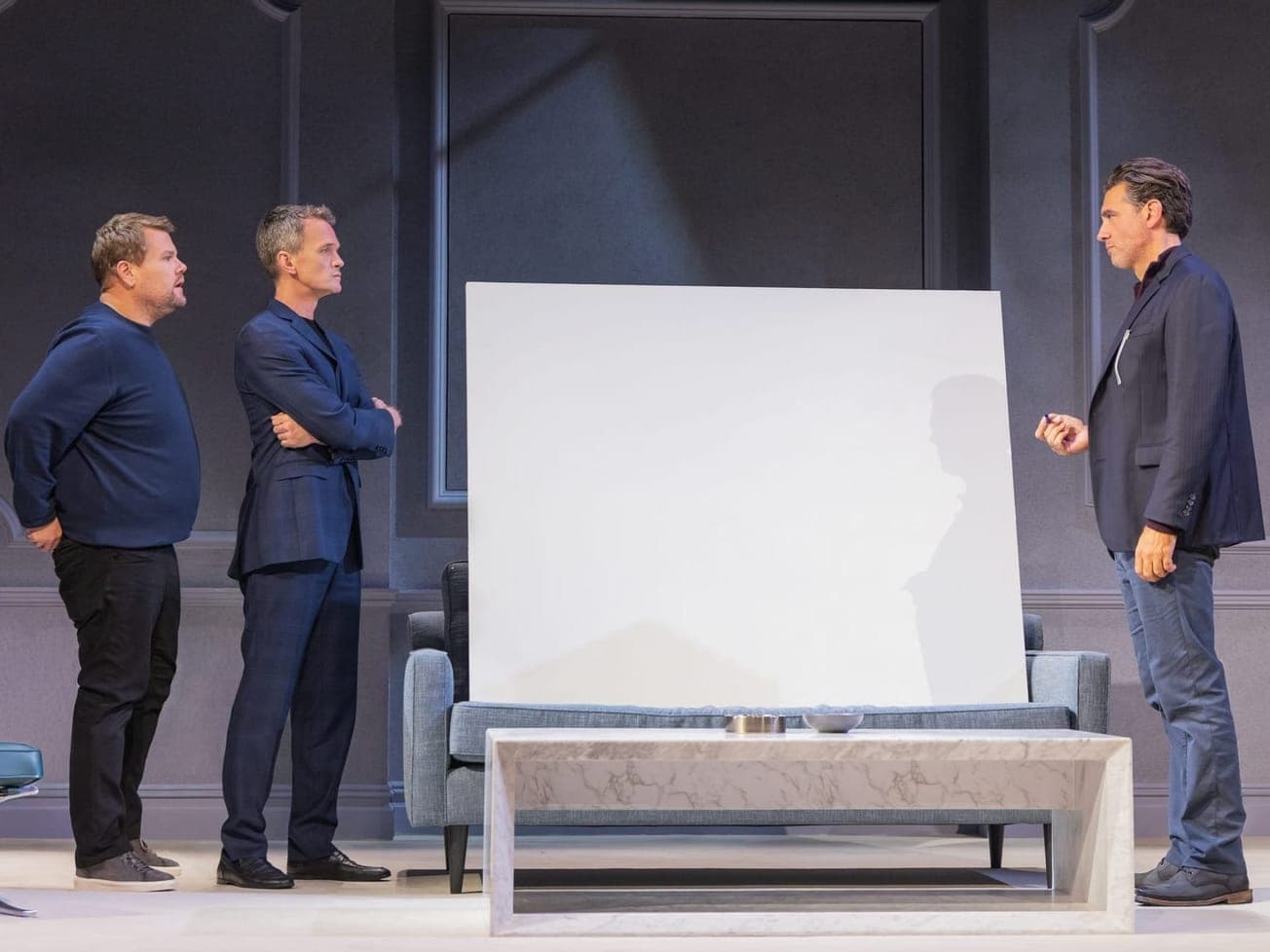
“Do you have any idea what binds you to me?” Serge (Neil Patrick Harris) asks Marc (Bobby Cannavale) at one point in Art. Serge has spent $300K on an avant-garde work of art, a canvas painted entirely white, and the expenditure so enrages Marc that he detonates a quarter-century of goodwill, dragging would-be peacemaker pal Yvan (James Corden) into a three-sided melee of brutal insults and, eventually, physical blows.
Yasmina Reza’s French comedy, which arrived on Broadway in 1998, may still offer some venom-laced fun, but the characterizations are so flimsy that you’ll never feel as if there’s a convincing answer to Serge’s question. The play itself does few favors for a trio of actors seeking to establish a believable decades-long rapport. We only encounter these friendships on a spectrum from thinly veiled hostility to all-out violence, and there’s little in the script or in Scott Ellis’s low-key staging to illustrate their closeness before Serge’s preposterous purchase.
The men, played here by three actors who are each operating in a different comedic register, already appear worlds apart when the play begins. This revival, now running at the Music Box Theatre, always seems to be about three guys with wide gulfs between them rather than the Pangaea of a brotherhood undergoing shocking fragmentation. Ellis allows the actors to overemphasize their signature gestures that signify difference: Cannavale’s gruffly scornful laughs, Harris’s cynical double-take eye rolls, and Corden’s breathy, panicked posing.
Which isn’t to say that the acting isn’t generally good enough. Corden is strainlessly charming in a virtuosic marathon monologue in which the high-strung Yvan re-enacts the latest drama in his tortuous wedding planning, facetiously impersonating his embattled fiancée and mother. And there’s something complete and lovely in the actor’s late-breaking revelation of Yvan’s self-awareness of the role he’s played in his social circle: “I made all my friends laugh their heads off playing the fool, but at night, who was left solitary as a rat?” For the performer himself, a former talk show host with a recently much-mocked and much-memed film career, there’s a graceful parallel, too, as he persuasively reasserts his seriousness as a stage actor.
Cannavale, quipping raspily like Jimmy Durante when quoting Oscar Wilde, is compellingly obnoxious in communicating Marc’s self-assuredness in his good taste. Harris, though, brings a sardonicism to Serge that makes his affection for the central canvas unconvincing: “Objectively speaking, it’s not white,” he insists. “It has a white background, with a whole range of grays.”
The would-be frenetic chemistry among the three men kicks into gear only when they’re all at peak meltdown. Indeed, Reza is most shrewd in her depiction of the mania of three men all too eager to describe the women in their lives as “hysterical” while they themselves sink into neurotic puddles. But Art isn’t quite a full-blown satire on masculinity, even as Ellis has the easiest times wringing laughs at the expense of the characters’ fragilities.
Because Art is so monomaniacal in its conversation topic (whatever the equivalent of the Bechdel Test for middle-aged men talking about canvases might be, Reza fails it), it’s hard to trace the contour lines of a central argument as the men veer between meaningful reflection and shocking insults. Since they ceaselessly dissect their own and one another’s reactions to the painting, bursting into rages and storming out of apartments, it’s impossible to tell which, if any, of the accusations or self-analyses along the way are meant to be understood as truly revelatory.
In one such moment of potential personal expurgation, Marc confesses, “I love Serge and I can’t love the Serge who’s capable of buying that painting.” It’s the revival’s chief weakness that it’s hard to imagine these guys loving any version of each other. But despite that elusive sense of real connection, Art still asks, provocatively enough, whether it’s always nobler to find a way to maintain affection for someone whose actions become incompatible with the person you thought they once were, and to integrate a friend’s “whole range of grays” into what would be so much simpler, so much more convenient as unchanging blank canvas.
Art is now running at the Music Box Theatre.
Since 2001, we've brought you uncompromising, candid takes on the world of film, music, television, video games, theater, and more. Independently owned and operated publications like Slant have been hit hard in recent years, but we’re committed to keeping our content free and accessible—meaning no paywalls or fees.
If you like what we do, please consider subscribing to our Patreon or making a donation.