 With 1994’s In the Mouth of Madness, John Carpenter again drew on cosmic horror traditions, like he did for The Thing and Prince of Darkness, but ramped up the metatextual vibes. At the film’s center is a Stephen King-esque pulp horror writer, Sutter Cane (Jürgen Prochnow), who, redolent of King’s own Misery, inspires dangerously passionate fandom. But where Annie Wilkes, however grotesque, represented a grounded portrait of obsession, Cane’s own fans have begun to succumb to a mass psychosis in response to his work and, more pressingly, his sudden, unexplained disappearance.
To investigate the latter, Cane’s publisher solicits insurance investigator John Trent (Sam Neill) to find the author. Accompanied by editor Linda Styles (Julie Carmen), John sets off for Hobb’s End, the town featured in Cane’s stories—and which may or may not actually be a real place. The pair do indeed find a quaint, Rockwellian hamlet upon arriving there, albeit one that rapidly starts to feel strange and unwelcoming. Soon, they fall prey to a vast, Lovecraftian conspiracy in which Cane reveals an ability to control others and the world itself through his writing.
Carpenter’s carefully composed, symmetrical widescreen images have an uncanny quality, giving the world around the characters an unnatural perfection. He then compounds that alienating effect by changing things up and placing the camera at extreme high and low points and at tilted Dutch angles that reflect how John’s sense of reality is altered.
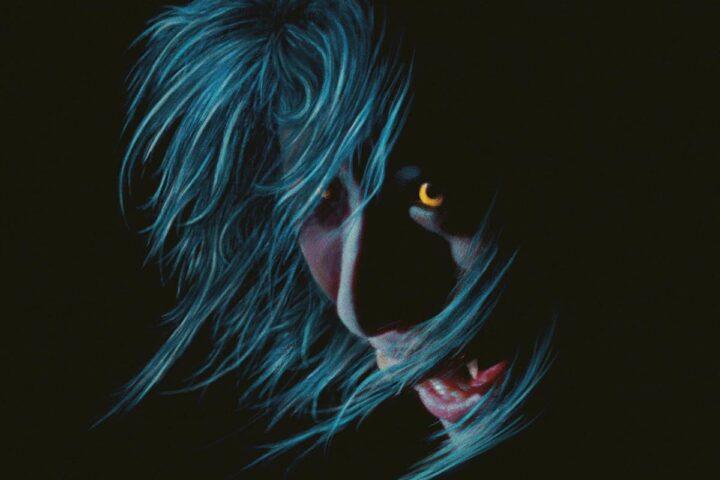
In the Mouth of Madness generally avoids jump scares, preferring to let shots percolate for maximum discomfort. In one such moment, John and Linda pass a young cyclist while driving toward Hobb’s End, only to shortly thereafter pass a much older cyclist on the same bike and wearing the same clothes. Alternating between quick, first-person POV glances at the man and languid shots of him receding into the inky night as the car pulls ahead of him, the sequence eventually ends with a blackly comic payoff that works because of how long Carpenter draws out the tension. Later, the film gets a jolt out of nothing more than a day-for-night filter when Cane tells John that he will turn the world blue and the latter suddenly awakes to see that everything has indeed been tinted a pale azure and lets out a scream.
Carpenter’s emotionally detached, patient visual grammar contrasts with the intensity of Neill’s expressionistic performance. Initially reserved and even sardonic, John rapidly descends into paranoia and despair as the impossible happens with increasing frequency. The film is the final installment of Carpenter’s “Apocalypse Trilogy,” and it could be considered the middle chapter of Neill’s own trio of hellish horror vehicles. Here, he cuts far looser in depicting his character’s madness than he did in Possession or would later in Event Horizon. John is introduced as a smarmy know-it-all who couldn’t take his latest assignment less seriously—all the better to set up the man’s collapse into a bug-eyed, screaming lunatic who gives up trying to rationalize the increasing barrage of monsters and mind-controlled attackers who beset him.
While Carpenter would continue to make compelling work for both the big and small screens, In the Mouth of Madness is his last unalloyed triumph, a showcase for all his strengths as a filmmaker able to use minimal budgets and simple, effective film grammar to convey a sense of doom. And coming from an artist who once dreamed of enjoying a Hawksian career as a journeyman director of all kinds of movies, the story of a man who finds himself trapped within the confines of a horror novel and increasingly frazzled until he’s finally left laughing madly in the face of despair may have a personal resonance that makes the material cut all the deeper.
Image/Sound
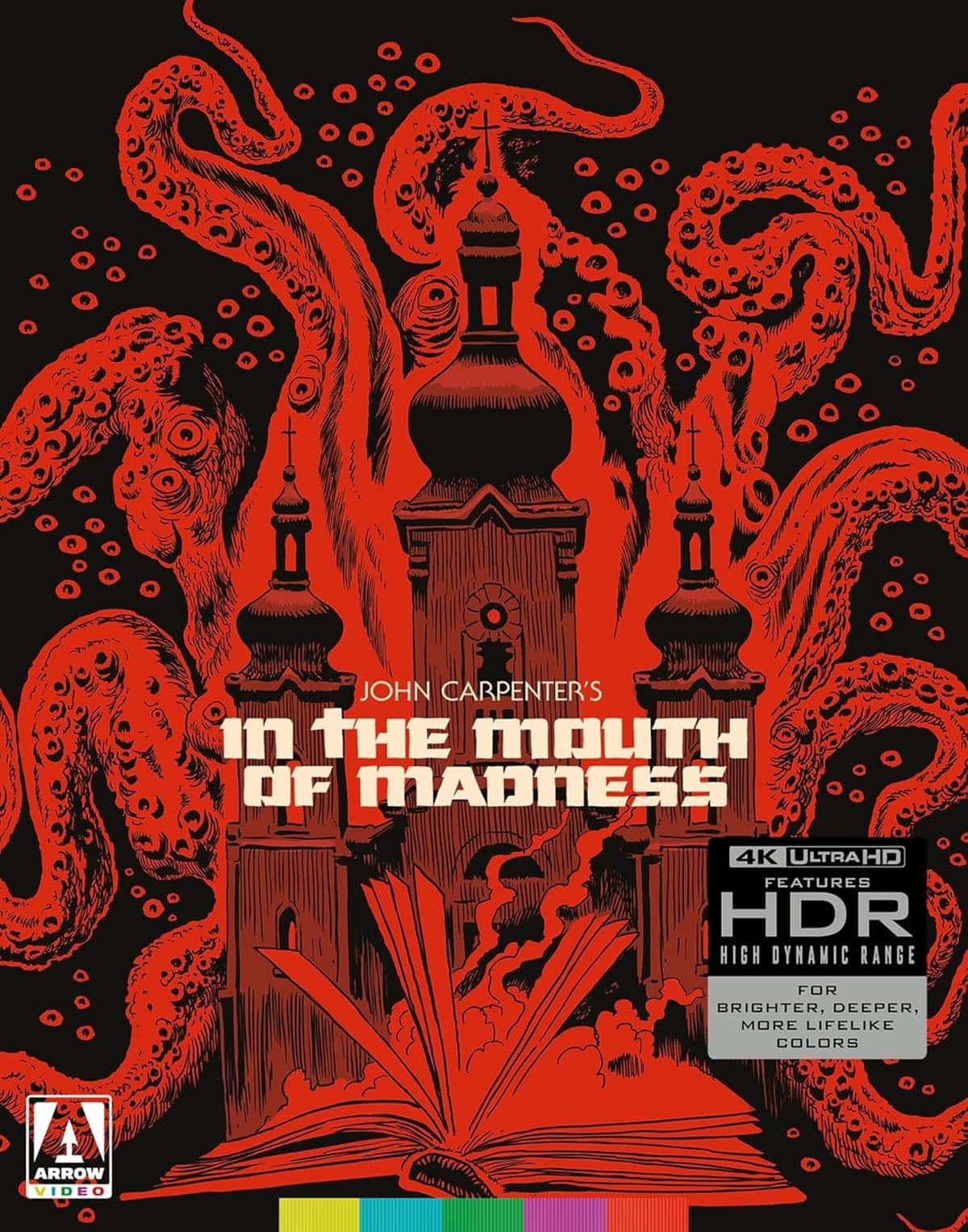
Shout! Factory’s 2018 Blu-ray transfer was sourced from a 4K scan that looked terrific, but Arrow Video’s transfer comes from a proper restoration, and in native 4K with HDR boosting. Fine details are remarkable, and many intentionally under-lit scenes now boast deeper black levels with no noise artifacts in sight. Flesh tones are naturalistic, while the bursts of color pop like never have before on a home video release of the film.
The 5.1 DTS-HD Master Audio surround track is superbly balanced, making ample use of side channels to create an oppressive soundscape of noises bearing down on John as his perception of reality is disrupted. The soundtrack is especially strong in the bass-heavy moments of the score’s most dread-inducing ambient swells and the sudden bursts of violence, yet even in these overwhelming moments dialogue is never drowned out by surrounding noise.
Extras
Arrow’s package comes loaded to the brink with new and archival extras. Two commentary tracks from prior video releases finds John Carpenter talking to, respectively, his wife and producer, Sandy King, and cinematographer Gary B. Kibbe. Both tracks fit well within Carpenter’s pattern of providing commentaries that are copiously detailed but never too serious, with the filmmaker speaking with a mixture of pride and self-deprecation at some of the ways he was able to deliver the project on time and on budget. Most endearing are Carpenter’s many reveries on Panavision, wistfully reminiscing about the days of shooting on celluloid.
Arrow supplements these tracks with a new commentary by filmmakers and podcast hosts Rebekah McKendry and Elric Kane. They’re prone to fawning, but their technical knowledge is evident, as when they point out the subtle visual distortions from the shifting focal depth in certain scenes to the implications of sudden changes in lighting.
There are also retrospective interviews with cast and crew, as well as interviews with critics such as Alexandra Heller-Nicholas who heap much praise on the film and Carpenter’s other work. An archival featurette focuses on the locations used for sets like the mental asylum where Sam Neill’s character is kept, while another documentary offers a broader overview of the production. Additionally, the disc comes with some on-set footage, and an accompanying booklet contains a host of critical essays from writers such as Willow Catelyn Maclay and Josh Hurtado that tackle the film from numerous angles.
Overall
Arrow salutes John Carpenter’s 1994 masterpiece with an unbeatable A/V transfer and a treasure trove of extras old and new.
Since 2001, we've brought you uncompromising, candid takes on the world of film, music, television, video games, theater, and more. Independently owned and operated publications like Slant have been hit hard in recent years, but we’re committed to keeping our content free and accessible—meaning no paywalls or fees.
If you like what we do, please consider subscribing to our Patreon or making a donation.