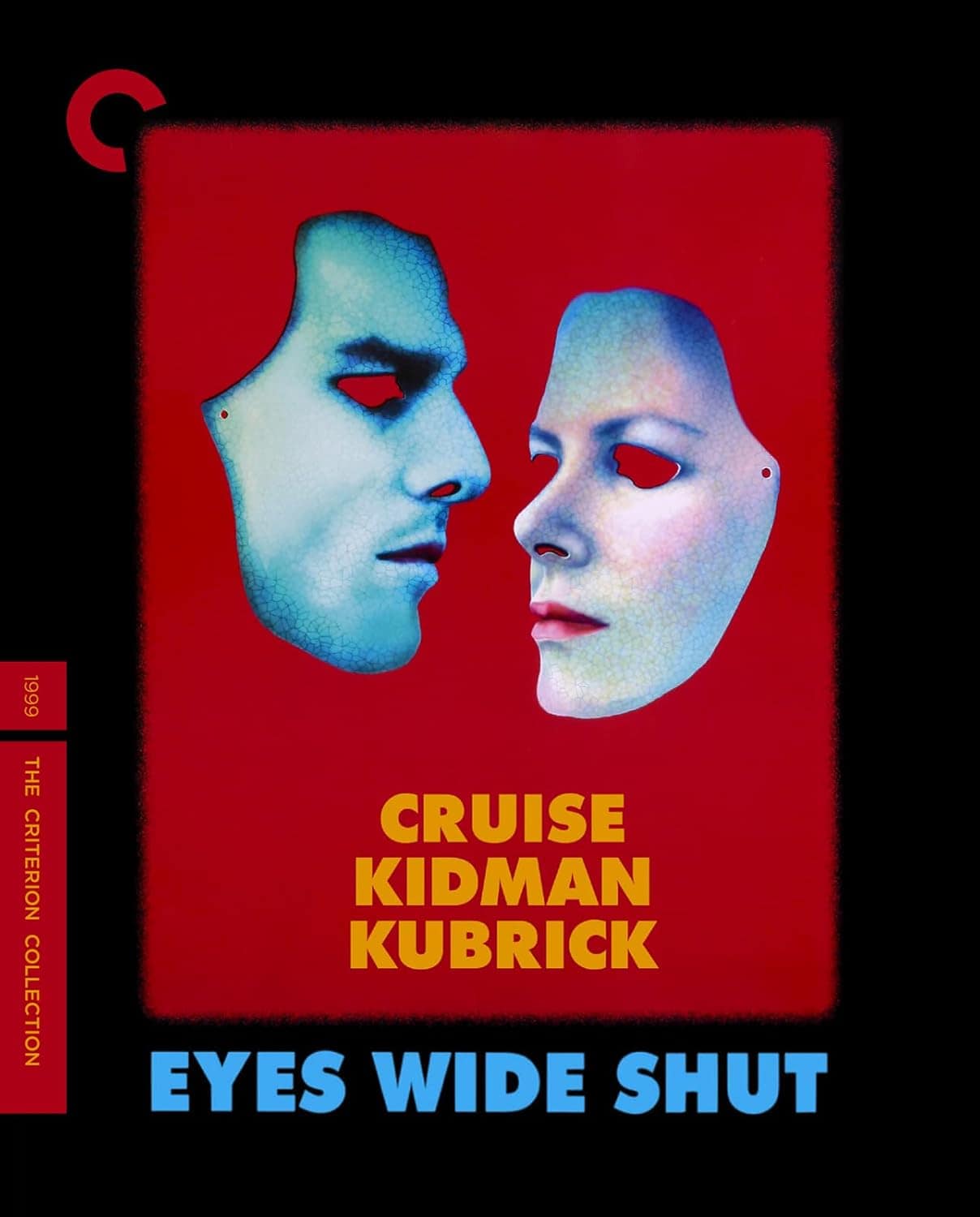
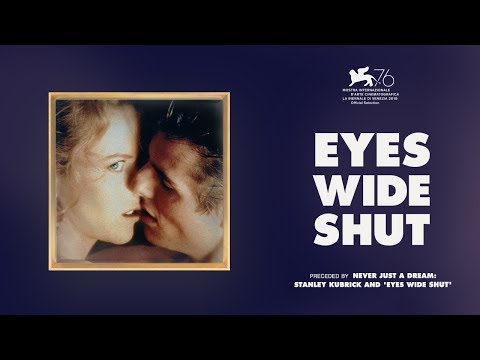
 Stanley Kubrick’s indelible swan song, Eyes Wide Shut, is a haunting and at times surreal examination of a married couple’s fears and desires. Adapted by Kubrick and Frederic Raphael from Arthur Schnitzler’s 1926 novella “Dream Story,” the film transposes its source material from Vienna during carnival to New York at Christmastime, all the better to play up sociopolitical themes that are absent from Schnitzler’s work. The film’s very title informs us that it will explore the tensions between apparent opposites: dream and reality, men and women, fidelity and adultery, and love and death.
Eyes Wide Shut chronicles the erotic odyssey of Dr. William “Bill” Harford (Tom Cruise) that’s set off after an object lesson from his wife, Alice (Nicole Kidman), on the subject of jealousy and feminine desire. Much like the magic circle featured at the masked orgy that Bill attends (and the parodic version available at the toy store at film’s end), Eyes Wide Shut possesses a circular structure, focusing on a doubled series of encounters that suggests Alex’s journey in A Clockwork Orange.
Each of the women Bill comes across on his nocturnal voyages represents a different aspect of sexual availability: a patient’s daughter (Marie Richardson) who professes her love for him; the sex worker, Domino (Vinessa Shaw), with whom he almost consummates an erotic transaction; a costume store owner’s (Rade Šerbedžija) underage daughter (Leelee Sobieski) who insinuatingly offers up her wares; and Mandy (Julienne Davis), first seen at Ziegler’s party and who later sacrifices herself to redeem Bill’s transgressions at the masked orgy.
The centerpiece of the film occurs when Alice tells Bill about a dream that comprises both gross infidelity and Bill’s sexual humiliation. His subsequent anger and jealousy set him off on the second day’s round of inquiries. For Bill, Alice’s dream betrays a level of hostility toward him that she consciously represses, just as he more or less represses his own desires to actually stray outside the bounds of matrimony. This points up Schnitzler’s proximity to Freud and his dream theory. As Bill puts it, “No dream is ever just a dream.”
Clearly visible on a bookshelf in Domino’s apartment is a textbook titled On Sociology. This is a cleverly subtle clue that Eyes Wide Shut works on more than just the psychological level. Most of this material concerns one-percenter Victor Ziegler (Sydney Pollack), who’s entirely the creation of Kubrick and Raphael. Ziegler’s vast apartment puts the admittedly swank Harford digs to shame, and more closely resembles the Gold Room at the Overlook in The Shining.
We get a sense for how Bill affords his place—since we know Alice is jobless at the moment—when he says, apropos their invitation, “This is what you get for making house calls.” What that actually means, as we soon discover, entails Bill dealing with a sex act interrupted by a drug overdose upstairs in a regally appointed bathroom. Covering up the petty indiscretions of the ultrarich proves to be par for the course for him. Just put it on the “Dr. Bill,” as it were.
At the end of this particular rainbow, Bill discovers not the two models from the Christmas party, let along Milich’s jailbait daughter, but the opportunity for a cozy tête-à-tête with Ziegler in the billiard room. Note that the red baize of the pool table matches the carpet at the masked ball, linking Ziegler to the diabolic orgy before he even admits he was there. What’s more, Ziegler’s first name identifies him as a man who’s used to winning, seemingly at all costs.
Ziegler taunts Bill about the people who were there that night: “Who do you think those people were? Those were not just some ordinary people.” They are, to quote Stuart Ullman about the patrons of the Overlook, “all the best people.” If Bill only knew their names, Victor tells him, he wouldn’t sleep that well at night. His dreams would be as uneasy as Alice’s had been.
Red Cloak (Leon Vitali) and his minions learning that Bill hired a taxi to take him to the ball, and that he left the receipt for the costume and mask he rented in his overcoat pocket, is nothing if not pointed. The ultra-rich don’t rent. Rather, they own, and what they own often includes people like pianist Nick Nightingale (Todd Field) and Mandy, who they feel free to intimidate and even possibly murder. Sex is a transaction for these people, and Mandy forgives or redeems Bill’s debt with her life. Given the satanic Black Mass quality of the masked orgy, it’s interesting that certain versions of the Lord’s Prayer include the phrases “forgive us our debts” or “forgive us our trespasses,” both of which Bill has accrued by his very presence there.
Eyes Wide Shut’s coda, which ties these disparate themes together in a Gordian knot, takes place in an FAO Schwarz-like toy store. Bill and Alice engage in a conversation about the meaning of dreams and how the events of one day affect a lifetime with dialogue lifted straight out of “Dream Story.” But Kubrick and Raphael carry things further with Alice’s delivery of the coda’s naughty punchline: that she and Bill really need to fuck.
This moment may be a harbinger of healing, a tentative embrace of connectivity within the confines of “real life.” On the other hand, given the location of the discussion, Alice’s sentiment could just as easily acknowledge the reduction of their sex life (and, by extension, their married life) to just another commodity to be both fetishized and traded on the free market. As was so often the case over the course of his legendary career, Kubrick brings the considerable weight of his filmmaking talents to bear on crafting a lavishly stylized yet troubling enigma, and then allowing audiences the moral and intellectual freedom to solve it for themselves.
Image/Sound
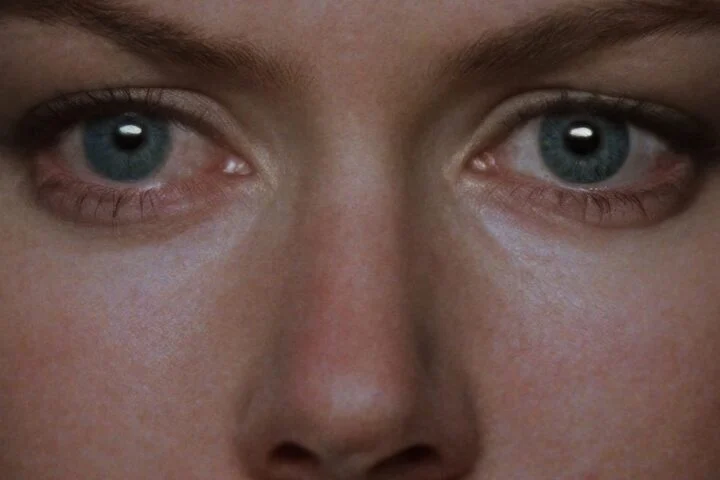
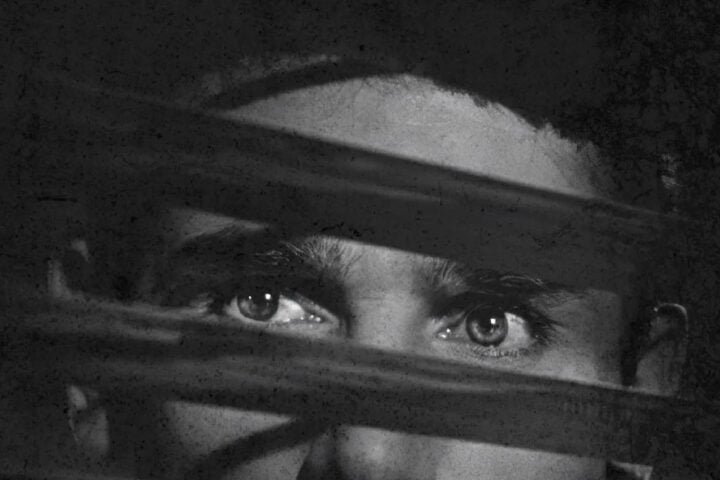
The 2160p HDR transfer of Eyes Wide Shut boasts a 4K restoration of the international cut of the film, sourced from the 35mm original camera negative, and it looks incredible. Most apparent here is a very active grain structure, which is the result of cinematographer Larry Smith “pushing the film” in order to achieve brighter colors. And those colors, especially frequently recurring passionate reds and icy blues, truly pop. Contrast is consistently impressive, and the HDR really brings out the ubiquitous Christmas lights, emphasizing Stanley Kubrick’s penchant for using available light (as at Ziegler’s party). Audio comes in a Master Audio surround track that agreeably captures the film’s ambient soundscapes, and amply conveys Jocelyn Pook’s score and Kubrick’s always acute selection of needle drops.
Extras
The Criterion Collection has put together an impressive array of bonus materials for this release, including some fascinating new interviews. Smith discusses working his way up to DP, his earlier collaborations with Kubrick (on Barry Lyndon and The Shining), and goes into a lot of technical yet fascinating details about shooting Eyes Wide Shut. Set decorator and second-unit director Lisa Leone talks about her start shooting hip-hop music videos, her friendship with Vivian Kubrick, how Kubrick tapped her to shoot location stills, then second unit, and even essaying a small role in the film. And archivist Georgina Orgill traces the origins of Eyes Wide Shut back to the late 1950s among the nearly 10,000 items deposited in the Kubrick archives.
From 2007, the 20-minute “Lost Kubrick: The Unfinished Films of Stanley Kubrick” delves into Kubrick’s extensive pre-production preparations for both his Napoleon project and the WWII-era Aryan Papers. Elsewhere, the 84-minute Kubrick Remembered is a charming documentary on Kubrick’s life and career. Also included is Kubrick’s 1998 acceptance speech for the Directors Guild of America’s D.W. Griffith Award, where he amusingly redefines the meaning of the Icarus myth (“Work on better wings”), and a French press conference from 1999 where Tom Cruise and Nicole Kidman discuss their reactions to the more than year-long production. Finally, the accompanying booklet includes an essay from author Megan Abbott about feminism and desire in Eyes Wide Shut and a 1999 interview with filmmaker and actor Sydney Pollack.
Overall
Given a stunning new 4K restoration and excellent extras, Stanley Kubrick’s Eyes Wide Shut is a haunting and at times surreal examination of a married couple’s fears and desires.
Since 2001, we've brought you uncompromising, candid takes on the world of film, music, television, video games, theater, and more. Independently owned and operated publications like Slant have been hit hard in recent years, but we’re committed to keeping our content free and accessible—meaning no paywalls or fees.
If you like what we do, please consider subscribing to our Patreon or making a donation.