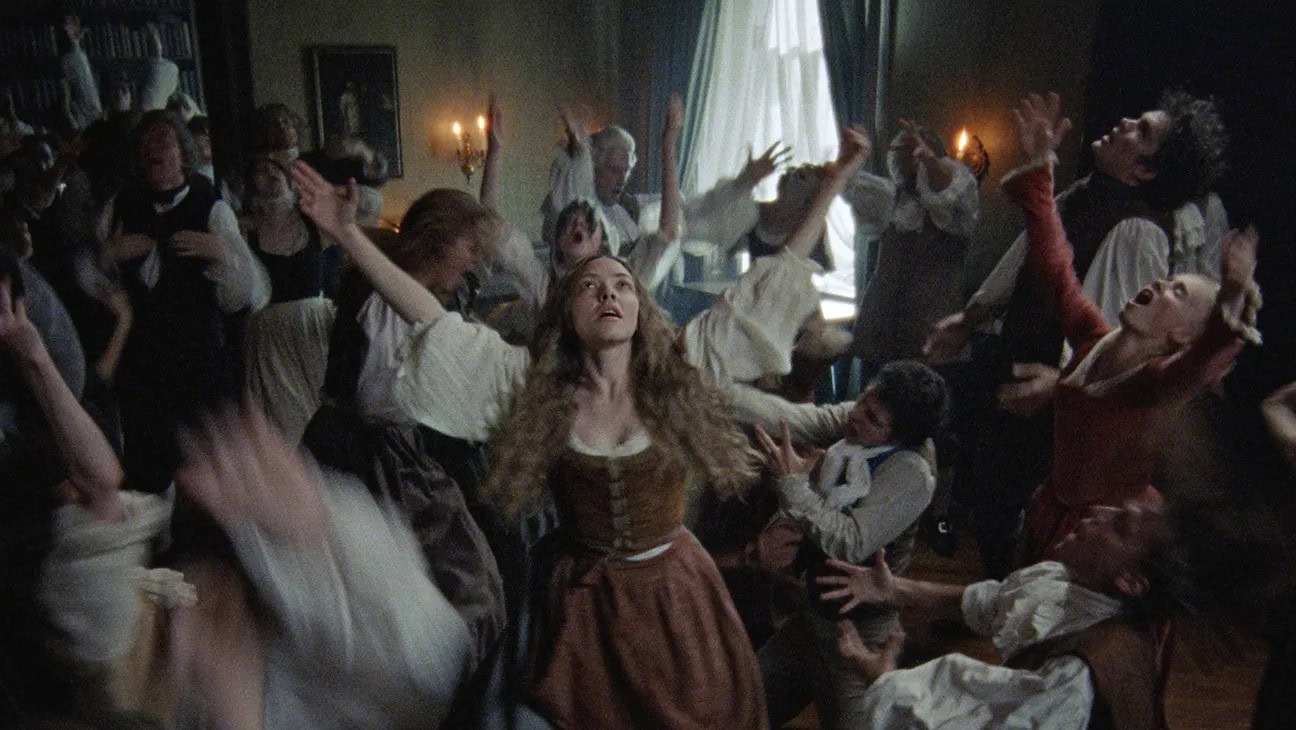
Ever since the invention of synchronized sound, musicals have been one of cinema’s preeminent forms of worship. These films invite our faith in far-fetched mechanics equipped with built-in short cuts to the sublime, making the genre a suitable Trojan horse for the story of Ann Lee (Amanda Seyfried), a pioneer of the Shaker movement and, according to her followers, the embodiment of the second coming of Christ. The Shakers were an offshoot of Quakerism who, true to their name, reached for the divine not just by way of hymn and scripture, but through thrashing physical exaltation—a doctrine built on song and dance.
Mona Fastvold’s The Testament of Ann Lee is a film of many contradictions. Some may call it bonkers by sheer dint of its theater-kid commitment to theological pageantry, while others may call it boring because it sports the conventional trappings of a birth-to-death hagiography. More still may claim that it’s only nominally a musical, as the song-and-dance numbers are often few and far between, with rules that blur the boundaries between what is sung for the characters and what is sung only for the audience. Fastvold’s protean fable is, for better and for worse, all these things and more. It’s tremulous, tricky, and intrepid, much like its pious protagonist, dually vexed and spellbound by the pull and pall of all-consuming belief.
Divided into three movements that chronicle Ann’s progression from girl to woman to mother (as she was eventually called by her followers), the film begins in 1740s Manchester, during a time of Evangelical upheaval. The opening passages plant the seeds for defining facets of her life: a dedication to her younger brother William (Lewis Pullman), a skepticism toward the Church of England, and a revulsion toward “fleshly cohabitation.” Her parents are careless with their dispassionate lovemaking, and when the girl calls them out at the dinner table, her father beats her with a switch, indelibly conflating sex and punishment in Ann’s psyche.
This negative association is further exacerbated by her marriage to Abraham (Christopher Abbott), a man with sadistic sexual proclivities. Together they have four children, none of whom live past their first birthday, and these traumatic births and deaths are glimpsed in a shattering musical montage—one of several sustained crescendos that punctuate this portrait of her life—and it’s not surprising when Ann adopts chastity as one of the pillars of her faith soon after. Written by Fastvold with her partner Brady Corbet, the screenplay draws a correlation between Ann’s traumas and teachings, but wisely allows us to infer causation for ourselves.
The film is couched in the dramaturgical trappings of a biopic, and this impression of conventionality is one of the sharpest tools in Fastvold’s conceptual arsenal, but it’s revealed to be double-edged in The Testament of Ann Lee’s second half, when Lee struggles to spread her doctrine to America. As the Shakers try and fail and try again to recruit members in New England, the film’s heretofore assured rhythm begins to slump and emotional developments begin to stagnate, even as Ann is repeatedly shunted between bliss and abjection.
Still, there are compelling flourishes that keep things afloat throughout these muddled passages, like a love affair that leads to desertion, and a possessed index finger that leads a group of scouts to new land for the colony. In spite of Fastvold’s persuasive stylistic efforts to frame her subject as a suffering saint, The Testament of Ann Lee remains commendably ambiguous about the psychology behind her power and the casualties of her influence.
The narration by Thomasin Mackenzie—who leads a chorus of women in the forest and serves as the story’s primary mediator—occasionally lines up word for word with Ann’s own musings. This suggestive formal flourish subtly raises the question of whether Lee is a puppet or a prophet. Immediately following her prohibition of all sexual activity, a brief scene shows William leaving the bed of a male lover, bidding him farewell, and turning to cut his hair in the mirror—a gesture of brotherly devotion and submission. William’s loyalty to Ann is unflinching and unconditional, never questioned or commented on; this unspoken bond, and the sacrifices made in order to maintain it, is the film’s emotional and thematic fulcrum.
The film ends with the line “a place for everything, and everything in its place,” a cryptic epitaph that evokes the coordination of ritual and the choreography of belief. Though The Testament of Ann Lee is as rousing as it is baffling, and raises more questions than it answers, these qualities capture the confusion and dissonance that frequently underpin gestures of religious conviction.
Since 2001, we've brought you uncompromising, candid takes on the world of film, music, television, video games, theater, and more. Independently owned and operated publications like Slant have been hit hard in recent years, but we’re committed to keeping our content free and accessible—meaning no paywalls or fees.
If you like what we do, please consider subscribing to our Patreon or making a donation.