The most disappointing thing about Rachel Lee Goldenberg’s Swiped, which documents the rise, fall, and rise again of Bumble founder Whitney Wolfe Herd (Lily James), is that it never even tries to escape the shadow of The Social Network, content as it is to trace the general outline of David Fincher’s film while capturing none of its depth or nuance.
The film begins with the twentysomething Whitney becoming involved in the startup Cardify, a project led by Sean Rad (Ben Schnetzer) through the IAC incubator Hatch Labs, and quickly figuring out that the real gold mine is the company’s soon-to-be-released dating app, Tinder. Working tirelessly alongside her new workplace bestie, Tisha (Myha’la), Whitney rapidly turns Tinder into the new must-have app, watches its user base soar past the one-million mark, and earns herself a snazzy new title as one of Tinder’s official co-founders.
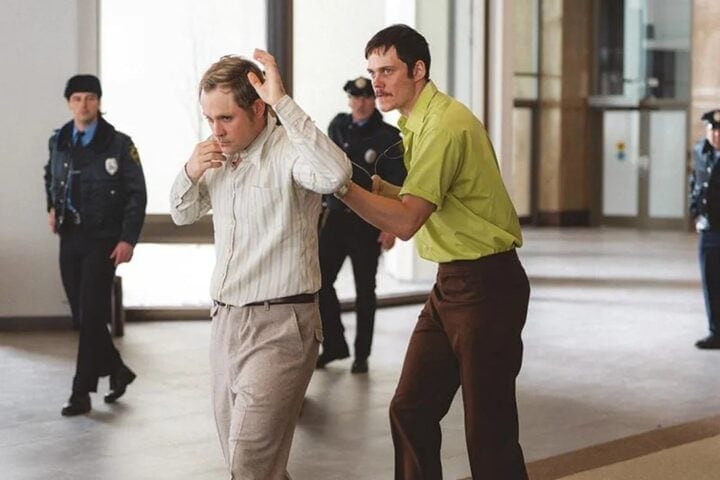
This portion of the film is captured with a feel-good energy, propelled by a seemingly endless procession of zippy montages and early-2010s chart-toppers. And then the bubble bursts. Whitney starts dating one of her colleagues, Justin Mateen (Jackson White), whose nice-guy façade quickly crumbles to reveal an insecure, vindictive manipulator. They break up, he continues to harass her, and, when Whitney finally complains about his behavior, the other men circle the wagons to ensure that Justin is protected and Whitney is destroyed.
Swiped is the sort of film that practically writes itself, a true story with timely themes etched in big, bold letters—the tale of one woman battling her way through an industry that only looked like it represented the workplace of the future. It’s about the myriad ways sexism and tech intersect, both within the companies and within the dating apps they produce. It’s about how women like Whitney have to choose between compromising themselves and playing by the rules of the “boys club” culture so that they can one day rise high enough to change things, or finding themselves locked out of the industry with their principles intact.
Swiped pays only lip service to these ideas, with Whitney’s story presented as one of uncomplicated GirlBoss triumph. As written by Goldenberg, Bill Parker, and Kim Caramele, she’s devoid of flaws beyond the sort so small that they can be erased with a quick hug. Sexism is presented in stark, simple terms that fail to really capture how insidious and ubiquitous it is, on and offline. Everything about Swiped is simply too softened and smoothed down, its whole world rendered like a tech startup office space or the pearlescent UI of a dating app.
In its second half, the film continues to struggle to find new angles on a world ruled by patriarchal prerogative as it rehashes seemingly every cliché in the biopic book, right down to the moment when Whitney suddenly stops talking so that she can scribble down the genius idea that will change everything. After being ousted by Tinder and villainized by the company’s PR machine, she becomes the target of endless online abuse, but nothing here, certainly not the pedestrian visuals, comes close to capturing the uneasy feeling of being sucked into the online vortex that’s hell-bent on tearing you apart.
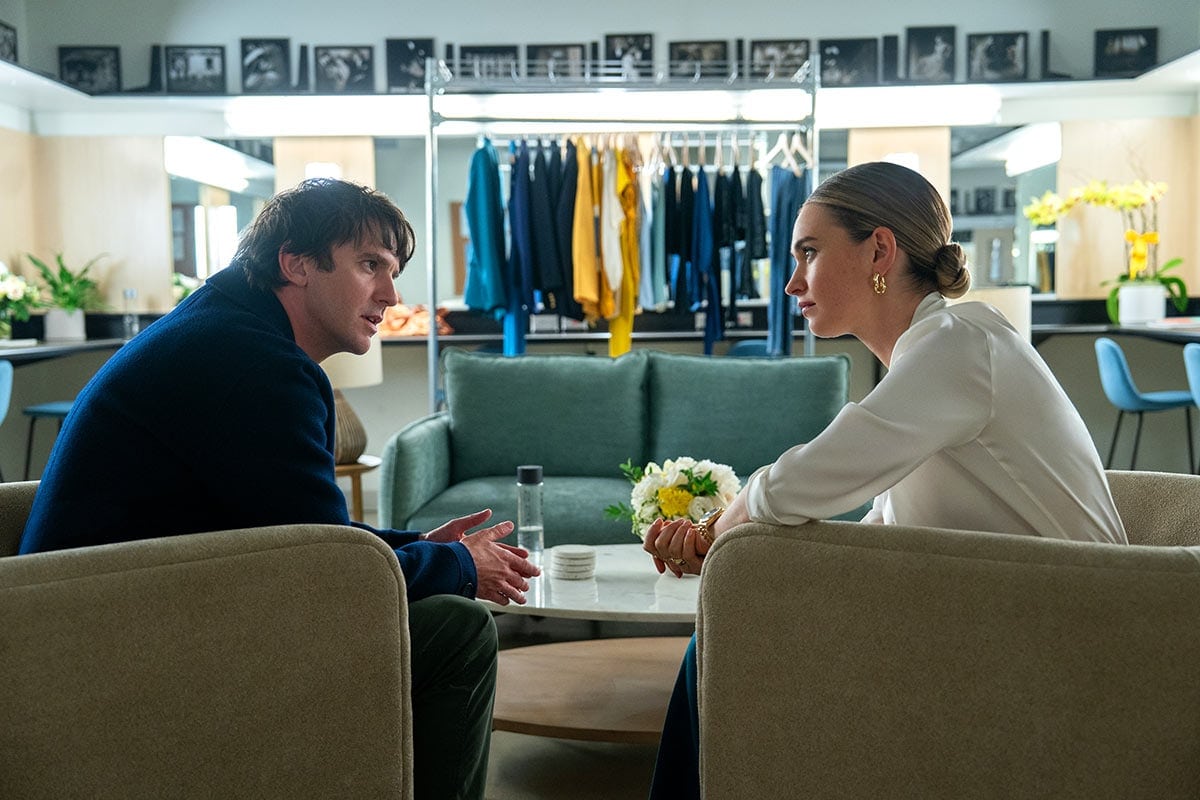
James is charming enough as the one dimension of Whitney that she’s given the chance to play. Whitney and Tisha make for a likeable pair, but after watching Myha’la thrive in Industry in a similar role as a woman in a male-dominated workplace, her Tisha feels like a version of that character with all its intriguing, diamond-hard edges rubbed away. Dan Stevens injects some humor into the film’s back half as Russian tech mogul Andrey Andreev, but his Bond-villain accent is also an indicator of the film’s unwillingness to grasp the moral complexities of its tale—like a purposefully progressive initiative like Bumble drawing its funding from Russian billionaires and, later, megacorporate megalomaniacs like Blackstone.
Swiped’s story sits right at the center of so many vital issues, and a smarter, braver rendition of it—that is, one interested in actually probing beneath the surface of things—might have yielded a film truly worthy of comparison to The Social Network. Instead, we get a piece of corporate hagiography that sweeps all those issues aside to celebrate another tech billionaire.
Since 2001, we've brought you uncompromising, candid takes on the world of film, music, television, video games, theater, and more. Independently owned and operated publications like Slant have been hit hard in recent years, but we’re committed to keeping our content free and accessible—meaning no paywalls or fees.
If you like what we do, please consider subscribing to our Patreon or making a donation.