
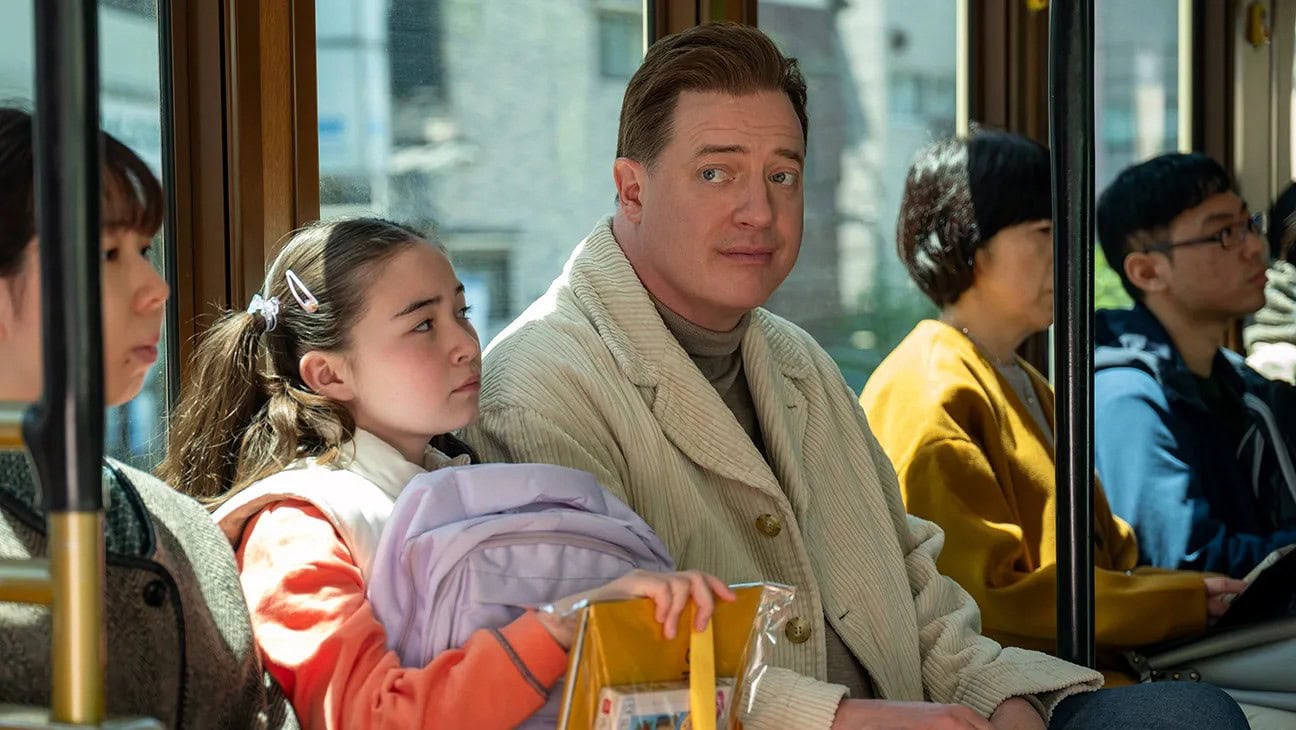
Midway through Rental Family, a father and daughter visit a digital art museum in Tokyo with rooms bedecked floor to ceiling with colorful projections of light. Eleven-year-old Mia (Shannon Gorman) initially scoffs at the apparent fakery of her surroundings, as children of a certain age often do. Her father—or, rather, the struggling actor, Philip (Brendan Fraser), who’s been hired to play him—responds, “Sometimes it’s okay to pretend.” It’s but one of countless instances in this grotesque dramedy that you could charitably call on the nose.
Philip came to Japan seven years prior to play the mascot in a toothpaste commercial, but his new life offered him no real career prospects in the time that followed. One day, his agent sends him racing across town for the part of “Sad American,” and he winds up acting as a mourner at an open-casket funeral. As a woman cries for her lost love, the deceased suddenly sits up in his coffin, moved to tears by this counterfeit griever’s performance of romantic devotion. As the guests file out, the man thanks the organizer, proclaiming, “I finally feel like I deserve to exist!”
The mock funeral is among many services offered by Rental Family, which employs actors to stage elaborate encounters—and even entire relationships—for the company’s clientele. Citing a society that stigmatizes mental illness, the company founder, Shinji (Hira Takehiro), insists that this work addresses the existential anxieties in people’s lives, and could fulfill a higher calling for Philip in turn. He also admits that the three-person outfit needs a token white guy.
Throughout Hikari’s film, we see Rental Family’s employees run the gamut of interpersonal stand-ins. Philip plays the groom at a straight wedding that covers for a lesbian elopement, and provides a lonely gamer with some bro time. Elsewhere, Shinji kinkily scolds a corrupt executive, and co-worker Aiko (Yamamoto Mari) assumes numerous “other woman” roles, apologizing to housewives who’ve caught their husbands cheating.

Two through lines emerge from the woodwork: Philip playing the star-struck journalist profiling Hasagawa Kikuo (Emoto Akira), a faded veteran film actor whose daughter wants to shield him from obsolescence, and him playing papa to Mia, whose mother needs a stand-in to get her daughter into a top-ranking private school that discriminates against single parents. The former shows Philip the emotional fallout of a successful acting career (growing up, Hasagawa’s daughter knew him as “the man in the screen”), while the latter allows someone who grew up fatherless the chance to be there for a child similarly shafted by an absentee.
It’s a setup that’s milked for all its potential humor and pathos—and then some. This is a film, as written by Hikari and Stephen Blahut, whose comedy comes at the expense of its characters, and its drama at the expense of the audience. But in addition to its failures in form and construction, Rental Family is also freighted by the inherent compromise of being built around its resurgent star. In spite of the filmmakers’ best efforts to position their protagonist as a respectful and well-meaning outsider, the film can’t help but occupy that perspective in more profound ways.
The audience’s introduction to Philip’s milieu is complete with speed-ramped wide shots of bustling Tokyo streets, montages of stoic pedestrians, and fawning close-ups of anime posters and cosplaying passersby. The screenplay constantly gestures toward the complexities of Japanese culture that Philip might be ignorant to, but he remains our primary point of identification from start to finish, with more compelling characters on the sidelines reduced to cheerleaders that support and challenge Philip through his midlife crisis.
Philip is a character defined by his masculine frailties and life of quotidian tragedies, jerry-rigged to elicit pity. The few glimpses we get of the supporting characters—most memorably during a provocative narrative rug-pull involving Shinji’s home life—suggest a more exploratory film, but these strands only exist to be woven back into Philip’s formulaic journey of self-discovery. Rental Family is a grueling schlep toward its climactic stretch, in which the film ties off every loose end and stoops to mawkish feel-goodery of the highest order, sanding off the roughest, darkest edges of its conceptual hook and sweeping them under the rug.
Since 2001, we've brought you uncompromising, candid takes on the world of film, music, television, video games, theater, and more. Independently owned and operated publications like Slant have been hit hard in recent years, but we’re committed to keeping our content free and accessible—meaning no paywalls or fees.
If you like what we do, please consider subscribing to our Patreon or making a donation.




do you enjoy anything other then tik-tok music because it doesnt feel like it
Darkest edges??? Do movies always have to take a proctologist’s view of life to satisfy Mr. Mooney? Maybe Mr. Mooney should go back to his former job as bank manager.
I can’t for the life of me understand how one can get a 1-star reaction out of this joyous yet contemplative film, but that’s why I turn to Slant to get another perspective, however troubling it often is.