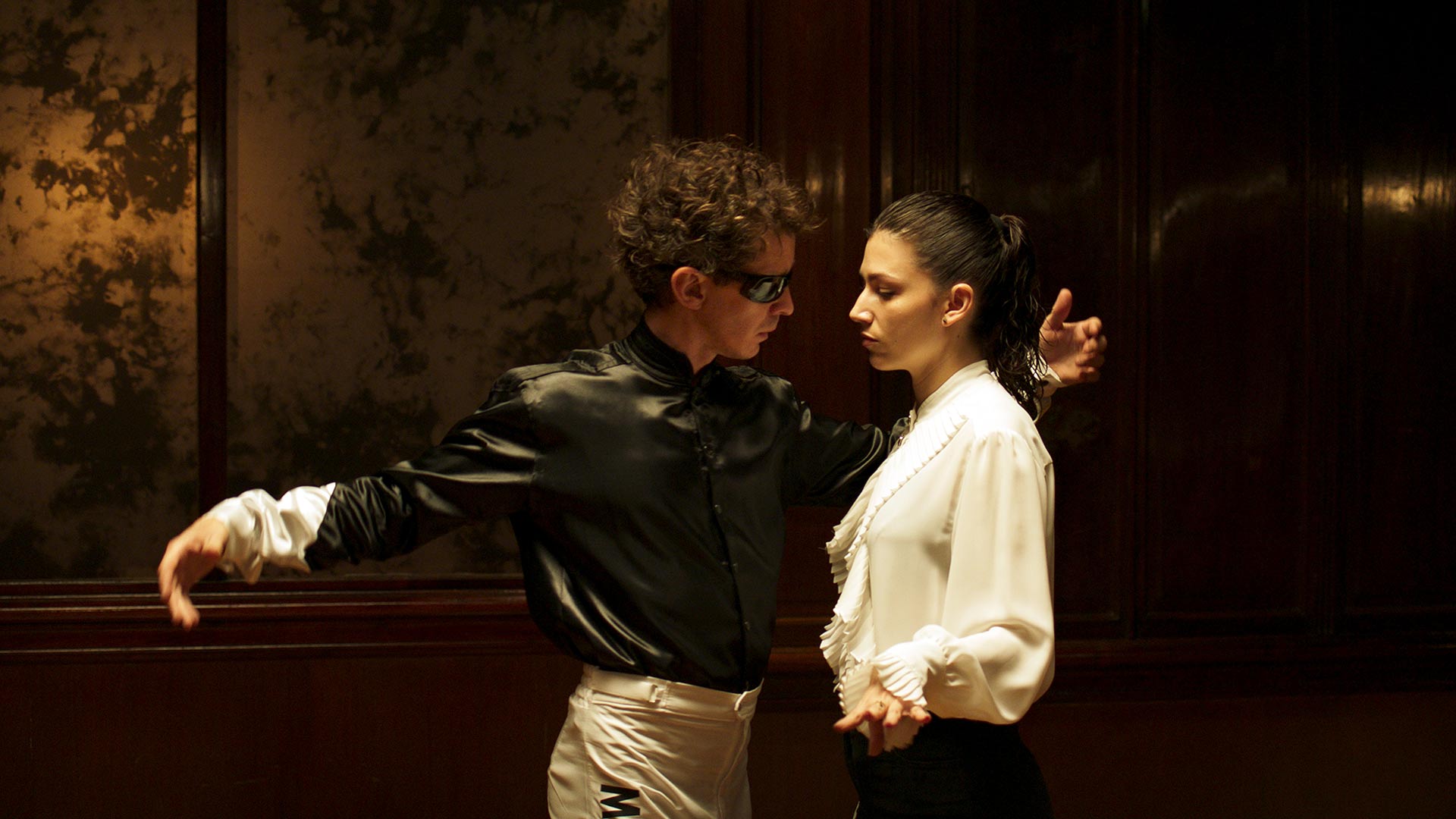
Holed up in an attempt to go cold turkey before a crucial race, once-renowned jockey Remo (Nahuel Pérez Biscayart) asks his pregnant partner and fellow jockey Abril (Úrsula Corberó), “What can I do to make you love me again?” To which she replies, “Die and be reborn.” Accordingly, director Luis Ortega sets out with Kill the Jockey to tell a prototypical sports-movie comeback story, albeit through far from conventional means.
Set in Buenos Aires, the film is a sports movie in the same way that Alejandro Jodorowsky’s El Topo is a western. It could just as easily be shelved under crime drama, rock mockumentary, or ghost story. While Ortega’s style doesn’t quite transcend the influence of filmmakers such as Lynch, Godard, Fellini, and Almodóvar, it melds them with surprising assurance. Kill the Jockey’s originality consists not just in taking the clichéd metaphor of rebirth literally, but in casually ratcheting that literalness to ever more fantastical degrees.
Remo races for a mobster called Sirena (Daniel Giménez Cacho). He has the morose charisma of a Lou Reed or David Bowie, and a ketamine habit to go with it. His “uncontrollable thirst for disaster” has started to make him an unprofitable liability. Sirena gives him a final chance: He’s to ride a horse named Mishima (a possible nod to the controversial author) imported at great expense from Japan, in a race where he will be tested for doping, and he must win.
Kill the Jockey’s easygoing surrealism is accomplished entirely through editing and misdirection as opposed to, say, CGI. In one scene, Abril boards the underground and encounters fellow jockey Ana (Mariana Di Girólamo), with whom she has developed a flirtatious repartee. “I was looking for Remo and I found you,” she says. “Look, a little bird,” Ana replies, pointing out of frame. When Abril looks, Ana steals a quick kiss on the cheek and exits the train. Where another film would leave it there, Ortega cuts to a literal bird perched on the grab rail, as if Ana’s made-you-look power of suggestion was enough to conjure it out of thin air.
Another crack in verisimilitude is the film’s quasi-self-contained dance sequences, which are tinged with the musical’s theatricality, a la A Woman Is a Woman. In one, Remo and Abril dance to “Sin Disfraz” by Argentine New Wave band Virus. Another more elaborate number takes place in the dressing room of the hippodrome where the jockeys rhythmically limber up to Acid Arab’s “Stil.” These are but two of the deep cuts in a phenomenal soundtrack.
Throughout the film, shifts in genre go hand in hand with the changes Remo undergoes in identity. After a racing accident, he wakes up in the hospital with amnesia, eventually becoming a woman named Dolores who narrates the invention of the saddle to fellow inmates in a penitentiary. No matter how fantastic or contradictory, the film places his transformations on the same level of reality. Before one final transfiguration, Dolores ends up on a dirt track in the Pampas, where races are held between forms of racing: horse versus motorcycle, horse versus greyhound. She races a muscle-car driven by a mysterious gaucho with watery blue eyes (Jorge Prado), who seems to embody the lack of identity altogether.
Kill the Jockey may not amount to more than the sum of its many genres and influences, but it collages them together with an anarchic panache. And while Ortega may be dinged for chasing the current and, by now, almost exhausted trends of genre mashup and open homage, he approaches the outer limits of these techniques without sacrificing a coherence of style and mood, and with an awareness of certain philosophical implications. In particular, Kill the Jockey treats identity—whether considered terms of nationality, gender, sexuality, vocation, or otherwise—as a continuum the points of which are never entirely fixed or stable, where not even death puts a definitive stamp on who we perceive ourselves to be.
Since 2001, we've brought you uncompromising, candid takes on the world of film, music, television, video games, theater, and more. Independently owned and operated publications like Slant have been hit hard in recent years, but we’re committed to keeping our content free and accessible—meaning no paywalls or fees.
If you like what we do, please consider subscribing to our Patreon or making a donation.