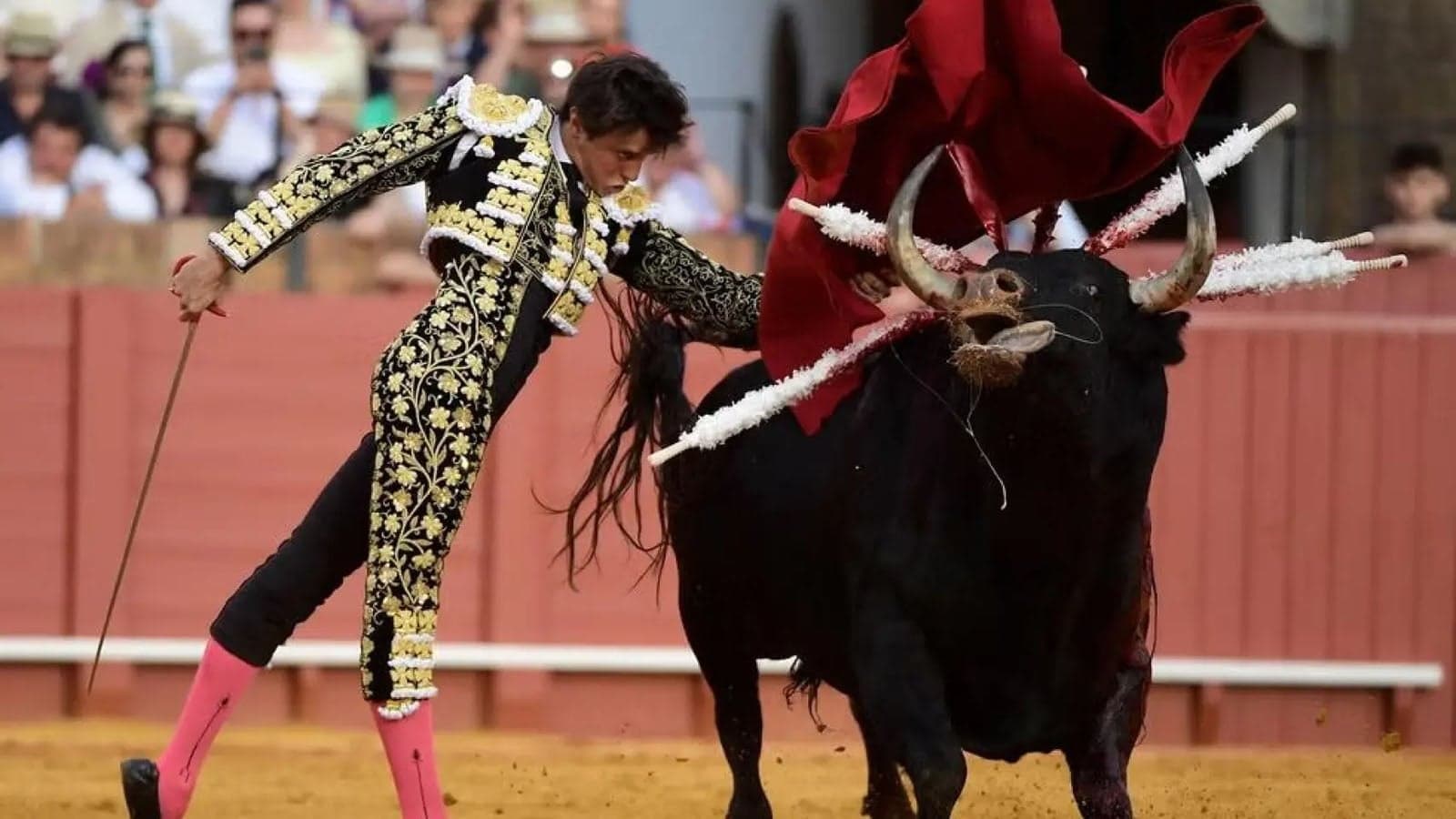
Albert Serra’s first nonfiction film, Afternoons of Solitude, centers on Peruvian matador Andrés Roca Rey. Throughout, Serra’s approach involves not so much conveying information or telling a story as inducing a poetic trance. The film opens with a pair of arresting long takes, reflecting the two opponents that a torero faces in the “afternoon” of a traditional corrida. In each, a different bull looks into the camera, shrouded in a purgatorial or primaeval dusk. Over the soundtrack only their breathing can be heard.
Over the course of the film, we learn hardly anything concrete about the rules, the history, or the symbolism of a physical contest that melds blood sport with performance art. Likewise, Roca Rey’s past and present life remains obscure. Serra alternates rigorously between shots of Roca Rey getting in or out of costume in various hotel rooms, traveling to and from fights with his entourage by car, and the fights themselves. He offers no commentary, only images that neither condemn nor condone. Keeping well out of the way of both his subject matter and his audience, Serra allows a more direct encounter between them. Pure montage is a refreshing change from being told how to think or feel, particularly when it comes to such a controversial topic.
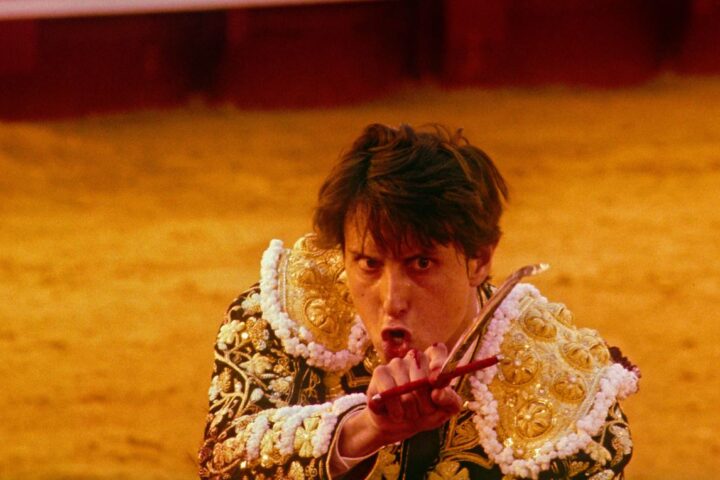
The film still conjures a distinct mood, if obliquely, through intimations of doom. This can be chalked up in large part to Roca Rey’s tormented face, which Serra captures in lingering shots. Even as his entourage showers him in adulation after a victory, he scarcely acknowledges them, eyelid twitching slightly as he stares into the middle distance, as if contemplating death at all times. More uneasy in a slow elevator than in the ring, Roca Rey crosses himself to the point where he looks more compulsive than pious. What little he says is often cavalier in the extreme: “Life is worth nothing,” “fuck the dead,” and so on. Whether he’s expressing his faith through disavowal or if it’s nothing more than machista nihilism is impossible to say.
In the absence of any overt commentary, the film’s more open-ended choices in editing and music take on added significance. In a scene where Roca Rey poses for a photoshoot in his extravagant traje de luces, Jefferson Airplane’s “Embryonic Journey” plays over the soundtrack, lending a paradoxically fitting psychedelic tinge to the proceedings, since watching him suit up is like watching an astronaut prepare for a spacewalk. Elsewhere, composer Marc Verdaguer steeps Serra’s images in an eeriness that wouldn’t be out of place in a science-fiction film. This is less incongruous than it sounds, as the bullring is a self-enclosed world with its own fantastically elaborated customs and rituals, existing outside of modernity.
Serra will be reproached by some for failing to explicitly condemn animal cruelty, to say nothing of a masculine ideal that may have seemed antiquated not so long ago but is again disastrously resurgent. But Afternoons of Solitude is a salve to a deeper infection. The space carved out for free interpretation by aesthetic experience is dwindling rapidly in a culture where algorithms stand in for taste and critical thought, where influencers, conspiracy theorists, and facile ideologues compete to stuff our heads with “content.” One film on its own won’t save us from that, obviously, but Afternoons of Solitude reclaims space for free interpretation.
The tantalizing difficulty of pinning down Roca Rey’s motivations, let alone Serra’s stance toward bullfighting, can make for an uneasy viewing experience, at once immersive and distancing. Whatever feelings you may have with this mixture of pageantry, masculinity, barely sublimated ritual sacrifice, nationalism, and sensuality, Afternoons of Solitude affords ample opportunity to explore them. It’s hard to shake the suspicion, though, that the film is only incidentally about bullfighting. Considered in the context of his other work, it may be that Serra’s real, secret subject here is a protean need to brush up against death, to taunt it, even inflict it, in an irrational, futile, at times beautiful effort to shrug off its inevitability.
Since 2001, we've brought you uncompromising, candid takes on the world of film, music, television, video games, theater, and more. Independently owned and operated publications like Slant have been hit hard in recent years, but we’re committed to keeping our content free and accessible—meaning no paywalls or fees.
If you like what we do, please consider subscribing to our Patreon or making a donation.