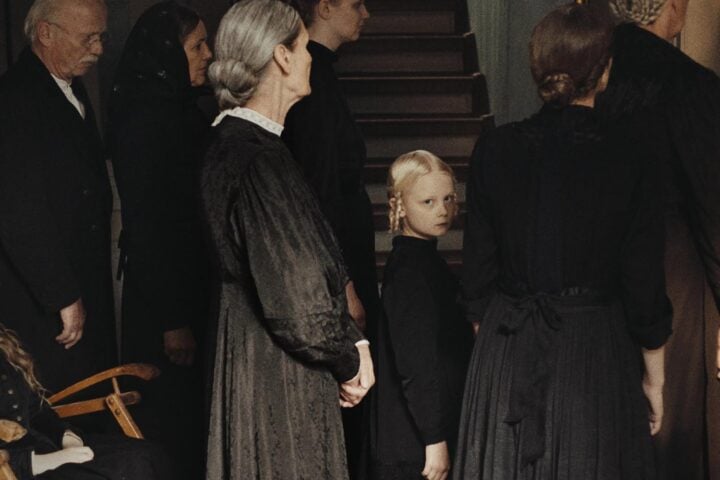
Tense, ominous, and stuffed with psychosexual insinuation almost to the point of absurdity, The Sparrow in the Chimney has much in common thematically with writer-director Ramon Zürcher’s previous feature, The Girl and the Spider, which he co-directed with his twin brother, Silvan Zürcher. His third feature, on which Silvan Zürcher served as first assistant director, is a similarly elliptical chamber piece demonstrating a fascination with the conflicts and desires that simmer beneath mundane or sedate social surfaces, though here an expanded canvas allows him to occasionally loosen up and paint with slightly broader strokes.
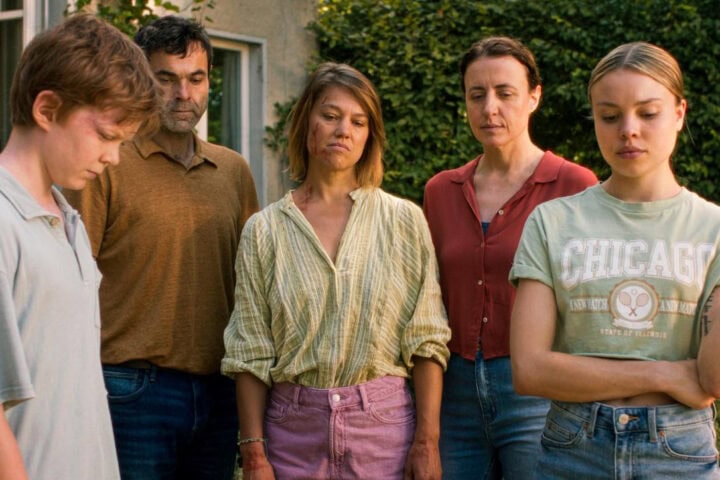
The film opens with a few bucolic, sun-dappled images of a rural house and its surrounding countryside, the setting for an extended family gathering arranged by dour, prickly matriarch Karen (Maren Eggert) in honor of her husband Markus’s (Andreas Döhler) birthday. We’re soon introduced to the family of Karen’s more outwardly relaxed, cheerful younger sister, Jule (Britta Hammelstein), who mostly tries to keep the peace and placate her elder sibling, an approach resolutely not adopted by Karen and Markus’s rebellious teen daughter, Johanna (Lea Zoë Voss). Meanwhile, babysitter Liv (Luise Heyer) lurks mysteriously in the background.
Though not as obsessively controlled as in The Girl and the Spider, Zürcher’s blocking is precise and continually inventive, seeking to disrupt the established boundaries between different characters in order to complicate their behavior and interactions with each other. Often, someone will intrude upon what seems to be a hushed conversation or moment of peace, but the way the space is presented by Alex Hasskerl’s camera makes it difficult to tell whether their presence had previously been concealed or whether they were visible the whole time.
This fragmentary exposition also makes the specifics of familial histories and interpersonal dynamics impossible to parse with confidence. The overall effect might be deemed “immersive” if it wasn’t for the sense that the characters in this environment are themselves mostly distanced from events, in their own private reveries or preoccupations.
As the party progresses and the network of relations gets increasingly complex, the tone of interactions can shift unexpectedly as family members act out in peculiar ways. Johanna gleefully flaunts her “ripe for the plucking” (her words) body in defiance of her mother’s decorum, alternately titillating and torturing Jule’s bemused husband, Jurek (Milian Zerzawy). Elsewhere, Karen’s fussy, timid son, Leon (Ilja Bultmann), carries out an act of extreme cruelty against the family cat, while multiple characters also find a kind of stress relief through plunging their hands into the food that’s so carefully being prepared for the occasion.
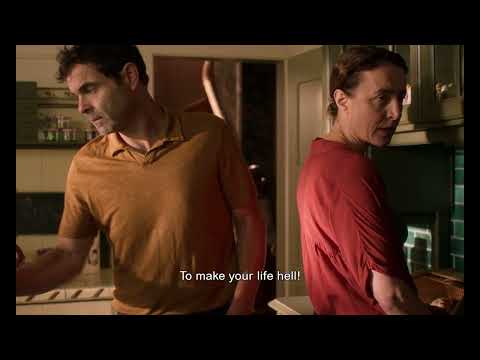
As bewildering as many of these incidents are, their matter-of-fact depiction gradually normalizes them, while also going some way toward casting the family’s more ordinary activities in an odd new light. Everything comes to appear symptomatic of a fundamental dysfunction, as well as being another reflective surface in the elaborate hall of mirrors that Zürcher has devised.
Whereas The Girl and the Spider rarely gave any direct elucidation of its characters’ motivations, here a major skeleton key seems to be a childhood incident in which a parent died under tragic, shocking circumstances. However, the multiple retellings of the incident and a general sense of ambiguity in characters’ accounts of it denies this revelation any linear cause-and-effect potency. Its impact seems to be disseminated throughout the basic emotional fabric of the group and, as such, something that binds them together, for better or worse.
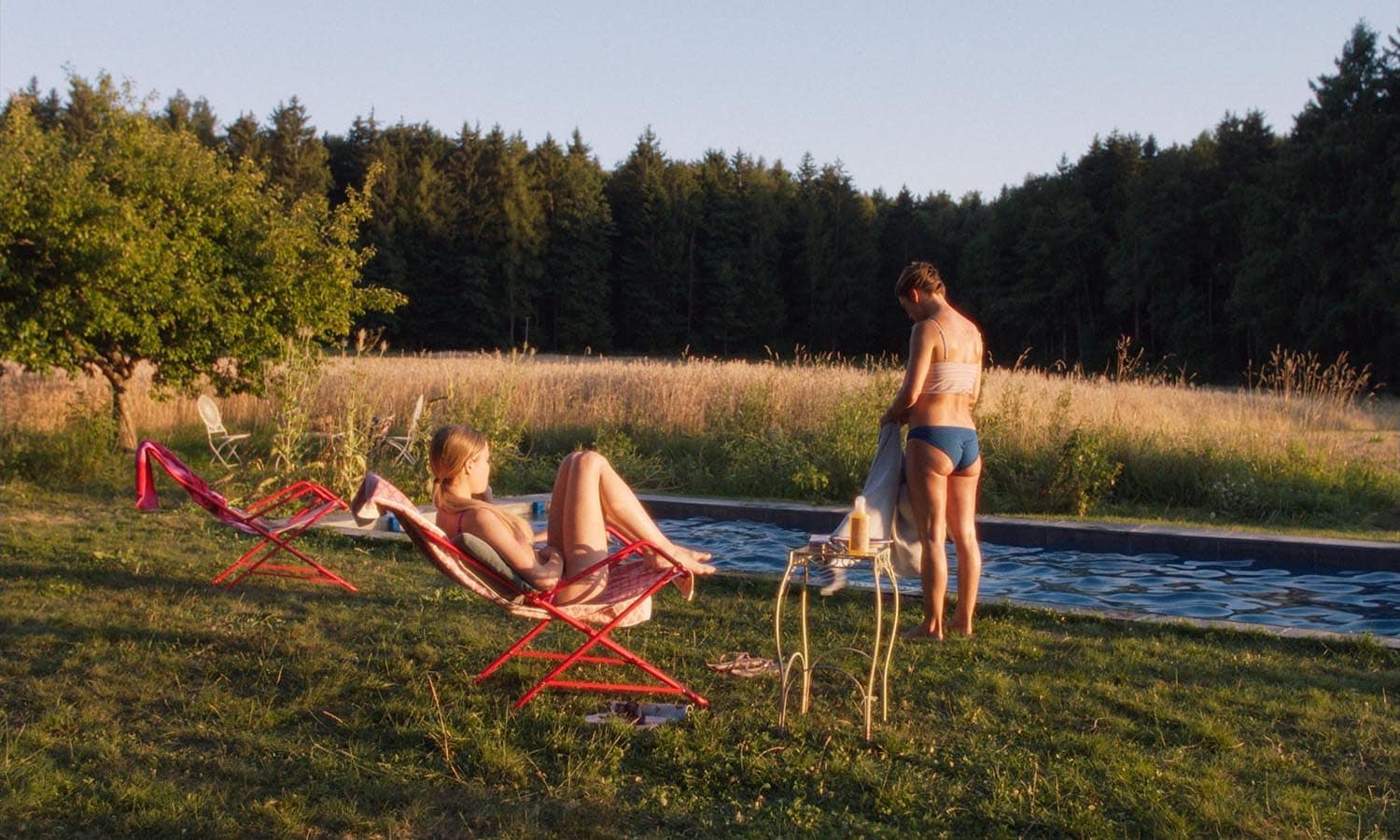
The film betrays some hints of a gothic sensibility in Zürcher’s work, which is most clearly on display in an oneiric scene in which Karen takes a moonlit journey across a lake on the grounds of the house. Undressing to her underwear and crossing the water peacefully, she finds what could be comfort, kinship, sexual liberation, or, perhaps, some form of revenge as she stands among a dense, screeching flock of cormorants occupying a small islet in the lake’s center.
Though short-lived, it’s a cathartic moment for both Karen and, by extension, the audience, reconfiguring the understanding of oppressive roles and opening up a new perspective on a space depicted in such a restrictive way up to that point in Zürcher’s film. It also ushers in a newfound acceptance of the ways in which these characters are imprisoned and shaped irreversibly by their past and by each other, as The Sparrow in the Chimney seems to insist upon the idea that intimacy and isolation are ultimately two sides of the same coin.
Since 2001, we've brought you uncompromising, candid takes on the world of film, music, television, video games, theater, and more. Independently owned and operated publications like Slant have been hit hard in recent years, but we’re committed to keeping our content free and accessible—meaning no paywalls or fees.
If you like what we do, please consider subscribing to our Patreon or making a donation.