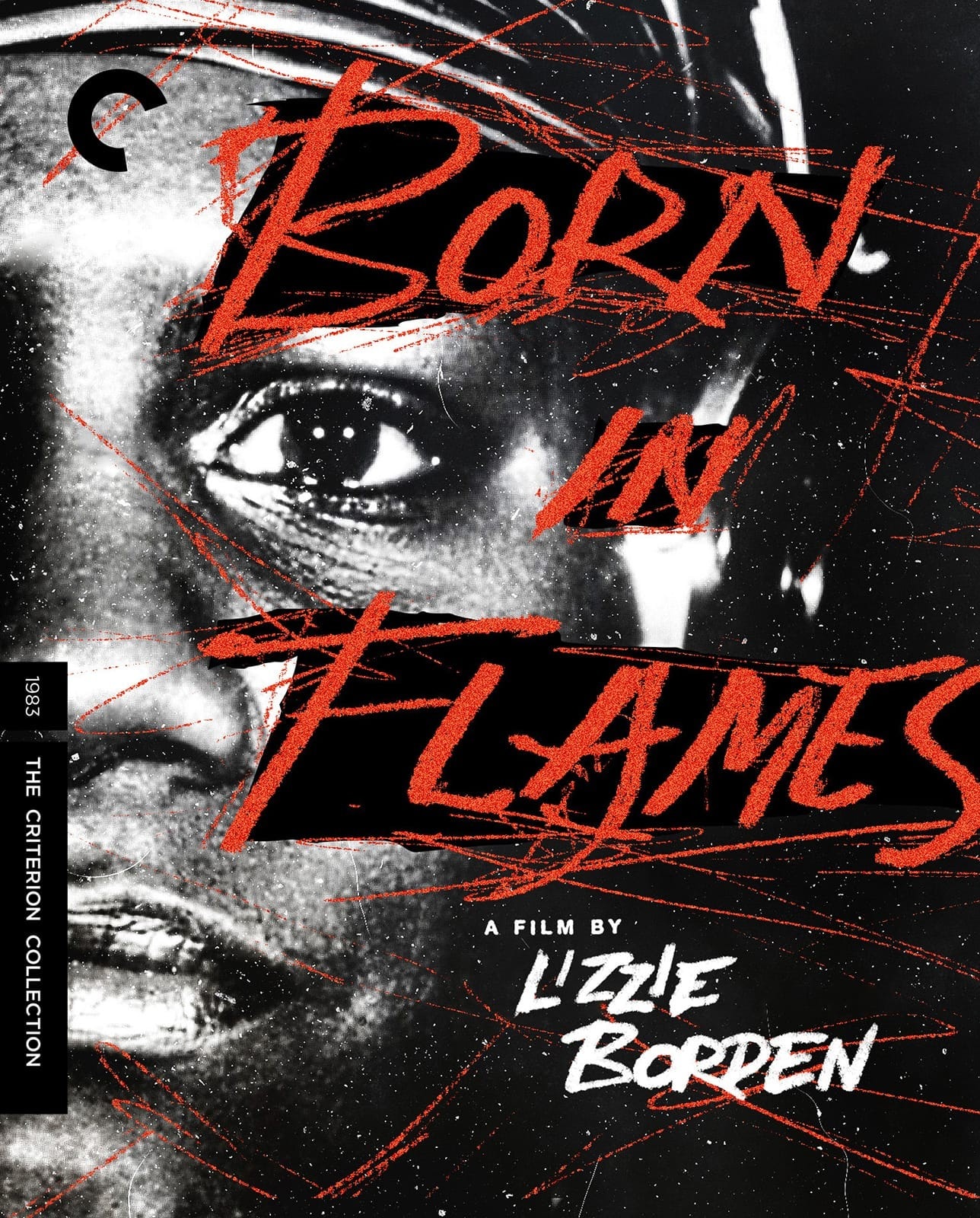
 Early into Lizzie Borden’s Born in Flames, two men flip through photographs of Adelaide Norris (Jean Satterfield) from off screen, attempting to construct her profile as founder of the Women’s Army. “Homosexual?” one man asks the other. “Yes,” the other responds, adding that the group “seems to be dominated by Blacks and lesbians.”
Borden then cuts to Norris sitting around a kitchen table and talking about employment legislation, though the men’s dialogue is briefly heard over the new scene. Such a small detail reveals Borden’s directorial strengths and political cognizance, implicitly placing competing dialogues within the same cinematic space.
Immediately, the tensions of making one’s intentions heard and understood are presented without concern for labored thematic exposition. It’s a choice that speaks to the ways in which Born in Flames excitingly fuses documentary and dramatic sequences into a free-form narrative that exists somewhere between essay film and political manifesto.
Scripted scenes of ongoing conversations about organized protests and recent instances of sexism across the U.S. are broken apart by news broadcasts and the didactic pleas of two pirate-radio DJs, Isabel (Adele Bertei) and Honey (Honey). These events occur in an alternative America where a socialist revolution occurred a decade prior but did little to narrow the gender gap or bring about comprehensive social progress. Scenes offers little contextual around the imagined past or even the tumultuous present, which may or may not have to do with the film’s micro-budget. Either way, Borden’s premise is a pretext for conversations surrounding Marxist counter tactics, like Isabel’s claim to be “rebuilding a warrior nation of guerillas.”
There’s something maddening about this film’s refusal to adhere to traditional channels of communication. Take Isabel’s previous, forcibly spoken claim, which is visibly received by no one. Much of Born in Flames consists of messages being transmitted, but there’s scant indication of how they’re being decoded, and that approach can come across as incoherent. But a certain level of incoherence is part of the film’s coherent understanding of the multitudinous channels of communication bred by competing political rhetoric.
In one of the film’s several montages, always accompanied by Red Krayola’s title track, Borden cuts between radio and television broadcasts, interspersed with speeches at various rallies, continuing to overlay message upon message, with little indication or instruction as to which course of action should be privileged over the other. Not that Borden lacks a radical political viewpoint. Quite the contrary, especially as the consistent binary opposition for the Women’s Army as “Terrorists or Revolutionaries?” troublingly suggests neither term to be a functional diagnosis for group actions within a consistently reshaping socio-political milieu.
The film also uses the conflicting terms to suggest that media outlets only highlight oppositional actions to sell ambivalence and fear to consumers in the first place. Spike Lee’s Chi-raq made similar suggestions about gender inequality but did so in a more satiric register. Born in Flames, like some of Lee’s best work, thrums with an emblazoned interest in signaling its concerns with human rights through its needle drops. Borden’s approach, though, omits explicit references to actual events, placing in its stead more philosophical rhetoric that hangs over the film like a darkened cloud that has the potential to explode with thunder and lightning at any point.
In fact, given that Born in Flames concludes with an actual explosion, it balks at finding a less literal end for its incendiary politics by promoting a similar brand of ambivalence regarding political procedure that the filmmaker seemingly castigates media outlets for. However, Borden’s strengths as an artist lie not in subtle narrative textures, but generating intensive responses to injustice. No wonder, then, that author Howard Hampton borrowed the film’s title for his 2007 monograph on “termite dreams, dialectical fairy tales, and pop apocalypses.” Born in Flames defiantly occupies all three spaces at once.
Image/Sound
Born in Flames was shot on location and guerilla-style, and Criterion’s transfer brings out the best in the internegative used as the source print (the film’s original 16mm negative is lost). Colors are mostly stable and details are clear even in low-light conditions, and any loss of contrast due to sudden light fluctuations or a quick movement of the camera is endemic to the print. The audio track occasionally betrays a faint echo owing from the film being shot with direct sound in locations without adequate soundproofing, but otherwise the track is clear whether reproducing dialogue or some of the tapings in underground no-wave venues.
Extras
Criterion’s disc comes with a newly recorded commentary track by Lizzie Borden, who discusses the process of crafting the film on a minimal budget by cobbling together footage she had shot around New York City with a narrative crafted with collaborators from the LBGTQ community and alternative arts spaces. Borden also plays recordings from members of the cast and crew who taped their reminiscences of their involvement in the film.
The disc also includes Borden’s debut, the 1976 experimental, Godardian documentary Regrouping, which begins as a taping of a group of radical feminists but slowly unspools as Borden uses overlapping interview audio and contradictory images to reflect the way that even ideologically united groups comprise individuals with their own beliefs and generic interests. Eventually, the subjects rebel against Borden herself for attempting to edit them into a simplistic narrative. The mixture of serious political analysis and playful self-critique is a clear predecessor for Born in Flames’s own radical comedy.
A booklet contains two essays, one an overview of the film’s themes and unorthodox assembly by film scholar Yasmina Price, and the other a contextualization of Borden’s feature amid experimental feminist cinema of the time by author So Mayer.
Overall
Lizzie Borden’s ultra-low-budget Born in Flames is one of the most exciting films of 1980s, and Criterion honors it with a solid transfer and substantial extras.
Since 2001, we've brought you uncompromising, candid takes on the world of film, music, television, video games, theater, and more. Independently owned and operated publications like Slant have been hit hard in recent years, but we’re committed to keeping our content free and accessible—meaning no paywalls or fees.
If you like what we do, please consider subscribing to our Patreon or making a donation.