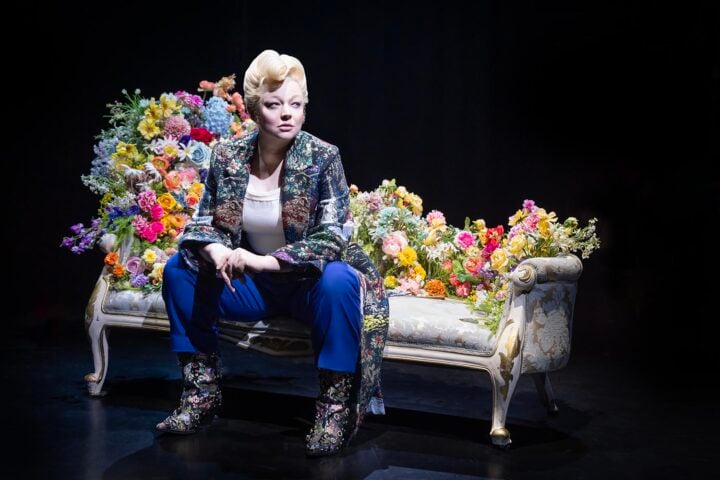
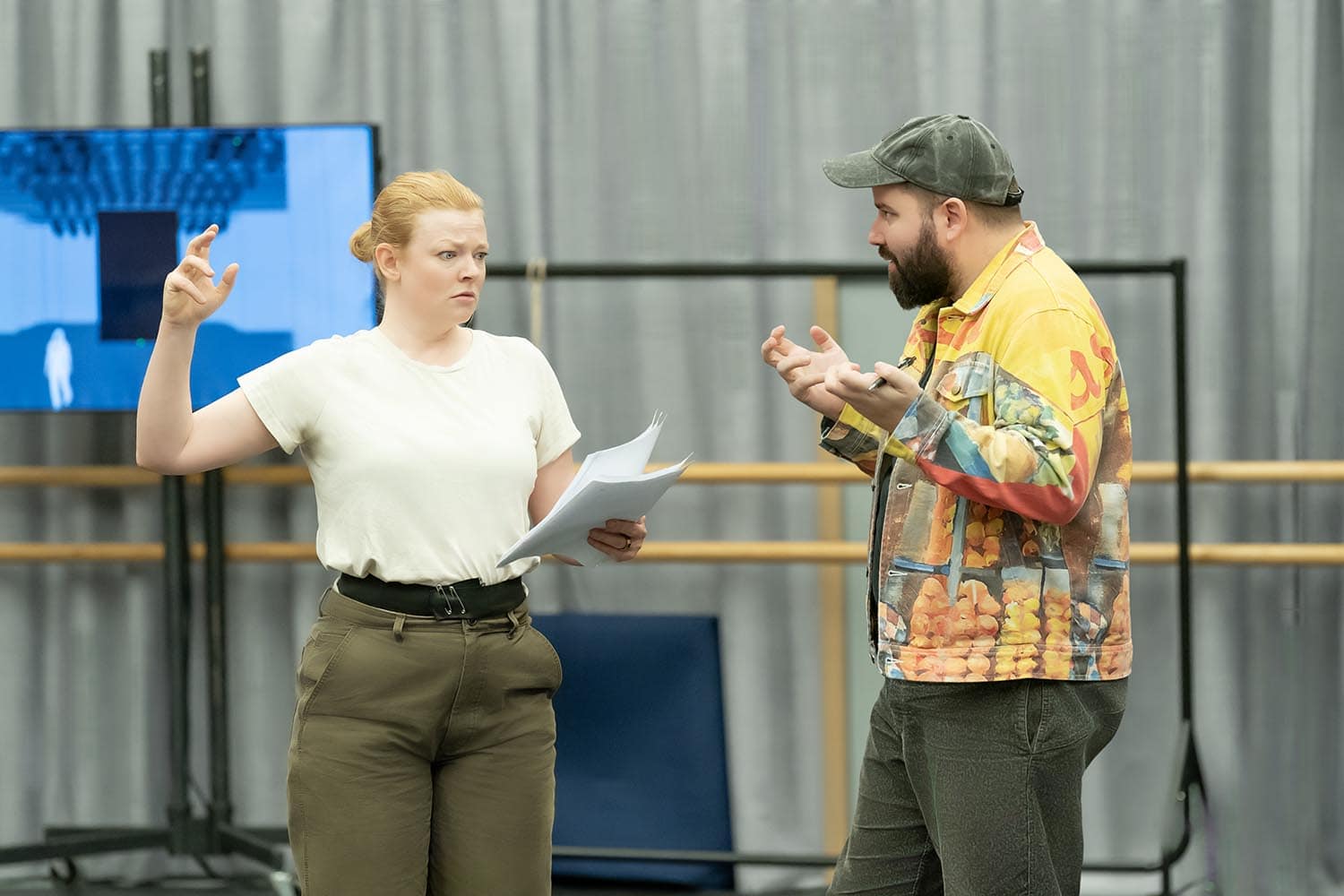
Now playing at the Music Box Theatre, The Picture of Dorian Gray is an enthralling multimedia tour de force starring Sarah Snook that seamlessly integrates live and pre-recorded video with live stage performance. The production is directed by Kip Williams, who also conceived this new adaptation of Oscar Wilde’s 1890 novel.
In the production, Snook portrays not only the three central roles—the hedonistic aristocrat Lord Henry, painter Basil Hallward, and the handsome titular Dorian Gray—but also more than 20 additional minor characters. Throughout, she’s supported by a dynamic interplay of shifting video screens, live camera feeds, and state-of-the-art mobile phone technology.
The story follows the impressionable Dorian, who, upon seeing his freshly painted portrait, pledges to trade his soul for eternal youth and beauty. As he indulges in a life of scandal and depravity, Dorian’s youthful appearance stays unblemished, while his portrait visibly shows the evidence of his growing spiritual and moral decay.
Shortly after the Broadway premiere of The Picture of Dorian Gray, I spoke with Williams about his virtuosic star performer, his approach to adapting Wilde’s legendary novel, and his use of video technology to fashion a cutting-edge theatrical experience.
What was your first contact with The Picture of Dorian Gray?
I read the novel as a teenager when performing in a production of The Importance of Being Earnest, which was my [introduction] to Oscar Wilde. The book was among a number of novels that were hugely informative of my adult and queer awakening. About seven years ago, I returned to a number of works of Victorian gothic literature. In that era, “individualism” was coined in France. You have this simultaneous burgeoning progressive thought, the growth of the middle class and spread of education, and the notion of the separation between public and private life emerging. There were a lot of questions around religion, but there was also this sort of puritanical pushback. So the stories that emerged from this era grappled with that societal tension. Dorian Gray jumped out to me as being the most intensely modern of all of these books. It has an almost prophetic vision of a world that was obsessed with youth, beauty, material gain, and with the individual. I was immediately struck that this was a story for now.
Why did you adapt the story for a single actor?
Within that you could express Wilde’s philosophy that life is a grand act of theater, where people are performing different versions of themselves based on which context they are in—be that public or private. And you can express this notion that a human being is a multi-form complex creature that contains within it myriad lives and myriad sensations.
Did you always have a female performer in mind?
It was an instinctual decision, that I also intellectually understood would resonate within the work. The majority of the characters are male. Having Sarah perform those characters [gives] a critical perspective upon certain types of male behavior that are at play within the narrative. It’s also quite subversive in the way in which it expands the story’s understanding of gender, but plays with the gender binary and deconstructs it at the same time. So it feels very true to the queer spirit of Wilde’s novel. And in some ways, it’s true to my entry point into Wilde as well, because I played Cecily Cardew in that production of The Importance of Being Earnest that I mentioned. I was at an all-boys school and the junior students played the female roles.
We must talk about Sarah Snook and her fabulous tour de force embodying 26 different characters in this production. How did her casting come about?
We both went to the National Institute of Dramatic Art in Sydney. Sarah had just left when I arrived, but there was already a buzz about this incredible redheaded actress. I came to know her over the years through moving in similar social circles and seeing her on stage and screen. Then she played [Joan of Arc in] Saint Joan [during] my first year as artistic director at the Sydney Theatre Company. I was completely blown away by her performance.
It was a really interesting adaptation, where this young Australian playwright Emme Hoy was writing original monologues, inserting them within the Bernard Shaw play. Over the preview period, as Emme was responding to the audience and writing completely new monologues, Sarah would go on stage each night having learned a handful of new monologues and just knocking it out of the park. I remember watching her in that show and [thinking], not only is she prodigiously gifted as a performer, she has an incredible sense of drama and a remarkably quick mind. I knew that whoever was going to perform this role in Dorian Gray had to have the chameleonic gifts of a great actor and also the kind of hunger and rigor and dramaturgical relentlessness that a role like this asks an actor to possess. So yeah, she was the one.
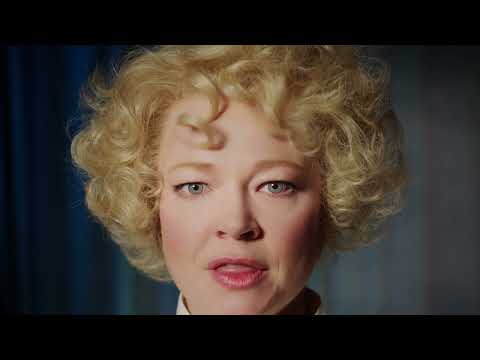
I’m curious to know how you see Sally Potter’s Orlando, which you’ve brought up in interviews, as having influenced your work.
One of the things that’s so remarkable about it is the way [Potter] radically breaks the film form in how she tells the story. Tilda Swinton as Orlando constantly breaks the fourth wall, looking directly into the camera. From that I saw the possibility of a complicit relationship between character and audience via the camera lens that was intensely theatrical. It’s very much akin to when an actor directly turns to talk to an audience—a Shakespearean soliloquy of sorts.
We’ve seen it highly successful in recent years in television shows like Fleabag and I May Destroy You, where an audience can develop an identification and complicity with the character via that direct address through the camera lens. That’s informed my entire relationship to using camera on stage. [As opposed to the camera being a] removed voyeuristic presence, for me it was an active extension of the audiences’ act of watching a performer on stage.
It works so powerfully in The Picture of Dorian Gray because Dorian is intensely aware of the way in which he is perceived by those around him and is caught in a bind of trying to prevent the world from seeing who he really is. But [he’s also] watched with complete truth by his portrait. In my adaptation, the audience takes on, via the camera, that perspective. In fact, you never see the portrait—you only take on the portrait’s POV of watching and regulating Dorian. In that sense, I think, it’s the same way in which Wilde understood life as being like an act of theater in which people were performing ideas of themselves and revealing and concealing truths.
How would you specifically describe “cine-theater,” the term that you use to refer to the hybrid of live performance and video you employ in this production?
Prior to Dorian, I’d done about seven productions that used video in them, and it was always live. That was a fundamental rule for me, essentially because, you know, one of the things that defines theater is that it takes place in the now. With using screens, I was always concerned with the spatial relationship between character and audience, and how the screen could help crack open the dramaturgy of the storytelling. When it came to Dorian, it was the first time I ever used prerecorded [material] in my practice—[and] it was a terrifying breaking of the rule.
But in its purest essence, it forged what I call the cine-theater form. The pre-recorded element is always playing out against, and in concert, with live performance and live video, and it’s integrated in such a way that the prerecorded performances of Sarah feel as if they are live and happening in the moment. In those pure moments of cine-theater, you have a frame that’s interlacing live and prerecorded imagery—literally colliding within the same frame in the same moment on stage—that’s the most exciting. It takes [a lot] of detail and technical precision to make that feel effortless and [spontaneous]. It’s quite magical when that happens.
It does feel effortless, but one can’t miss the plethora of “spike” marks on the stage, which indicate how critical the positioning of the crew and the props on stage are to this show. Does it become a kind of elaborate choreography?
I studied dance when I was a child and a lot of my major influences in theater-making are either choreographers or come from a dance background—like Pina Bausch, Robert Wilson, and Merce Cunningham. Because theater is first and foremost a spatial storytelling art form, I’m most interested in the way in which you can convey story through the body and through space. For me, the choreography of the show is how the visual musical score of the story unfolds.
So while there are several hundred marks on stage that have to be hit with millimeter precision, the more intense specificity of movement is actually about the rhythm of movement between those marks. It’s how Sarah, the camera team, the costume team, and the mechanists who move the set elements build and develop the movement from specific point to specific point. That’s the living, breathing organism of the piece that has its bend and flex each night. It’s a kind of music that gets released by the ensemble every evening. And it is an ensemble, you know. Sarah and I talk a lot about this Wildean paradox within our production: Although it’s a one-person show, you see more than a dozen people in the curtain call each night.
Did you have any qualms about adapting—re-writing—the Wilde text?
Yeah, it was a hugely daunting task adapting Wilde, particularly given that the form that I chose required a singular narratorial voice. It was paralytically terrifying beginning to write it and then putting it in front of an audience [that knows] his writing well. Wilde’s text was the starting point and there’s quite a lot of original writing in the play. It was his tone, his rhythm, his sense of humor, his idiosyncratic use of language that needed to be maintained. I think it’s one of Wilde’s most vulnerable pieces of writing, in how much he excavates the more challenging and personal aspects of his identity within his work. I wanted to honor that.
With The Picture of Dorian Gray, Wilde is much closer to the character Basil who’s too afraid to exhibit his painting because he has, within it, revealed the secret of his own soul. At the same time, there were elements of the novel that I felt could be shifted and expanded to become more resonant and relevant for a contemporary audience—ideas around gender and sexuality that perhaps he wasn’t able to write about, or perhaps thinking has shifted around. And, except for two very specific moments, where the production itself aesthetically leans in a more contemporary area, I attempted by and large to maintain his voice.
You’ve remarked that the novel presents three different aspects of Wilde. What are those three aspects exactly?
He has this quote where he says that the three central characters are three different facets of his identity. Lord Henry is who people think he is publicly, Basil is who he is privately, and Dorian is who he aspires to be. I didn’t discover that quote until after I had written the adaptation and conceived the work directorially, but with [this version], where one actor performs all the characters to express the notion of the multiple selves that exist within all of us, I felt validated. It was sort of a sign from the Wildean universe to say you’re on the right track.
Since 2001, we've brought you uncompromising, candid takes on the world of film, music, television, video games, theater, and more. Independently owned and operated publications like Slant have been hit hard in recent years, but we’re committed to keeping our content free and accessible—meaning no paywalls or fees.
If you like what we do, please consider subscribing to our Patreon or making a donation.